
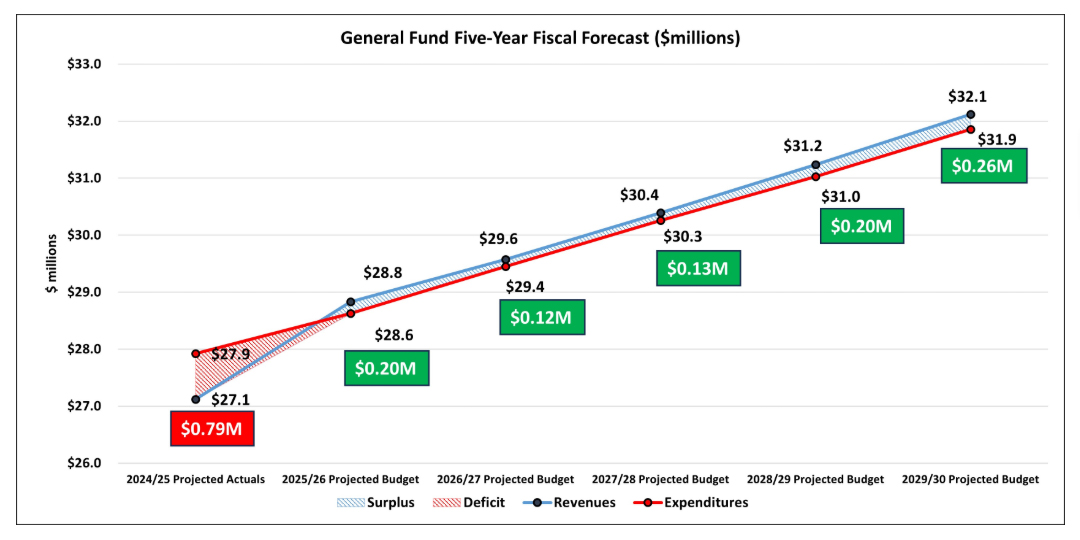
The City of Sonoma recently announced that it projects a General Fund budget surplus for the 2025-26 fiscal year of $200,000. This is good news, given that previous projections indicated a serious deficit. The passage of Measure T last election raised the local sales tax by a half-percent, and it’s estimated that nearly $3 million will be generated by it, which has closed the budget deficit gap.
This brings us to the not so good news, however, and raises these questions: Why is our General Fund budget deficit so high? And why does the addition of $3 million only leave a positive margin of $200,000? With a positive margin so small will we find ourselves in the same deficit situation in the years to come?
The City of Sonoma has a structural budget problem, and the situation is not likely to get better. The City Council goals, and the costs associated with them, are out of line with the resources available, and every time extra funds are available, they seem to be gobbled up by the rising costs of government.
Nearly 75 percent of the city’s expenses are personnel related, and the combination of raises (this budget cycle nearly 10 percent!) and staff additions, eats away at our financial margin. The residents want a responsive government that provides safety and service in a professional way, and we respect the talent and capabilities of city staff, but those of us who live in the City of Sonoma, and most of the city’s staff do not, also want a sustainable and resilient future.
Economic sustainability and resilience do not come at the snap of the fingers; they come from careful, prudent planning and accurate financial forecasting. What seems to be missing is a plan that does not include regular tax increases to cover expenses.
In response to the latest budget hearings, City Council members, including Mayor Patricia Farra-Rivas, expressed disappointment in the slim margin. Vice-Mayor Ron Wellander voiced frustration that no major money is being made available for Plaza upgrades and improvements. We agree on both points.
Hiring the director of the city’s new Parks and Recreation Department makes sense if the City actually had a department to manage. As it is, Sonoma’s recreational offerings are provided by a mix of nonprofits that each receive some funding from the city – the Sonoma Ecology Center, Vintage House, the Community Center and the Boys and Girls Club, among others. There is no recreational facility to manage, and no money to buy land and build a multi-purpose building with meeting rooms, recreational sport venues, presentation center or other resident-serving uses. Yet over $180,000 is being spent on the new manager position. Perhaps the City should try to lease or purchase the mostly unused Veterans Building from the County and convert it into a rec center.
Budgeting, even government budgeting, is a matter of balancing what money comes in against what money goes out. It’s not terribly different from budgeting for a household. The difference is that the government can levy taxes, and time after time, that’s what it does to balance the budget. Sales taxes are regressive; they negatively affect the poorer among us more than those with high incomes.
A sustainable economic future must rely on a different strategy than repeatedly raising taxes and continuing to accept the rising cost of government as inevitable.








The projected 800-900K yearly increase in revenue may be a bit rosy… The three drivers of our revenue, transient occupancy, sales, and property taxes, are boosted by tourists staying and dining in Sonoma, buying and drinking wine, and real estate transactions… All appear to be leveling off or declining.
Tonight I and a few other members of the Sonoma Valley Cannabis Group will be speaking during general comments at the city council meeting. About 3 years ago the council approved adding a second dispensary to the cannabis ordinance. Yet, they refuse to issue an RFP and open up the application process. There are many qualified dispensary operators who will apply for them to choose from. SPARC the one dispensary in city limits claims they will go under if another dispensary opens up. That is not true. SPARC is not losing money and in fact recently opened in Napa where there is no cap on the number of dispensaries allowed. They also applied in Healdsburg where 2 dispensaries are allowed, though they were not chosen. So, they are doing very well. And guess what? The City of Sonoma gets well over $200,000 per year in tax revenue from SPARC. So guess what? They will get another $200,00 per year if they get going and open up the process for another dispensary to open.