
Some Answers for Sonomans
By Anna Pier
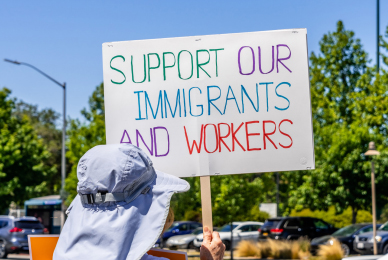
The news is filled with the administration’s ever-increasing push to deport immigrants. And these efforts, driven by quotas, are being made indiscriminately. The many breaches of Constitutional protections coupled with the beyond appalling conditions people are subjected to in deportation centers, begs the question, How to Be an Ally? Aware of the integral part our Sonoma Valley community immigrants play, approximately 100 people gathered to hear answers to this pressing, ever more compelling, question regarding our immigrant friends and neighbors here in Sonoma Valley. Sponsored by Sonoma Valley Catalyst Fund, and hosted by Sonoma Valley Collaborative, La Luz Center, Sonoma Immigrant Services and North Bay Rapid Response Network, the morning event was held Saturday July 26 at Vintage House.
Representing First District Supervisor Rebecca Hermosillo, Betzy Chávez told the crowd that her story is literally rooted in the story of immigrants in our Valley. She pointed out that the Board of Supervisors by a 5 – 0 vote, passed Secure Families, pledging to protect immigrants. In its 2025 budget the Board approved $500K for organizations that support immigrants.
Patricia-Farrar Rivas, Mayor of the City of Sonoma, affirmed that the City Council is supporting the Know Your Rights campaign, and added funding to the Secure Families provision. Regarding making Sonoma a “sanctuary city,” she recommends a “no” vote, believing it brings unwanted attention to the City. Farrar-Rivas urged people to be aware of the language they hear, and be brave enough to speak out when you hear questionable speech.
Attorney Vicki Handron, co-founder with Alondra Marroquín of Sonoma Immigrant Services, spoke about who is threatened. She defined “undocumented” as being here without permission. She pointed out that most immigration violations of the law are civil, not criminal. She talked about the change in immigration law in the 90s which allowed agricultural workers to stay, who then brought their families. Handron also pointed out that there are many mixed-status families, composed of a citizen, a green card holder, and an undocumented person. She explained, “Many people have no legal path, and are just stuck here.” U-visas can take up to 20 years, and even for a person married to a US citizen, obtaining legal status can take five years.
Asked about the administration’s offer of $2,000 and a plane ride to anyone who self-deports, Handron voiced skepticism, pointing out that there are high monetary penalties for crossing the border without permission, so those will be subtracted from the proffered $2,000; the immigrant may not get anything, and can’t turn back.
Handron forecast that the scope of the Big Bill means deportations will increase exponentially. She urged us all to exercise our Constitutional rights, to speak out, so the undocumented person is not alone. And to speak out about the erosion of rights, for instance about the use of the National Guard against peaceful citizens.
Claudia Robbins presented on behalf of North Bay Rapid Response Network. She noted that concern for our immigrant neighbors locally is high, reflected in the fact that over ten percent of the total number of trained Legal Observers from Solano, Napa and Sonoma Counties combined are in Sonoma Valley. Legal Observers will be called upon, in the event of an ICE (Immigration and Customs Enforcement) or other deporting agency’s activity in their area, to show up to observe and record the incident, never intervening. Another role of Legal Observers is to serve as monitors at large community gatherings.
Leonardo Lobato, Executive Director of La Luz, noted that we all know that immigrants are a vital force in this country’s cultural vibrancy, economic prosperity, and demographic growth. Just last year—on February 5th—the Congressional Budget Office reported that the past surge in immigration is expected to boost the U.S. economy by nearly $7 trillion over the next decade.
This growth is projected to increase federal revenues by $1 trillion—according to the nonpartisan agency. “That’s a powerful contribution,” he affirmed.
Lobato pointed out that In Sonoma County, immigrants make up seventeen percent of the population, yet they comprise thirty-nine percent of the workforce. We do not have these statistics for our Valley, but we all know that immigrants power these essential sectors: hospitality, food services, agriculture, construction—and more. In many of these industries, they are the hands that keep everything moving. For viticulture, perhaps Sonoma Valley’s signature industry, an estimated ninety percent of the workers in this field are immigrants.
He emphasized that it is not just about the economy. In Sonoma County, seventy-three percent of undocumented immigrants have lived in the United States for over ten years. And twenty-nine percent have lived here for more than twenty years. “Immigrants are woven into the very fabric of our communities. They are not takers, they are contributors. They are our neighbors, our friends, our coworkers, our caregivers, our teachers, and our fellow parents.”
The sponsors urged everyone to strengthen our connections with each other, and to
volunteer as well as donate to any of the many local support agencies – Sonoma Immigrant Services, Sonoma Valley Collaborative, F.I.S.H. (Friends In Sonoma Helping), WakeUP Sonoma, La Luz, North Bay Rapid Response Network.



Thanks to Anna and the Sun for keeping active and alive the topic and guided means for being part of citizenship responses.