
Gun Bun’s Art Truck
By David Bolling
While most media have focused on the economic challenges of the historic Gundlach Bundschu Winery, now in bankruptcy proceedings, not enough attention is being given to the history of all the extraordinary, sometimes hilarious, creative energy the Bundschu family has generated at their hillside estate.
Sixth generation president Jeff Bundschu, a serious rock n’ roller with guitar and piano chops, initiated the wildly popular, if economically dicey Huichica Music Festival, drawing name performers like Allah-Las, Mac Demarco, The Fruit Bats, Woods, plus legions of outstanding acts you’ve never heard of. The wine-and-music festivals were jubilant events, held in a family-friendly, uniquely beautiful venue, with a natural amphitheater, multiple stages and lots of good food.
And under the daringly imaginative leadership of Jeff’s father, Jim, the Gun Bun name became associated with a series of wildly creative “actions,” like holding up the Napa Valley Wine Train, faux-kidnapping British billionaire Richard Branson, and producing a highly collectible, often hilarious Gun Bun poster series, shot by iconic Sonoma photographer Ron Zak, and often featuring instructions on how to pronounce the winery’s name.
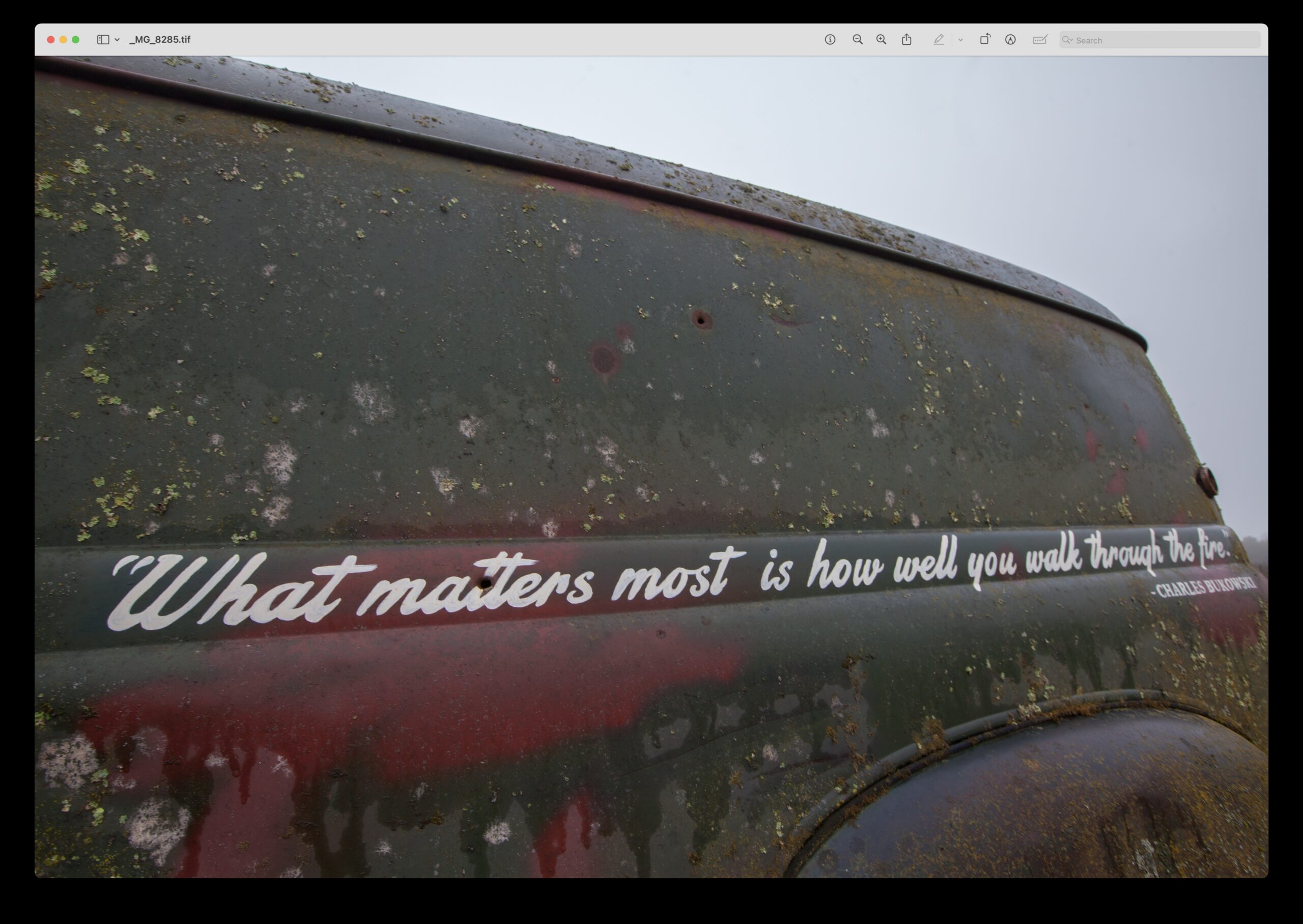
Art has been an integral element in the brand’s identity, perhaps nowhere better exhibited than in the rusting hulk of Gun Bun’s iconic wine truck, “Boss Lady.”
It was a discarded wreck, wrapped in a blanket of blackberries and nesting in the bed of Huichica creek on the edge of a vineyard at the Gundlach Bundschu winery. Given the heritage and traditions of Gun Bun – celebrated as both California’s oldest, continuous, family-owned winery, and a family tradition of irreverence, high jinx and dark humor, it was inevitable that someone would divine a use for what Gun Bun patriarch Jim Bundschu has referred to as both “Uncle Barney’s van,” and “a piece of junk.”
What that use might become wasn’t clear, even to the winery’s unofficial, sometime resident artist and creative muse Nate Reifke, who has an impressive list of commercial clients but finds his deepest satisfaction anointing rocks and other natural objects with creative designs that complement Mother Nature.
That said, Nate has a great eye for repurposing manmade materials, and his creation of prototype Gun Bun skateboards, made from barrel staves complete with bung holes, resulted in rolling artworks appealing to boarders of any age. It was that sensibility that inspired Reifke to wonder what might be done with the van, even as it lay in the embrace of blackberries. But he couldn’t imagine at the time that the rusting hulk would be liberated from the creekbed anytime soon, short of an edict from the EPA.
Little did he know that Jeff Bundschu would similarly view the 1953 International van as a potential treasure and have it hauled from its grave without so much as an exorcism.
Or perhaps that’s what Reifke was called upon to perform when he finally confronted the forlorn hulk resting in a Gun Bun barn with its wheels rejoined to its body by a welding torch.
Reifke’s vision, embraced by Jeff Bundschu, was a minimalist restoration, embracing the rust, and even the fungus growing from the paint, and the bullet holes perforating it, with just an overlay of artistry. God knows, there’s hardly a winery worth its AVA without a restored pickup truck gleaming with new paint and a prominent position within photographic embrace of a tasting room. But that wasn’t what the Gun Bun clan, and artist Reifke, had in mind.
Gun Bun’s six-generation roots go deep into historic soil, a century-and-a-half, so sometimes ancient bones are the best way to preserve the identity of a place. Reifke developed an instant affection for the van, intuiting its name to be “Boss lady,” and anointing it with careful restraint. The result preserves the patina of age, while presenting a contemporary image that seems to bridge the past century. And it provided a perfect palette for what appear to be Jeff Bundschu’s defining words to live by, borrowed from gritty poet/novelist and iconoclast Charles Bukowski, whose most famous line is probably the message now decorating the flank of “Boss Lady.
“What matters most,” Bukowski famously wrote, “is how well you walk through the fire.” For Gun Bun, for all the Bundschus, for all of the Sonoma Valley family who have taken Gundlach Bundschu into their lives and hearts, the bullet-pocked Boss Lady may just become a symbol of survival and rebirth.
Ensconced on her own gravel stage beside the Gun Bun entrance drive, an unassuming but roughly elegant invitation to a winery and a family comfortable in the folds of age and time, here’s hoping that rusting hulk, and that venerable winery, will survive with its irreverent history intact.

Be First to Comment