
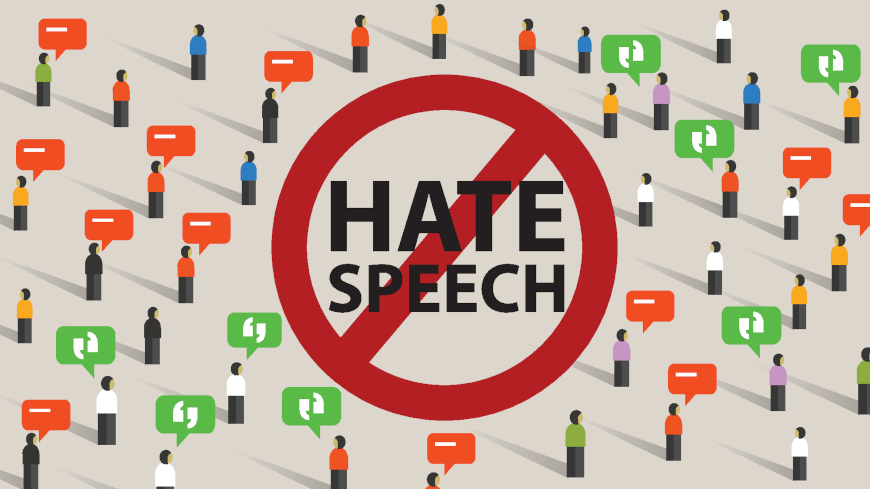
These days the media is awash in rants about hate speech. It seems everyone is saying how nasty things have become, how hate speech is tearing our country apart, provoking widespread violence and spitting, and that ‘it must be stopped!’
Easier said than done. Certainly hate speech is not nice and shouldn’t happen, but first we must be clear about what – exactly – it is, lest the utility of common expressions (e.g., “Up yours!”) suddenly be off-limits.
According to AI, the folks at Merriam Webster say: “Hatred is defined as intense dislike or disgust and ill will or resentment that is usually mutual, often stemming from prejudice or bias. It is a strong negative feeling characterized by hostility, aversion, and extreme dislike for a person or thing.”
So . . . talking ‘hate’ is hate speech. Got it. But we’re still not out of the verbal nit-pickery thicket.
What . . . exactly . . . constitutes “dislike” or “disgust?” Not to mention “ill-will” and “resentment.” And how “intense” is intense? How to know when speech becomes “extreme” enough to be . . . well . . . hateful? And if it must be “mutual,” do opposing haters have to know that someone hates them back before it’s mutual? If so, can they learn of it via third-party postings on Vilify?”
And must there be actual speech (i.e., with the mouth), or can hate speech be conveyed via e-mail? How about a cold stare, a sneer, sticking out the tongue? Or a just🖕?
Lawyers, weigh in here. These questions demand answers if America is to have any hope of a gentler society. That need recently became apparent to your correspondent upon receiving this e-mail from a friend: “I’m saving my urine in jars so I can pour it on Trump’s grave.”
Was this an “intense expression of dislike, disgust, resentment and ill-will?” Did it convey a “strong negative feeling characterized by hostility, aversion, and extreme dislike?” Or was it simply a great idea? And had your correspondent replied, “No one from our Valley would ever pour urine on his grave,” would that have been hatefully argumentative, or simply noting the precious nature of our wine-country urine?
Such questions demand answers. Without such guidance, Our Nation – a delightful mixture of the educated and uneducated, decent and indecent, and grown-ups who wear cowboy hats – could descend into a hell-scape of nastiness. Civility itself is at stake.
To avoid that, we must seek consensus, for example, as to which of these common expressions might cross the line into hate-speech:
- Moron
- Fat-a**
- Dork/suck-up/dingbat
- Republican
- Nepo-baby
- Polack/dago/mick/spic/kike/N-word/whitey
- (Etc.)
Would that our nation could look to Our President for guidance. Alas, among other things he has said:
- Re: Rep. Liz Cheney: “Let’s put her with a rifle standing there with nine barrels shooting at her, okay? Let’s see how she feels about it . . . when the guns are trained on her face.”
- Re: George Floyd protesters: “Can’t you just shoot them? Just shoot them in the legs or something?”
- Re: Himself: “I could shoot somebody and not lose any voters.”
- Re: Journalists: “I hate them.”
- Re: Immigrants: “They’re rapists. . . some I assume are good people.”
To be fair, like presidents before him, the man has his hands full just trying to run our vast and complex country, so it’s probably best not to bother him with complex word problems. As with many other things and people, he’d really hate that.






Be First to Comment