
By Michael Acker
Early in the 20th century, the climate and the healing waters of Sonoma Valley – Boyes Hot Springs in particular – were attractive to Pacific Coast League (PCL) baseball teams looking for places to train. The San Francisco Seals were the first.
The PCL was founded in 1903 and its teams were not initially associated with the major leagues. In fact, PCL baseball was considered an “outlaw” league until 1904, when an agreement was settled with Organized Baseball which made the PCL a Class A league. Still, the PCL was “the only game in town” west of St. Louis, until the Giants and Dodgers moved to California in 1958. Star players of the League included the DiMaggio brothers and Ted Williams, which tells you something about the level of play.
We know that the San Francisco Seals, a perennial powerhouse, were holding spring training at Boyes Springs as early as 1912. In that year, as a San Francisco Chronicle headline read, an “Eight Acre Ball Park (is) Being Built at Boyes Hot Springs.” The Chronicle goes on,…” it seems certain that the Seals will have the largest ball grounds in the world (!)-and very likely the finest – in which to prepare for their pennant struggle.” Manager Cal Ewing…is highly enthusiastic about the new quarters.”
In 1913, in an article about opening day, the San Francisco Call declared, “The Boyes Springs rooters were the most conspicuous of the bunch. Headed by Doctor Parramore and Rudie Litchenberg (sic), they arrived at noon in a big auto and they drove direct to the ball park to root for the Seals.”
Originally named Fetters Field, it later became Lichtenberg Field. Today, De Chene Ave roughly follows the old outfield fence.
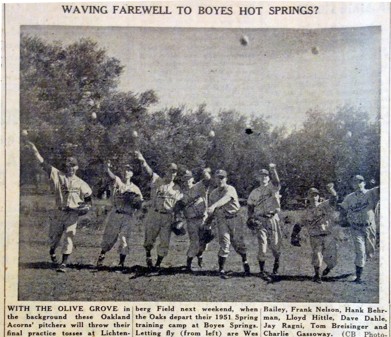
The Seals weren’t the only team to train at Boyes Hot Springs. In 1950, the Twin Falls farm team of the Yankees were there; as were the Oakland Oaks in1951. The Sonoma Index-Tribune put the story of their arrival on the front page, with a photo of manager Mel Ott.
Some of the major leaguers who came to the valley for training ended up settling there. One such was Sam Agnew.
According to the Society for American Baseball Research, “Sam Agnew is best remembered for being the catcher for both of Babe Ruth’s pitching victories in the 1918 World Series.” Agnew started in baseball with the Vernon team of PCL in 1912. His Major League debut came with the St. Louis Browns in 1913. He started as catcher for the Browns through 1915, when he was traded to the Red Sox. While a St. Louis player, he had the distinction of being called out while sitting in the dugout: the team was found to be batting out of order and he was supposed to be at the plate at the time.
Agnew opened a service station in Boyes Springs in 1935. It was at the corner of Vallejo St. and Highway 12, where the Sonoma Eats parking lot is today. Agnew died in 1951 in Sonoma.
Photo: The Oakland Acorns in Spring training in Boyes Hot Springs
This article first appeared in the April-June 2026 newsletter of the Sonoma Valley Historical Society. Reprinted with permission.


Be First to Comment