
Stanford Professor Provides a Roadmap
By Larry Barnett
The world’s use of fossil fuels has been marked by successive crises and temporary solutions. The widespread use of coal for heating and power generation in Britain created generations of soot and pollution, and was replaced by significantly cleaner natural gas and electricity. Leaded gasoline was identified as a major contributor to air pollution and health problems, and was replaced by unleaded gasoline. Internal combustion engine (ICE) emissions were traced to global warming and climate change, and catalytic converters were mandated on all ICE vehicles. In the 1990s it was widely believed that oil production had peaked, but new drilling technology rendered that premise moot.
Today, fossil fuels remain a major source of power generation, but contribute to health problems and environmental damage. The use of fossil fuels are responsible for 7.4 million air pollution deaths each year, costing $30 trillion, with global warming costing additional trillions beyond precise calculation, along with political and economic instability. The advance of renewable energy resources, however – wind, water, and solar – holds the potential to replace fossil fuels used for energy production.
According to Stanford University professor Mark Jacobson, the use of fossil fuels can be entirely replaced with a combination of renewable wind, water, and solar power generation, saving countless trillions of dollars. And, he advises, this transition can happen relatively quickly.
In a recent presentation by Professor Jacobson, sponsored by Praxis Peace Institute in a packed room at the Sonoma Community Center, he carefully laid out his vision for a fossil-free world. Using statistics and presenting hard evidence, Jacobson explained what various countries in the world have done to replace the use of fossil fuels, and the opportunities available to the United States to do the same.
“Mark Jacobson has the unique qualities of being both a practical and rigorous scientist while also being a visionary,” said Georgia Kelly, Founder and President of Praxis. “With the horrendous anti-environmental policies raining down from the Trumpian Regime, I thought it was time to bring a climate expert to Sonoma.”
Jacobson began by defining the four major energy sectors, (1) Electricity/Heating, (2) Transportation, (3) Buildings, and (4) Industry, and then described how wind, water and solar solutions can be applied to each sector to replace the use of fossil fuels. For example, replacing ICE-powered vehecles with battery-powered electric vehicles, using heat pumps instead of gas-fed furnaces in buildings, and various methods of replacing fossil-fuels in industrial applications with electrical devices and furnaces. “Electrical heat pumps are 400 percent more efficient than gas furnaces,” he noted.
“We have 97 percent of the technologies we need to electrify everything,” he described. “What we need more of is electrical storage.” The greatest source of energy storage at present is hydro-electric dams, but battery technology is advancing rapidly. There are also flywheel, compressed air, gravitational, solid mass, and hydrogen storage solutions. “There are now fire bricks that can store heat at 2,000 degrees celsius for industrial use.”
Jacobson believes this world-wide transition is not only necessary but possible; 155 countries, representing 99.9 percent of all fossil fuel emissions, can transition to 80 percent wind, water and solar by 2030 and to 100 percent by 2050. Moreover, his research indicates that the economic benefits are enormous. His calculations show that the total social cost of continuing the use fossil fuels for energy production will amount to $94 trillion per year by 2050, as compared with a cost of electrification of only $6.1 trillion annually, due to efficiencies. The investment in a transition will pay itself off in five years, based on energy costs alone, not counting health and climate costs.
“The round-trip efficiency of a battery electrical vehicle is 80 percent, while the efficiency of an internal combustion vehicle is around 17-20 percent,” he explained. “When you use an electric car, you’re using one-fourth the energy of a gasoline powered car.”
The impact of a transition away from fossil fuels on land use would be major. In the United States, 1.24 percent of land is used for production of growing corn for ethanol (4 percent of U.S. energy) and 1.6 percent of land for the production of fossil fuels and infrastructure (abandoned wells, pipelines, filling stations and 50,000 new wells each year), a total combination of 2.40 percent of available land. By comparison, a comparable amount of solar and wind energy production uses only 1.11 percent of land.
Fifteen countries have already achieved 95-100 percent of their electricity generation from wind, water and solar systems; the United States is currently at 27.1 percent. China, (now at 35 percent) has been making enormous gains, and is projected to reach 100 percent by the year 2051. “In just six months, China replaced enough gasoline and diesel-powered vehicles with electrical ones to equal the United Kingdom’s entire oil production for the same six months,” he revealed. “At its current pace, the U.S. won’t reach 100 percent until the year 2150.”
He concluded his presentation by summarizing the benefits of transitioning to a combination of renewable wind, water and solar systems:
- Avoids 7 million air pollution deaths each year worldwide.
- Slows then reverses global warming.
- Reduces energy needs by 55 percent.
- Reduces energy costs by 66 percent.
- Creates 23 million more jobs than those lost.
- Requires less land than current energy infrastructure.
- Keeps electrical grids stable worldwide.
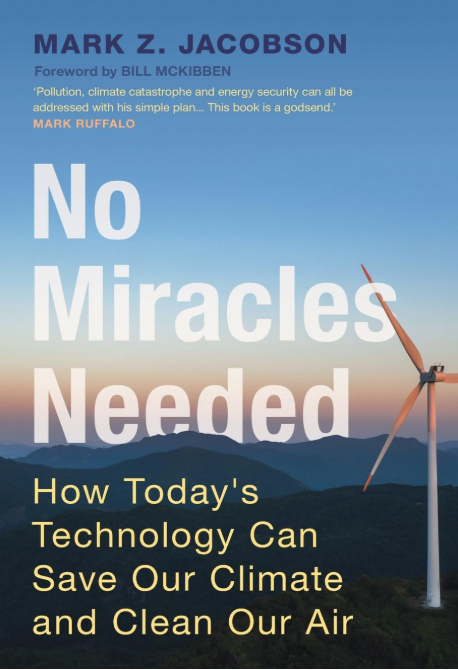
All this is detailed in his new book, “Still No Miracles Needed.”








Be First to Comment