
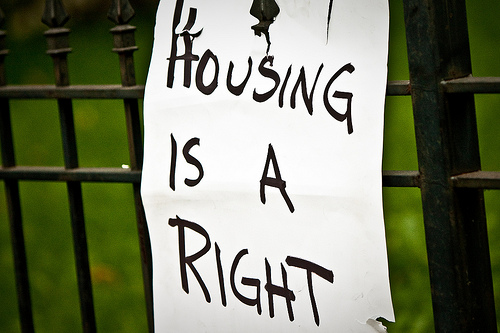
I’ve worked in housing for years, in low-income housing as a resource coordinator, and I’ve counseled homeless people. I have bought, sold and been sold out during the foreclosure years. I’ve been around the block.
Housing is a serious, insidious, corrosive problem for community. The system doesn’t work anymore. Houses sit empty while well-off people travel year-round. It’s a monopoly game. Buy a lot of houses and pass “go” to the boardwalk. The problem is that it makes no sense (or cents) for the general population and certainly not for young people.
Low income people wait five-to-twelve years on lists to get in, fill out boxes and piles of paperwork, then get into a “lottery” (if lucky), something like a roulette wheel. Applicant’s names are proverbially pulled out of a hat, after all that waiting. They might get picked for available housing. In order to “qualify” you have to have just this much income and that much savings. It’s infinitely complicated.
Problems with housing are deep-seated, having cancerous effects on society. Food and shelter are fundamental for our life-force. The famous psychologist Abraham Maslow figured it out years ago: food and shelter come first, then we learn to love and be loved, and finally to self- actualize, in that order.
In a 2025 Atlantic article, “Stuck in Place,” Yoni Appelbaum writes, “People who have recently changed residences report experiencing more supportive relationships and feeling more optimism, greater sense of purpose, and increased self-respect. Those who want to move and cannot, by contrast, become more cynical and less satisfied with their lives. States and cities and towns will need to reform their rules and processes to allow the housing supply to grow where people want to build. That would return agency to people, allowing them to pursue opportunity wherever they might find it.”
There has to be a way to accommodate citizens devoted to their own area. It’s time to think outside the box. Help kids buy our big houses if we’re over 72, give us a tax break to make enough on the sale to downsize in our own town. People who own more than one home and do not live in the community could be limited. We need available, well trained and paid counselors providing us with support on application processes and alternatives for housing.
Which leads us to the policies of insurance companies. According to Amy Bach, executive director of United policyholders, as quoted by The Press Democrat, “Once you’ve been through a fire, you understand why insurance matters, and then you also are now in the bull’s eye for insurance companies… the strategy is aimed at restoring availability, not necessarily affordability.”
We have to name this problem and deal with it. Connecticut U.S. Senator Chris Murphy, has written, “Fixing up a few streets or apartment buildings in a handful of targeted neighborhoods won’t do the trick if nobody can afford the fancy new units. Until we are honest about the way in which discrimination and poverty relegate millions of Americans to lives on the margins of society.”
Okay, I’m in the shuffle myself. I can’t downsize my older home in Sonoma where I have lived for 30 years. A reverse mortgage won’t work for infinite reasons. I can’t get into “affordable housing” because of some new law that I’ve been told went into effect in 2024: Allegedly, “home owners cannot apply for low-income housing in Sonoma.” Sure, I’ve done the math. I could sell tomorrow and rent, then run out of savings in five years.
What do we want? Locals unable to live and work here? Lots of slick places with nobody home?







Nice to see your spotlight on this important subject.
We need local think tanks to create stair step housing. And invest in it. Level 1 – starter homes or condos for local job holders. Let’s call the lucky renter Pat. Part of Pat’s rent goes to individual owner’s saving pool. After a set period, Pat is offered incentive option to move to Level 2 housing: A little bigger, a little more expensive But uses the money in the savings account to step up. Repeat savings account from part of the rent. Level three housing becomes available in a set period of time with a little more space because maybe Pat’s family is growing – and a little more savings is involved.
Eventually, Pat will have enough savings to purchase a home in the community and move up – keeping the channels open for other stairstep residents. The savings accounts are managed by a local bank where the funding and interest return to local investors and stairsteppers. If the government is involved, only in a way that doesn’t get in the way. If the land is large enough, there are small retirement homes for people downsizing. They can invest in their own community.
It can be so exciting and we have the resources.
Anyone who has studied Urban Science has grown up knowing about such communities. Restin, VA is an example. Read all that it provides.
It’s not a give away. It’s going back to making it possible for our next generations to find a way on their own. Motivation.
This is written as a rough example but the right minds could find a way.
We have forced on our government employees far too many absurd rules they must enforce. Imagine Turning back the clock to more simple times.
These are the burdens we are putting on our government employees when we could be investing their good knowledge and time into Stair-Step housing.
Yes you’ll find holes in this idea.
It’s just the seed for your readers to takeoff from.
Let’s get back to being an ascending village
waking up our can do energy once again. It’s what many American generations rose up with.
We can do better.