
By Anna Pier
Sonoma Valley Unified School Board Trustees approved two resolutions at their regular meeting on October 9, thereby finalizing their preliminary decision of September 23 to close Prestwood Elementary School at the end of the 2025-26 school year. Both resolutions were approved by 4-1 votes, with Trustee Anne Ching, who represents the Eastside attendance district, opposing each.
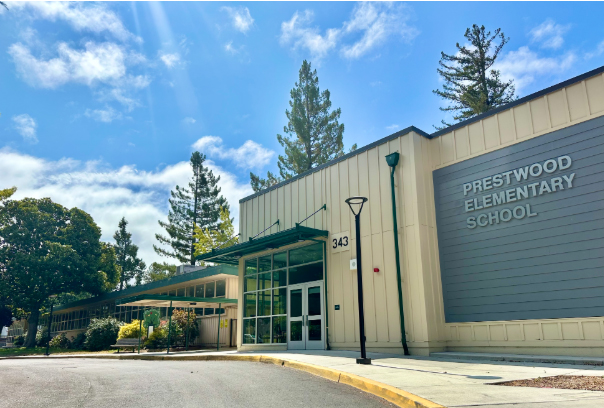
The first resolution, 14.1, Approving Attendance Boundary Adjustments & Approving Elementary School Consolidation, was considered together with new School Boundary Maps which had been prepared for the consideration of the trustees as they approached a final decision on closure of the Eastside elementary school located at 343 E. MacArthur, and consolidation of its students into Sassarini Elementary School, located at 652 Fifth St. West, and El Verano Elementary School, 18606 Riverside Drive. The District’s other elementary school, Flowery, has a school-wide dual immersion Spanish and English language curriculum, and is not able to accept transfers after Kindergarten.
The pertinent materials were presented by Attorney Harold Frieman, the District’s consultant on school consolidation, who has been guiding the process for two years. His presentation included the CEQA (California Environmental Quality Act) report regarding environmental effects of the proposed consolidation. According to the CEQA analysis, the consolidation of Prestwood’s current students into Sassarini and resulting move of some current Sassarini students to El Verano, has no negative environmental effects, but actually reduces the number of vehicle miles traveled, resulting in reduced traffic and reduced greenhouse gas emissions.
At the beginning of deliberations, Trustee Ching announced that she would not support the resolution, and challenged fellow trustees to give her the rationale for their decisions. Board President Catarina Landry responded first. She said that she had reviewed all the data that has been brought to bear on the question of school closure since she began as a trustee three years ago, including the Perkins-Eastman Study, commissioned by the Board, the report of the School Consolidation Committee, and the Attorney General’s Letter and Guidelines, as well as considering extensive community input. President Landry remarked that the fact that most of the audience were from Prestwood “makes her sad,” reflecting that the District is still divided.
Trustee David Bell began by asserting that he “has been demonized,” accused of “pushing the Board to make a decision.” Defending himself, Bell said that he has considered options that the public has suggested, such as reducing District Office staff and selling the building, but those measures would not accomplish the budget reduction necessary. Bell then pointed out that, with regard to identifying Prestwood as the site to close, no one is questioning the demographic data – “It’s where the kids live.” 100 live on the Eastside, 300 west of Broadway.
Next Trustee Gerado Guzman stated that he concurred with the previous statements, mentioning the nearly 800-page binder filled with data collected since the process began. Guzman also said the Attorney General’s letter had great weight for him, charging those responsible for deciding on school closure to “ensure every student has access to a high quality education as close to home as possible.” Guzman continued, “The heat maps spoke to me,” affirming that the highest concentration of students and the highest concentration of need is in the Springs area.” He ended, “The Attorney-General wants us to take care of the neediest.” Guzman also pointed out that the Consolidation Committee had ranked Sassarini over Prestwood as they considered the Attorney General’s criteria.
The last trustee to reply to Trustee Ching was Jason Lehman, who was attending the meeting virtually. Lehman asserted that their objective was to find the best way to provide the best resources they could to the students of Sonoma Valley; and that required having only three elementary schools. He detailed the criteria he had used to decide to close Prestwood. First was travel reduction and proximity; then equity. Answering the question he posed, “Who has the harder time to get to school?” with “the working class living clustered along Highway 12.” Finally, with regard to facilities, he said the differences were not significant between Prestwood, Sassarini and El Verano. Trustee Lehman also challenged the idea that there will be an “ebb and flow of numbers” of students. “It’s an issue of right-sizing our District.”
Trustee Bell weighed in again, speaking to the move of the Extensive Support Needs (ESN) students. He stated that only because they are able to be housed in permanent classrooms at Sassarini did he support the closure of Prestwood. “The ESN students will be in the middle of the school, where they should be,” he concluded.
The roll call vote was 4-1, with Trustee Ching maintaining the position she had announced before hearing from her fellow trustees.
After a break, Trustees began to consider Resolution 14.2, Approval of Elementary School Consolidation Transition Plan. Following a presentation by Acting Superintendent Rena Seifts, and questioning by the trustees on details, a roll call vote was held, and again four trustees approved the resolution, and Trustee Ching voted against it. The SUN will report details of the plan, as it is developed in the next months, in a later story.



The Prestwood PTO with its deep pockets had gotten a city planner to (ostensibly from a neutral perspective) push back against the closing of the school after the district had given Flowery School in the chronically underserved Springs Area a reprieve. The history of Prestwood is one of a once all white school that is bleeding white students. This “White Flight,” from integration to private and charter schools is a problem not only here Sonoma; but other cities are at least Talking about it. Sonoma is a place where a primary school on the very white east side of town has seen an exodus of students to private and charter schools in recent decades, as open enrollment has increased the number of students from the predominately Latine western Sonoma Valley; but, unlike other cities such as Pasadena, city government seems uninterested in acknowledging, let alone addressing this end-around, which contributes to the enduring pattern of segregation here.