
Second of Two Parts
By Seth Dolinsky
The first installation of this article looked at the benefits of community access to land for food production. Community gardens, school gardens, along with private farms and gardens growing for public benefit, have proven invaluable to our Sonoma Valley population. Local, fresh produce, which defines the majority of the food crops available in Sonoma Valley, is limited to the amount we actually produce. With the higher relative costs for these products, working to provide access for all citizens is an important goal. But with a Valley population over 40,000, we will need much more land in production to feed even 10 percent of our population, and that’s just in produce. Meat, dairy, eggs, orchards and staple crops (wheat, legumes, corn, rice) are limited or nonexistent in local Valley production, and could be crop categories for further growth. Given the physical and monetary obstacles, how can we move closer to this goal? Some solutions may be found in models around the state and country.
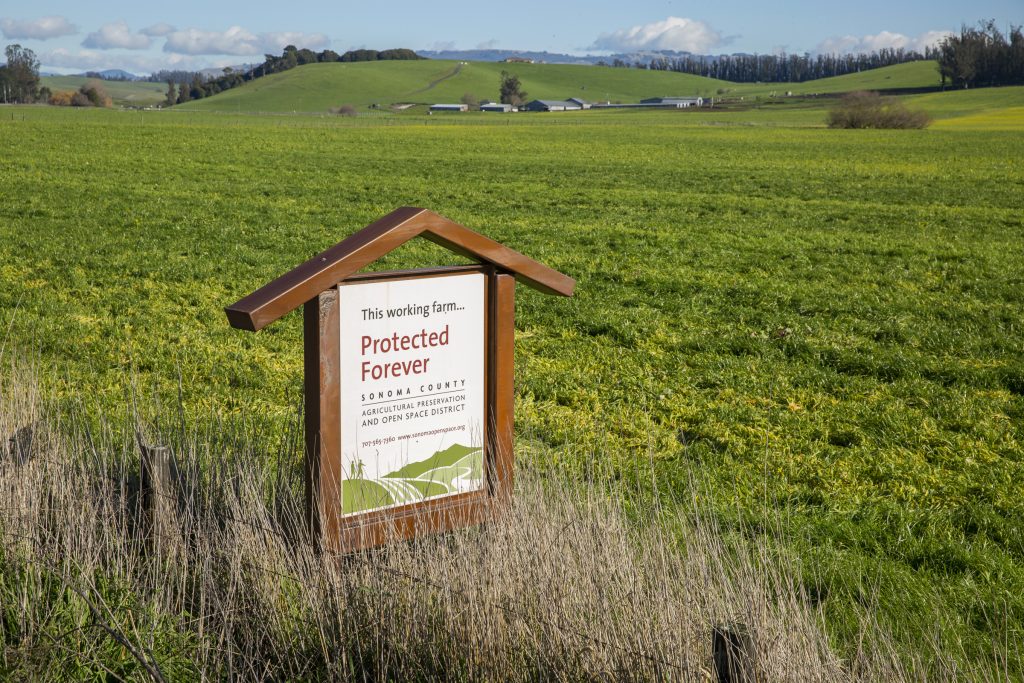
The Sonoma County Ag+Open Space District is a county governmental agency which oversees the protection of “diverse agricultural, natural resource, and scenic open space lands of Sonoma County for future generations.” The District is funded by a ¼ cent sales tax voted on and renewed through Measure F, and has an annual operating budget of almost $75 million. To date, the District has protected over 120,000 acres of county land, and over 39,000 acres of land supporting agricultural operations. Much of this protected ag land is in the form of grazing land for livestock or for feed crops like hay. They have recently launched a Buy-Protect-Sell program to support farmers and ranchers seeking their own small-to-midsize agricultural properties. The program has led to a pool of potential buyers, and is still open to applications. Ag + Open Space General Manager Misti Arias summarizes the program as she explains, “Now is a time for creative responses to the many challenges facing farmers and ranchers… while we continue to conserve our multi-generational dairies and ranches, we are also looking at the current and future needs of our community and seeing what role we can play in supporting diverse agriculture throughout our county. Our Buy-Protect-Sell program is one way we’re trying to meet this moment.”
A similar program has been under implementation by the Peninsula Open Space Trust (POST) in San Mateo County, which has been actively purchasing productive farmland and working with groups like FarmLink to sell the property back to the farmers at an affordable price, keeping the land in production essentially forever. Other land trusts throughout the country have similar models, often working with state and local agencies in creative ways to finance and secure easements, long term leases or outright purchases of farmland. Additional funding may come from private foundations, government agencies such as USDA, even local crowdsourcing resources. These models may be applicable to the Sonoma Valley, particularly during a time when some productive vineyard or grazing land may be left fallow due to market forces or changes in family or business direction. Funding conservation easements can lessen the burden on land-rich families and help keep them in production. And City and County land, such as the former SDC site, should be considered in the search for productive farming locations.
With options available for securing farmland, the next step would be finding those farmers and ranchers willing to take on the difficult work in growing food. They are out there, as a recent resurgence of small farms in the Valley lays testament to, run by young(er) farmers. They may be found in the family already on the land, or in our immigrant community, often from new residents with agricultural backgrounds who may already have the necessary skills to bring more local food production online. But if we do have prospective land and farmers, we still have the dreaded “Housing” factor. Tying some form of housing support to farmland access seems a great strategy for attracting capable, willing farmers. With groups such as Sonoma Collaborative working diligently on addressing the housing crisis, there is hope that farmers and farmworkers may find advocacy and support.
Those interested in furthering this conversation are encouraged to contact me at [email protected], attention:Seth
(Seth Dolinsky is Lecturer of Sonoma Valley Grange, whose motto is: Healthy Farms, Healthy Food, Healthy Community)


Be First to Comment