
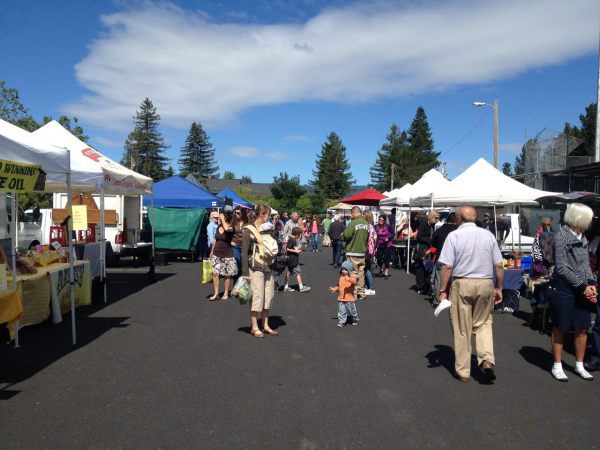
Sonoma’s Friday Farmers market – officially the Sonoma Valley Certified Farmer’s Market (SCVFM) – has been the Valley’s main source for locally produced food for decades. Over four to be exact, having been founded in 1985 by some forward-thinking farmers and residents, notably including Paul Wirtz of Paul’s Produce, Chris Gertz of Gertz Farm, and the late Ann Teller of Oak Hill Farm. The Friday Farmers Market has evolved from the original 10 vendors to over 40, open year-round, on Fridays 9 a.m. to 12:30 p.m. Jimi Good, enthusiastic farmer at Oak Hill Farm, took on the role of market Board President to help facilitate this growth. He and market manager Melissa Lely recently offered insight into the current state of affairs
What does it take to be a Certified Farmer’s Market?
Melissa: All farmers markets in California must be “Certified” to operate. This means that you pay a fee and apply to obtain a certificate from various governing bodies, including the California Department of Food and Agriculture (CDFA) and the Center for Environmental Health. Once “certified” you may operate your market. These agencies inspect the market, the vendors’ stalls and products, and the farms and food processing facilities, to ensure compliance with rules associated with each type of vendor to sell their products in a safe and legal way.
Shopping at the market, we’ve seen some changes in the layout, and some new vendors, can you describe?
Jimi: We have added a lot of vendors in the hopes of bringing in more customers and giving our long-time customers more options. There is always a tricky balance between giving the customers more options and having too many vendors that they start to lose customers. At Oak Hill, our farmers market sales haven’t really changed even though we are seeing more people coming to the farmer’s market.
The board votes on all new applicants. As the main Sonoma Valley Farmers Market, we have to prioritize Sonoma Valley farmers. n the last couple of years we have added a few farms from here in the valley including Sun Ray, Seven Moons and Cassidy Ranch.
Melissa: The market layout was designed to create a better flow through the market for shopping. Like in stores, how there are departments of types of food, so you can see your product options side by side. Also, we wanted to create more of a “lunch scene” with picnic tables and hot food options closer together, surrounded by beautiful music so people can shop, then enjoy lunch and good farmers market vibes.
You have a market match program and a free produce table, any details on that?
Jimi: This is an area that is of great interest to me. When I first started at Oak Hill Farm, the Sonoma Valley Certified Market offered a 10% match. This was always funded by the market, which gets its money from vendor fees. Coming from a few very large markets in Oregon I saw a market match of 100% funded through community fundraising. When I became a board member we lobbied the Sonoma community to help fund a 100% match, which we were thankful to obtain from an individual donor. Then, Sonoma Rotary stepped up with grants and support, followed by the Catalyst Fund, luckily coming in when SNAP benefits became threatened by governmental policy changes. Anyone with SNAP benefits can go to the manager’s booth and buy tokens with their EBT card, which are matched. In addition, we have a pantry booth where we accept food donations from vendors and customers and have a “Leave what you can, take what you need” policy.
How can we keep our farms growing in the valley?
Jimi: I think it would be great to see the Sonoma Valley continue to be an agricultural hot spot. As the wine industry goes through a slump, I worry that vineyards will just be ripped out and turned into horse pasture for the super-rich. I also worry that having no packing house for all the orchards is going to make even more orchards close down. So what goes in when those grapes come out? What are orchards supposed to do with all those apples? I think that community support is again the answer. Either at the farmers market, grocery store, restaurants, or farm stands. Don’t be afraid to ask, where was this grown? Is it really local or was it grown in the Central Valley? Am I spending my money to support local business? When you support local farms, you start to see more local farms.
Melissa: We can keep the farms going by shopping with our farmers and supporting their endeavors. Also, like Jimi mentioned, providing the spaces for farms and packing/processing facilities to operate, and having community support is essential for small farms to thrive. This is a BIG question, and the real answer is there needs to be a huge shift in our culture and food system as a whole in order for small farms to be sustainable and successful.
Seth Dolinsky is Lecturer at Sonoma Valley Grange, whose motto is, “Healthy Farms, Healthy Food, Healthy Community.”


Be First to Comment