
The Dangers of Demolition
By David Bolling
In the enduring controversy over SDC – whether Sonoma County and the State of California should be allowed to shoehorn 2,400 new residents and their personal vehicles, pets, accumulated presence – onto an ecologically fragile, biologically-critical and logistically dangerous 160-acre rural slice of the former Sonoma Developmental Center – is an almost entirely overlooked issue county and state officials appear to be ignoring, at least in public.
Here’s the issue: What happens when you demolish something approaching 95 percent of the historic buildings, up to 90 percent of the existing SDC infrastructure, tearing down at least 61 very substantial structures, excavating their basements and foundations to a depth of 12-feet, exposing more than a century’s accumulation of toxic material?
Critics of the proposed project claim the plan to build almost 1,000 homes in the watershed of Sonoma Creek, embracing one of the North Bay’s most important wildlife corridors, has so far failed to mention the toxic threat represented by a laundry list of contaminants that may be exposed in the process. That list includes:
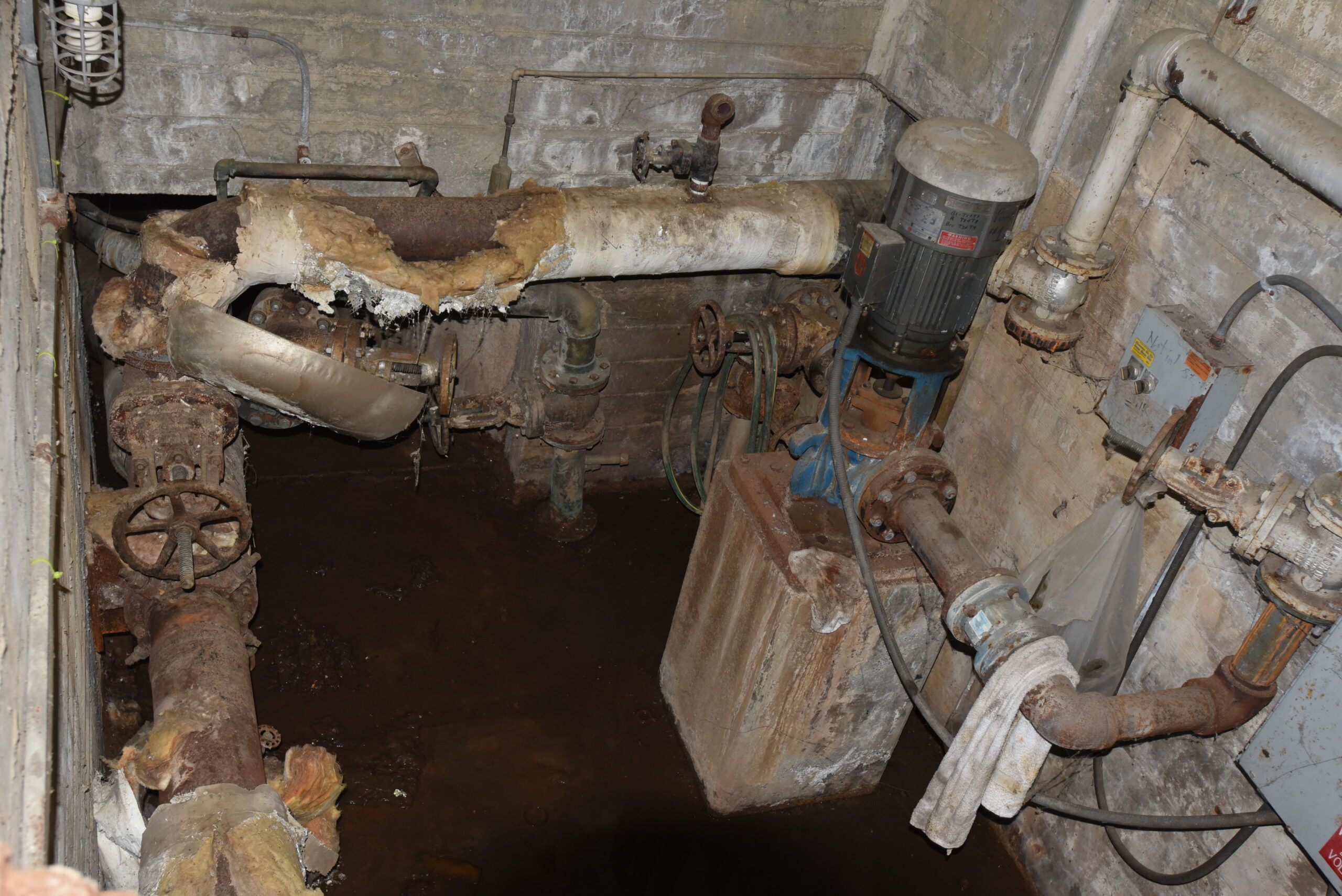
- Asbestos, which was used to insulate the steam and hot water pipes that serviced every building through an underground network of tunnels and trenches, and is layered into the linoleum floors used in most of the buildings.
- Lead paint, accumulated in layers over the years before it was banned in 1978. That lead is not considered hazardous until it is exposed through demolition.
- Gasoline, diesel and fuel oil leaks from underground tanks.
- PCBs from the former use of hydraulic cylinders in the motor pool shop area, and from widely used fluorescent light fixtures.
- Un-permitted solid waste disposal sites.
- Aluminum sulfate contamination from historic spills.
- Historic sewage releases into Sonoma Creek.
- Release of radiological waste to the municipal sanitary sewer.
- Arsenic, released from farming practices.
Not all these toxic substances represent clear and present risks. But all of them require more thorough examination and testing, most importantly asbestos and lead. Because most of the SDC infrastructure preceded the evolving science of toxic risk from most of these listed substances, both asbestos and lead are known to be present in virtually every building, and along the grid of all underground steam and water pipes.
A preliminary assessment conducted for the State Department of General Services by the noted San Francisco geologic consulting firm, URS Labs, concluded that, “According to excerpts of various testing reports provided by the SDC, many of the residential and non-residential buildings tested positive for asbestos-containing materials … [For example] Selected materials in the Corcoran building were found to contain various percentages of asbestos: mudded joint fittings and boiler packings in the Air Handler Room and pipe coverings, boiler packing and mudded joint fittings in the Kitchen …”
And asbestos isn’t an issue in the buildings alone. Some of it is outside. URS was told that “lava rock northeast of the plumbing shop on Manzanita was placed to encapsulate the open ground that may have been contaminated from deteriorating insulation on the overhead piping. It is unknown if the insulation was repaired or replaced. In an effort to encapsulate any contaminated soil below, maintenance staff rolled Visqueen over the area and covered it with red lava rock. Because the pipe insulation was presumed to contain asbestos, the potential for contaminated soil is an item of concern.”
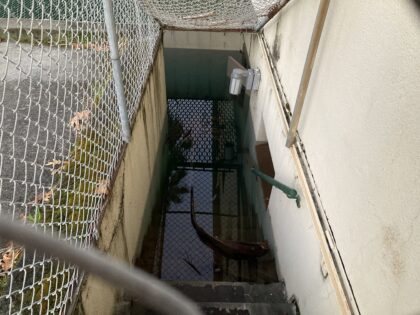
The asbestos risk was amplified after recent heavy rains flooded the basements of several buildings on the east side of Sonoma Creek, pushing visible standing water up outside stairwells and, according to one former plant supervisor, reaching the level of asbestos-insulated steam pipes in those basements.
Tom Sokoloski, a former stationary engineer and decades-long SDC employee, said steam and hot water pipes wrapped in asbestos insulation were most likely enveloped by water in the flooded basements, potentially resulting in asbestos-contamination in the water and complicating any effort to pump them dry. He said he contacted County officials who had been unaware of the problem. As of the date of this Sun issue, the basements remained flooded.
The flooding occurred, Sokoloski said, because power had been cut to the buildings, precluding the automatic intervention of sump pumps in each basement. That failure reflects a general sense that the entire campus has been abandoned to incremental decay. Examination of some of the former residence halls reveals ceiling tiles littering floors, mold taking root, roofing tiles falling away exposing bare expanses of roof.
More serious is the shifting course of Sonoma Creek which, over the last three or four years, has severely eroded its western bank at the intersection of SDC property and the private homes in the immediately adjacent Eldridge subdivision on Burbank Drive. One home, now mere feet from a 15-foot drop into the creek bed, has already been red-tagged, forcing the owner to evacuate. Two drain pipes from the close-by Redwood circle area of SDC extend out of the eroded bank. Whether they contributed to the accelerated erosion is currently unknown, but the issue suggests a broader concern about placing more residential housing in immediate proximity to a significant watercourse.
Riverbed geomorphology is a dynamic process, and Sonoma Creek routinely reaches river-levels of streamflow, with extreme storm currents rising up to and well beyond 3,000 cubic feet per second. That’s a river, and volumes that high have extraordinary scouring power. Typical remedies include placement of riprap, huge boulders or cement obstacles to deflect the flow. But riprap often runs the risk of simply deflecting the destructive flow to another point downstream. And as streamside development increases, room for the water to spread out is further constrained, and it inevitably forces streamflow into an ever-deeper and narrower channel, thus increasing velocity and exaggerating the problem.
The failure to take into account the fluid dynamics of an iconic waterway that serves as a wildlife corridor and a spawning stream for chinook salmon underscores the controversy that continues to dog the historic SDC property.
While the decay of the historic infrastructure is, at one level, an obvious consequence of closure and the intention to demolish the buildings anyway, at another level, critics say, they suspect it is a deliberate decision to make adaptive reuse of some SDC buildings incrementally more challenging, if not impossible.
While the second iterations of a Specific Plan and its Environmental Impact Report (the first was thrown out in court as hopelessly inadequate) won’t be completed and ready to review for months, it appears the County is committed – prior to final public and legal review – to the highly controversial, 1,000-home plan.
What is most surprising about the current position of County and state planners is the complete absence of any substantive discussion of the environmental impacts of demolition, the potential of public exposure to asbestos contamination in air and water, and the environmental and social disruption of the entire campus and adjoining wildlife corridor during the years of demolition and construction necessary to build some 1,000 homes.
The heaviest and harshest impact on the land in question will occur during that period of several years, and that is an environmental, historic, cultural and public trust impact many Valley residents are waiting, and expecting, to know more about.
Main Photo: The entrance to the main tunnel carrying steam and hot water pipes through the SDC campus. Pipes are wrapped in disintegrating asbestos insulation. Photos by David Bolling





Oh boy! The salmon coming upstream in Sonoma Creek to spawn— and their spawn — will LOVE all that tasty lead and asbestos. Maybe that stuff explains the deathrate among former residents. In any case, all this talk of lead and asbestos in the SDC environment should make those 1000 new homes VERY affordable!