

The Japanese film “Perfect Days” features renowned actor Kôji Yakusho leading a Zen-like life in the heart of Tokyo, where he works as a public toilet cleaner. Yakusho won Best Actor for the role at the Cannes Film Festival. His character, Hirayama, is shown playing cassette tapes of his old favorites as he drives to his work every morning. Among the songs are Otis Redding’s “(Sittin’ on) The Dock of the Bay,” and The Animals’ “House of the Rising Sun.” The only Japanese song he listens to is “Aoi Sakana” – “Blue Fish” – a 1972 hit by singer-songwriter Sachiko Kanenobu. The popularity and success of the film is part of a renaissance for Sachiko, who lives in Glen Ellen. Anna Pier visited with her in her small home, to learn her story.
How did your song come to be played on the tape player in Hirayama’s van? The film’s producer wanted to make a documentary on the Tokyo toilets, which are architectural wonders. He invited the famous German director Wim Wenders to work on it, and they decided instead to make a feature film. Wenders likes my songs and got in touch with the studio where I had recorded the album Misora in 1972. All the other songs the character in the film listens to are Western.
And the film “Perfect Days” has increased your current popularity? That song, “Blue Fish, ” has had four million listeners on Spotify alone. My other songs are popular too – 400,000 listeners. You can hear me on YouTube at a club in New York City, Le Poisson Rouge, performing “Blue Fish.”
Tell me about the revival of your old songs. I have become very popular in Europe, in Australia, once again in Japan, and here. I performed “Blue Fish” – the song from the film – at the 2024 Tokyo International Film Festival where “Perfect Days” was screened. That year I toured in Japan, and on the East coast of the U.S.
Other tours? In 2025 I went to London, and I just got back from a mid-February tour of the four major cities in Australia. The places were packed – they were sold out in Sydney and Melbourne. The end of this month I will tour in Santa Ana and the L.A. area. Then I will work on the final mix for my new album, with a company in L.A. It will probably have 11 songs, all mine. It will include the single just released of my song “Music Carries Me On” on Side A, and “Keep On Smiling” on Side B. Then in September I plan to be in Japan. Fingers crossed that my new album will be out.
How did you come to this country? I was 18, Japan’s first singer-songwriter. They were calling me the Japanese Joni Mitchell. I was in Tokyo and was making my first album, “Misora.” It has the hit single “Blue Fish.” When I was recording it, I met the music critic for Rolling Stone and other magazines, Paul Williams. He was in Tokyo, working with the Japanese translator for his book “Outlaw Blues.”
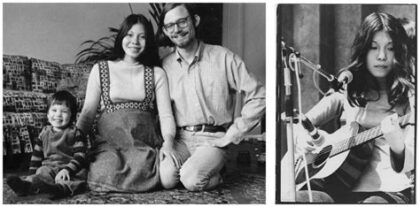
He was a wonderful writer. He discovered Bruce Springsteen and The Doors. He wrote in depth about Neil Young, Bob Dylan. He went deep into their songs.
He came to the studio when I was recording “Misora.” We started going out, we fell in love, and after three or four months he asked me to come to the U.S. with him. I left the album unfinished, even though it had been my dream to make an album. My child I was going to have with Paul was more important. So I moved to New York with him.
The recording studio did finish the album. It has been reissued many times. The last time was by Sony.
How did you come to Glen Ellen? Rolling Stone magazine was in San Francisco, and since my husband wrote a lot for that magazine, we were going to move there. My husband was good friends with the science fiction writer Philip K. Dick, and he suggested to us we might like to live in the Sonoma area. So we came to Glen Ellen and we liked it. This is the house I’ve always lived in here.
How long is that? Since 1976. Paul and I had two sons. The boys went to Dunbar Elementary School. Both are grown now, and I have two grandsons, one 21 and the other 16.
How did your career continue after you had started your family? Philip K Dick visited in our home here, and he loved my album. He encouraged me. “You got gift,” he said. “Take your guitar out of the closet and continue song-writing. ” He said it really strong. And he and my husband both encouraged me to write in English. I wrote fourteen songs in my broken English. I never studied English. I wanted Philip K Dick to correct my grammar, but he only corrected it a little.
By 1981 I had fourteen songs, and I felt like it was time to perform. So Paul and I rented the Women’s Club in Sonoma, and I gave a concert. I recorded these songs as an album for Philip K Dick. It’s called Fork in the Road. It was successful here and in Japan.
Can you talk about growing up in Japan? I grew up in Osaka. I was the youngest of six children. Everyone in my family loved music. I heard all kinds of Western music from my sisters and brothers. French chansons, classical music – Chopin. My second oldest sister was a theater actress and singer, very well-known in Japan. She played Maria in The Sound of Music in a huge theater in Tokyo, and it was very popular. She’s eighteen years older. From her I heard all the singers, Bing Crosby, Frank Sinatra, Dinah Shore, Peggy Lee, Nat “King” Cole.
Where did you study music? I never studied music. I just learned by ear. In the 60’s I was listening to Joan Baez, Judy Collins, The Brothers Four, Pete Seeger. I especially liked Donovan. And we listened to the Beatles, the Stones, the Animals.
I was learning guitar by listening to those early records. And I had a friend, a college student, who helped me with guitar. I would join with him and other college students – I sort of sneaked in – when they were practicing at their folk club. I got to perform at a Folk Club Festival in Osaka, performing my song. In ’69 I performed with a girlfriend – we called ourselves The Twins – Simon and Garfunkel’s song “All the Leaves.” Around this time I discovered Joni Mitchell. A very early recording from Canada.
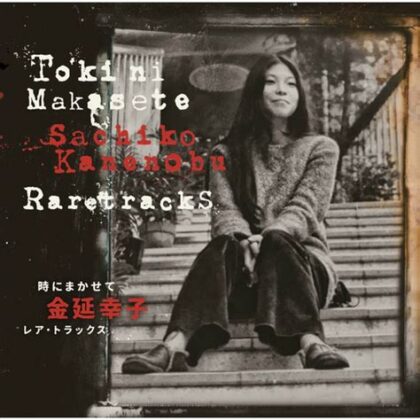
Talk about that. I was interested in her sound. She had limited hand movement, so she used open tuning, created a very interesting sound. I was creating chords by myself, and I have small hands. So I have an interesting guitar sound. I’ll play for you.
You’re 77. Talk about writing and performing at your age. It’s unbelievable. I thought to myself, ‘How shall I live my last page?’ I decided to live it as a child. First thing in the morning, I say, ‘Thank you, I’m alive.’
And your backup band is young. Yes! I feel I’m playing with kids, like my sons and grandsons. The guitar player is 25, my drummer and bass player are in their 30’s, and my wonderful road manager, Jordan Burgis, who plays keyboard, is 41. And my audiences are young, very young. I love them. I want to hug them all.
Anything to tell our readers? Let go your age. Don’t count it. I just go with my spirit. And it’s good to let your love to other people out. I go onstage and I say, “Welcome, my sons and my daughters.” I just love these young people. They should be loved, they are very important, they are our future.






Be First to Comment