
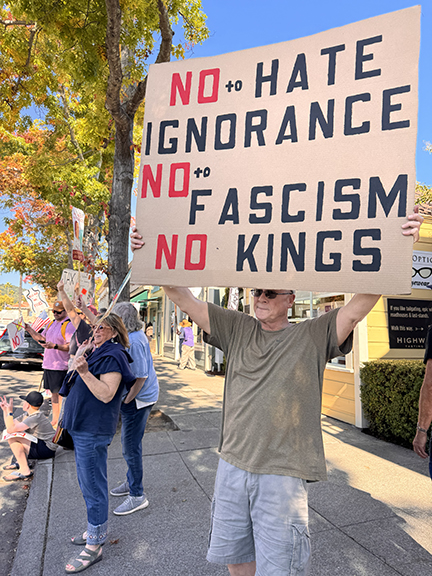
Several thousand people recently showed up locally for the No Kings III march. Motivated by concerns about the policies and governance of Donald Trump, they carried homemade signs, many quite inventive and arresting, expressing their discontent. In one sense, it was a beautiful example of freedom of expression in action, and yet in another, an example of enfeebled democracy.
Mass marches, protests, boycotts and collective action have profoundly shaped American history. The Suffrage movement, the labor movement, the civil rights movement of the 1960s and the antiwar movement that erupted over the Vietnam War, all changed the course of American history. Protest is, in fact, one of the pillars of American democracy. And we applaud this noble tradition and the (relative) freedom we have to practice it.
But protest is also a symbol of the failure of our system of government to reflect the values and the best interests of the people. America is a republic, not a direct democracy. We rely upon elected representatives to enact policy, and use our voices to influence them. Sometimes those voices are quiet; conversations happen behind closed doors with lobbyists and spokespersons everyday. Other times, as when thousands hit the streets, those voices are louder, and carry with them the implication that votes are behind them. In the end, however, elected representatives determine outcomes by majority rule, an awkward system of compromise or brute strength that produces winners and losers.
We call our system a democracy, but what exactly do we mean? When those who make policy are funded by specific interests – industries, billionaires, and various interest groups – where does that leave voters? Calvin Coolidge said the business of America is business, and so it is with politics. The business of politics finances an army of combatants: lobbyists, consultants, pollsters, advisors, media experts, and a vast bureaucracy. American Democracy is all about the nexus of money and power; the will of the people is secondary.
Anthropologist David Graeber points out that historically, democracy has been suspect. When the will of the people transforms into the power of the mob it’s the stuff of revolution. We witnessed it on January 6, 2021, when, like the storming of the Bastille, a mob violently drove its way into our nation’s capital and forced our elected representatives into hiding. It’s as close as modern America has come to armed revolution.
When a mob takes power from a despot to gain power and liberty, we hail it as a step to democracy. The force of violence is as much a tool of democracy as it is a tool of tyranny. Does this mean that even democracy must arrive at the barrel of a gun? Short of that, what does marching and protest actually accomplish?
The No Kings gatherings feel party-like. The signs, costumes and speeches range between funny and deadly serious, but overall, people seemed to enjoy themselves. There was no violence, no garbage cans set on fire, no obstruction of traffic, and overall the marches have been orderly and well-mannered. But are they simply preaching to the choir? Are any minds being changed among those who hold power, and what does it take to do that?
Unless “Citizens United” gets overturned and political campaigns get stripped of their current mode of financing, democracy will largely remain out of the hands of the voters. America is not only not a direct democracy, it’s not even a true representative democracy; it’s a plutocracy, a system of government controlled by the wealthy. And, it’s unlikely to change.
Most people are just trying to get by, caring for their families and hoping to stay ahead of the bills they must pay. They want comfort if they can find it, even if it’s only the sign-carrying companionship of others who want the same. Perhaps that’s better than nothing, and for most, maybe that’s enough. You say you want a revolution? “Well, you know…”
Sonoma Valley Sun Editorial Board

Be First to Comment