
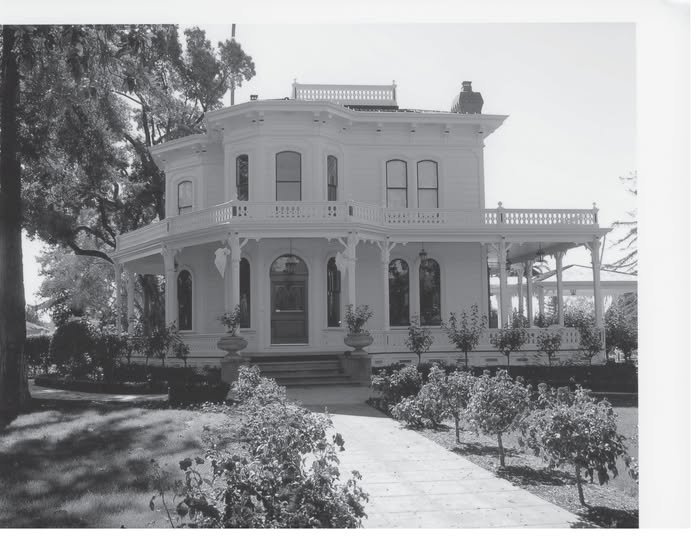
The Sonoma Valley Historical Society has shared the history of one of Sonoma’s most historic homes.
Another little known National Register Property in the city of Sonoma is Orange Lawn, its building style Late Victorian Italianate. The significance is for a representative example of Italianate architecture, displaying the distinctive characteristics of that style and possessing high artistic value. The building also represents the work of an unknown master craftsman whose sawn ornament achieves significance as sculptural folk art. The 1872 mansion was constructed on a concrete foundation with cellar, and the formal grounds include concrete walkways, flower urns and entry steps. The early use of concrete in the construction of the residence and landscape design is extraordinary for the country at this time, but consistent with concrete construction that occurred in Sonoma during the 1860s – 1870s.
Native and exotic trees dating from the 19th century grace the grounds of Orange Lawn and include olive, black walnut, cedar, magnolia, catalpa, Monterey pine and redwood species. A locust tree, pictured in an 1883 photograph of Maria Young, still stands in the west garden. Interconnecting walkways made of concrete wind through two acres of manicured lawn and are original to the construction of the house. The name may refer to several attributes associated with the landscape design of the estate, namely the color of summer lawns surrounding the mansion and the Youngs interest in citrus cultivation. Daniel experimented with orange and lemon trees and exhibited samples at the State Fair in 1873. Many in Sonoma hoped oranges would become an important industry including General Vallejo who shipped some, grown from his garden, to the Alta Newspaper in 1872. Fie hoped to gain notoriety for his successful “culture of semi-tropical fruit.” Pioneer resident, Caleb.C. Carringer, began planting orange and lemon trees as early as 1863 and by 1873 his orchard included 100 specimens.
The first recorded deed for the land dates from January 1850 between the Mayor of Sonoma, Alcalde William M. Fuller, and Solomon H. Carriger, a pioneer from Tennessee and Southern sympathizer. Carriger amassed large tracts of land, established vineyards and fruit orchards and was well known in the community for his political influence and business enterprise. Like so many land transactions that occurred during the Yankee settlement period, the property changed hands frequently and for vast amounts, reflecting considerable land speculation. Dona Maria Carrillo, a relative of General Vallejo, purchased the property in 1853 and retained an interest in the land until 1870. Remnants of adobe construction found on the property by the Armstrongs who owned the mansion from 1938 to 1987 suggests that the land may have been occupied during the Mexican Period.
By 1856, Coleman B. Smith, a farmer from New York, acquired the property and settled there with his wife and family. He recorded a homestead in 1861, declaring residency and was taxed in 1868/69 on improvements and 36 acres valued at $960. In 1870, the 58 year old farmer managed to raise fruit, pigs and some hay with the help of a Chinese laborer living with the family. Smith was losing his sight and sold the property to Daniel Young. He relocated nearby to Outlot 521. In March of 1870, Daniel Young agreed by promissory note to pay $2500 for the farm. The purchase also included the “strips of land” previously designated as streets on O’Farrells 1850 Map which added another 3.5 acres to the property for a total of 35 acres. The land was improved with fruit trees and English walnuts and included a residence and outbuildings for livestock and farm equipment.
The Youngs developed and owned Orange Lawn for twenty-two years from 1870 to 1892. Maria Young was forced to sell her beloved home in 1892. W.S. Miller of San Francisco purchased the property for $4,756.41 and maintained ownership for 18 years.
Now sitting in the Armstrong subdivision the property retains its historic character. It was used in the film Tucker, starring Jeff Bridges.



Be First to Comment