
The arc of History, from 1776 to 19th Century California
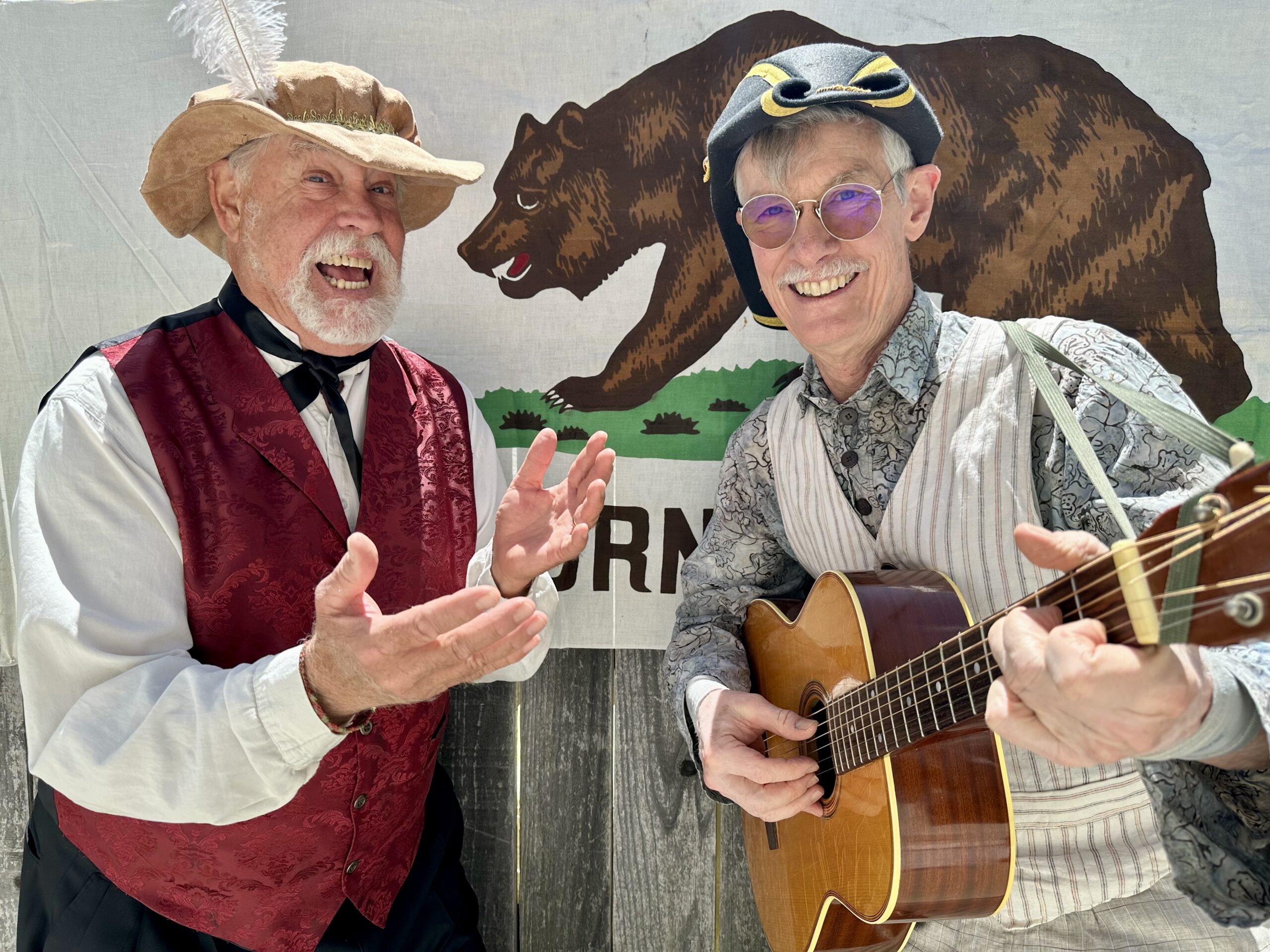
(Editor’s note: What follows is a segment from the script for a remarkable historical drama that will be enacted at the Sonoma Barracks on July 4 at 1 p.m. The script was written by George Webber, the multiple-personality Disordered actor/historian/tour guide who inhabits the soul of General Mariano Vallejo, founder of Sonoma, on his tours around town. The production will be acted by Webber, and by his performing partner and musician, CW Bayer. Admission to the event is free. Get a healthy dose of the history you will hear, right here.)
By George Webber
The Declaration of Independence was signed by people who banded together and said that they possessed the inherent right to govern themselves, and rejected their colonial ruler.
It was on another fourth of July – this one just 31 years in the future – that future Sonoman Mariano Vallejo was born. Yes, it was on the fourth of July, 1807 that the eighth child – and third son – of Ignacio Vicente Ferrer Vallejo and Maria Antonia Isabel Lugo first appeared in Monterey, the capital of Spanish California.
It is curious that Mariano Vallejo was born on American Independence Day – and yet fitting – for more than any Californio of his time, he was a friend of America and American ideals. Vallejo believed passionately in the values of Democracy – the ability and RIGHT of humans to govern themselves.
As amazing as it sounds, it appears that in the far away province of Alta California – run by Franciscan monks and a few civilians – a flower grew in the form of Mariano Vallejo – a true believer in Democracy.
Our intent in this 250-year Birthday of America Commemorative presentation is to explain how these ideals of political freedom were instilled in Mariano Vallejo – and how they arose in the first place in Europe in the late 1600’s.
And how these notions of self-government came to the New World – to Nueva España – and eventually to Alta California, and Sonoma.
And we will show Mariano Vallejo’s extraordinary good fortune at being born at the right time, in the right place – so that representative self-government in California would find its finest champion.
In Europe, in the late 1600’s, people began to consider that reason was more important than revelation. That science should be in charge, not religious dogma, and that government must have the assent of the governed.
By the time Vallejo was born in 1807, these lessons from the period historians call the Enlightenment were being put into action all over the world. The American Revolution began 250 years ago today in Philadelphia. We are here today to celebrate this momentous occasion in human history.
When viewed as an aspirational document, the American Constitution was a really excellent first attempt at creating a new country – where political freedom could exist. And once humanity got a taste of democracy, it didn’t want to stop.
The French Revolution started in 1789, and on August 26, the French National Assembly adopted the Declaration of the Rights of Man and of the Citizen. This foundational document of the French Revolution defined universal individual and collective rights.
It established the principles of Natural Rights, Equality, the Rule of Law and Freedom of Expression. Basically, it declared that everyone should be treated the same by who’s in charge, and that the folks in charge have to be elected by the people, and that people can say whatever they like, provided that it doesn’t disturb public order.
These ideas were ways for society to move past the previously accepted mode of arranging society – the divine right of Kings. It does appear, as we look back at history, that society as a whole had moved past a general acceptance of a ruler who had unlimited power.
When the French nation chopped off the head of King Louis the 14th on January 21, 1793, the news spread like wildfire around the world. Now this was a revolution. Among those deeply interested were black slaves in French-owned Haiti.
These slaves heard of their owner’s belief in freedom, and took their owners at their word. They declared Independence from France, because all men are created equal.
In what is just the first of many ironies, France refused to free them, and fought the well-organized and resourceful Haitians for the next 13 years. France gave up the fight in 1804, and French soldiers sailed away. Haiti remains the largest successful slave revolt in history, although its economy is still in shambles, thanks in part to debt compounded by reparations from that war more than two centuries ago.
West of Haiti in the Caribbean, Mexico began its war of Independence from Spain in 1810. That same year, Chile and Colombia began their struggle to break free of Spain.
In 1811, Venezuela and Paraguay joined in the revolt against the Spanish Empire. In 1816, so did Argentina.
Chile became free in 1818, three years later Peru and Panama cast off their colonial rulers. That same year, 1821, the 11-year Mexican Revolution was finally over, Mexico was no longer a colony of Spain.
Back to Mariano Vallejo, born on the Fourth of July, 1807 in Monterey, Alta California.
Mariano received basic instruction in reading and writing from a small school kept by a retired soldier named Miguel Archuleta. Taller than most of his peers, Mariano stood out as exceptional in bravery and intelligence. As such, he was noticed by the last Spanish governor of Alta California – Pablo Vicente de Sola, who became his tutor.
Sola had assumed the post of Governor in 1815, and was one of many hoping for a transition from a Nueva España ruled by the King, to a constitutional monarchy. A sort of intermediary-step between monarchy and democracy, a constitutional monarchy allows a country to possess both a King and a Congress. Each are given specified rights and privileges; the idea being that each power center would temper the other.
Sola, and many other liberal thinkers in Nueva España, desired a bloodless take-over. They wanted the Spanish monarchy to agree to a reduced role, and allow some amount of representative democracy. And it was these ideas that Sola shared with Mariano Vallejo.
Sola gave Vallejo Mexican newspapers to read, and official Spanish documents, as well as Cervante’s “Don Quijote de la Mancha.” Sola allowed Vallejo access to his personal library, where Mariano absorbed Voltaire, Jean-Jacques Rousseau and Jefferson. Pablo Vicente de Sola does appear as an admirable figure in California history. In his famous book “Recuerdos,” Mariano tells this story about Sola:
Sola believed in educating young people, including girls. In a letter to Don Arguello, Commander of the San Francisco Presidio, Sola told him, “Do not accept any excuse whatsoever from parents who refuse to send their children to school, because if our young people are not educated, the country will not make any progress. It is the duty of authorities to make sure this does not happen.”
Consider that Sola first appeared in Monterey in 1815, when the fortunate Mariano was eight years old, the perfect age to gain a mentor and tutor. Sola does an admirable job at this for the next seven years, and Vallejo became his personal secretary.
In 1822, the Mexican Empire was born and a new governor appeared in Monterey: Louis Arguello. Vallejo became his personal secretary, and when the transfer of allegiance of California from Spain to the Mexican Empire was drawn up, it was done in the graceful script of 15-year-old Mariano Vallejo.
With the end of Spanish control, trade with foreign nations became legal, and all manner of people arrived in California to make money from the hide and tallow trade.
One of those who arrived in 1822 was an English merchant named William Hartnell. A dynamic and resourceful man, Hartnell was also gifted at languages, a trait which served him well. His family had sent him to college in Bremen, Germany, where he learned Latin, German, and French. An uncle secured him a position in a trading firm in Santiago, Chile, where he mastered Spanish. When California opened up, Hartnell’s firm rushed in to be its first officially permitted trading company.
An Englishman with a scholarly turn of mind, Hartnell was nicknamed “white eyelashes.” His mastery of Latin impressed the mission fathers, who had the cattle that produced the hides and tallow he would collect and send back East.
Hartnell needed an assistant, and there was Mariano Vallejo, well-schooled in the necessary skills as a private secretary. Hartnell not only hired him as his clerk and bookkeeper, he launched Vallejo into intensive study of English, French and Latin.
Vallejo learned the formalities of making out invoices, handling bills of exchange, and the intricacies of extending credit. All these skills became useful as time went on.
Now let’s return to the Mexican Empire that ended Spanish rule in 1821. That government was a constitutional monarchy. The Revolution had been won by General Agustín de Iturbide, who then created a constitution with a congress and laws, along with a monarch that would preside over the government.
The new Mexican Congress offered all the crowned heads of Europe their own willing country to adopt, but no one would take up this offer, it being abundantly clear that such an endeavor was doomed to failure. So, General Iturbide declared himself to be King.
The new Mexican Congress was supposed to be a branch of government equal to the constitutional monarch, but King Iturbide didn’t actually care about democracy. He promptly took vast amounts of money from the rapidly dwindling public coffers to build palaces for himself and his family. He formed his own personal guard of thousands of soldiers, separate from the rest of the army, and spent most of his time far from Mexico City.
Meanwhile, the new Mexican Congress was full of reformers with dreams of a representative government. They had read the American Declaration of Independence, and its call for individual rights. They had carefully examined the American constitution, and they wanted a Chief Executive who respected the legislative branch of government. They wanted a President, not a King.
It didn’t take long for Congress to get rid of Iturbide. They wrote a new constitution and they changed their flag from an Empire Flag to a republican flag.
Mariano Vallejo was still working as Governor Arguello’s personal secretary in 1824 when the news of a Mexican Republic reached Monterey. Once again, it was Mariano who wrote the official document acknowledging California’s fealty to the new government.
Mariano was 17 at that time, the perfect age to enlist as a cadet in the new army of the United Mexican States. Mariano was quickly promoted to corporal, and then second lieutenant, and was made a member of the territorial legislature at the age of 19. This was quite an honor, made possible because of his extensive education.
Now, this history is not intended to be a comprehensive recitation of Mariano Vallejo’s life. A standard time-line narrative would now begin describing the many incidents of brutality and warfare subjected against the indigenous peoples of California by second lieutenant Vallejo and others. Vallejo himself saw his actions as that of a Roman General outnumbered by pagan enemies. He followed the Roman adage of “divide and conquer;” as per the many indigenous people for whom his continued occupation of the Sonoma Plaza causes historical trauma, the still-with-us descendants of those who suffered at the General’s hand.”
In the context of our careful description of the General’s belief in liberal ideals of freedom, democracy, and equality, it does at times feel impossible to square the circle, to hear of both his love of democracy and his brutality to those who were here before.
But, there you are. History is confounding.



Be First to Comment