
By Kathleen Thompson Hill
Many of us, in many ways, have a lot to learn from the indigenous peoples who lived here for centuries before white Europeans showed up to take their land.
Members of Pomo, Coast Miwok, and Wappo bands (or tribes) enjoyed their own settlements in Sonoma and Napa counties starting from 8,000 to 5,000 BC.
We hear of – and even joke about – men as “hunter-gatherers,” but among first peoples in Sonoma Valley, those weren’t necessarily the same people, nor were both of those functions performed only by men. Both men and women functioned as “hunter-gatherers.”
During the ages of nine to 13, girls began to go out with their mothers to gather acorns, berries, grapes, mushrooms, seeds, squashes, beans, hazelnuts, poundnuts, corn, grains, and other plants for food and juices. This is what the late Sonoma chef John McReynolds referred to in his books and demonstrations as “foraging.” Even picking watercress out of creeks or drain ditches is foraging.
Boys would help their fathers hunt. The men would catch deer, rabbits, squirrels, quail, mountain sheep, chipmunks, wood rats, and the occasional black bear or elk, often using clubs, spears, or arrows to make the kill while wearing animal skins to fool their prey. Some would trap snakes and grasshoppers for more protein. Nets or light natural drugs were used to catch fish or shellfish in local streams and creeks.
Acorns were a vital staple in the Miwok, Pomo, and Wappo diets, but the process for using them was and is arduous and extensive. First, the acorns have to be gathered from the ground under oak trees, dried, and stored for about a year.
Eventually the acorns would be pounded with heavy wooden pestles, or milling stones, by hitting them against a rock or a rounded vessel resembling a mortar of today. (Remnants of these practices are called grinding holes and can occasionally be found to this day.) Then they would boil the acorns to remove tonic acid, leach the gruel, and then heat it in an earthen oven or pit, and eventually make the result into flour.
Last year I gathered a few hundred acorns from our oak tree to try this process, put them in a metal colander to dry in the sun, and then proceeded to watch a happy family of squirrels abscond with the acorns, one by one.
Utensils were often made of wood, and spoons could be formed from mussel shells.
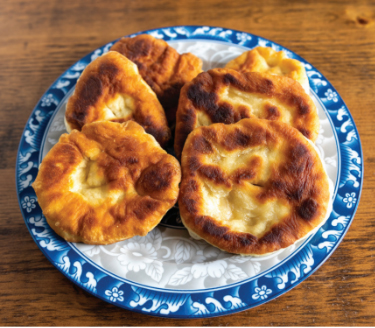
One of the most popular stories concerning native lore is that Indian fry bread, which originated among the Navajos, is a Native American staple. I first sampled it in Canada at a First Nations Festival at the Royal British Columbia Museum in Victoria and loved it. My piece was deep fried, hot, and sprinkled with powdered sugar.
Almost every country has a version of fry bread, which is basically made from any kind of flour, salt and sugar, fried in lard or other oil. Also under the definition of fry bread fall donuts, waffles and pancakes, elephant ears, beavertails, churros, sopaipillas, zeppoles (Italy) and chapatti (India). And even French crêpes.
But here is another perspective: Although fry bread is often associated with “traditional” Native American cuisine, some Native American chefs reject it as a symbol of colonialism. Indigenous Chef Sean Sherman calls fry bread “everything that isn’t Native American food.” He says fry bread is a symbol of resilience, developed out of necessity because the U.S. government provided the flour, sugar, and lard when they forced Arizona natives into “The Long Walk” to a part of New Mexico where they couldn’t grow the beans and vegetables they were accustomed to. So, they had to make do with these U.S. government handout ingredients. The resulting creation was fry bread.
Some baskets used for collecting and implements used for cooking can be seen in the soon-to-reopen Sonoma Valley History Museum, formerly the Depot Park Museum, all part of the Sonoma Valley Historical Society.
Note: My first version of this story appeared in the Sonoma Valley Historical Society’s newsletter. www.sonomavalleyhistory.org.


Be First to Comment