
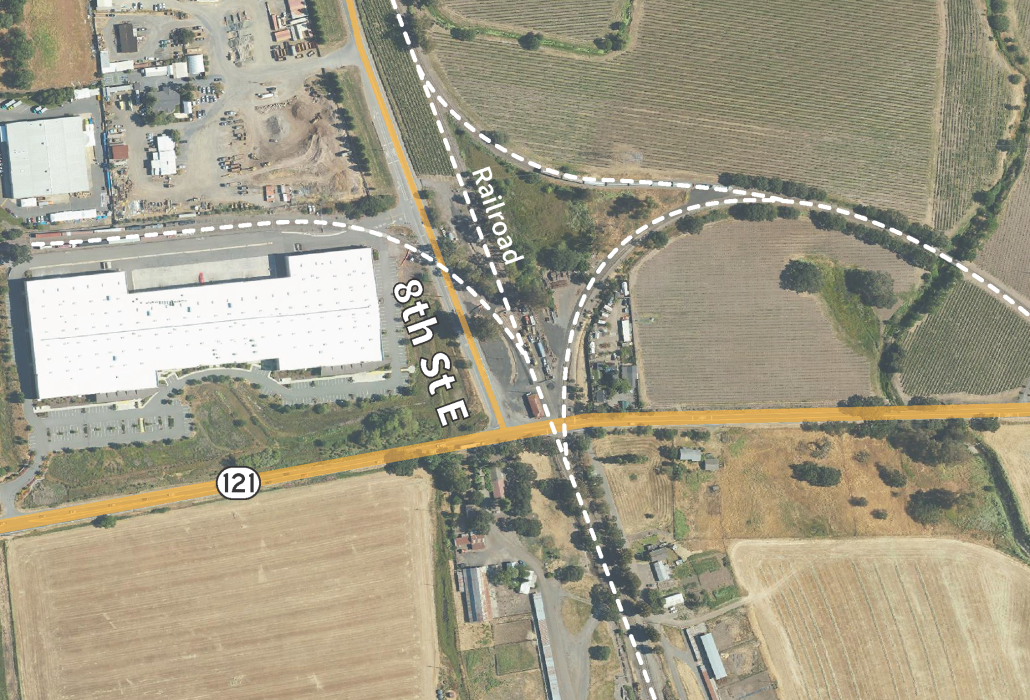
Editor’s Note: The road network along the southeast perimeter of the City of Sonoma, includes highways 116, 121, 12 and 37, along with 8th Street East. These numerical designated routes also have proper names, which may be more easily recognized by name than number, even for drivers who travel on them daily. To make this story easier to follow, we will alternately refer to the roadways by both names and numbers.
Therefore: 116, which for our purposes starts in Petaluma as Lakeville Highway and morphs into Stage Gulch Road, until it connects with and turns into Arnold Drive, leading down to the new CalTrans roundabout (at Big Bend, aka Bonneau Road) and melts into 121 headed for Napa; 121, meanwhile, carries traffic north from 37 – the main (and most crowded) commuter route from Vallejo to San Francisco – and picks up traffic from the tail-end of Broadway and melts into Highway 12 toward Napa at Schellville. A short distance further east, 12 passes through the two-way intersection at the bottom of 8th Street East. This network is the focus of considerable transportation planning, aimed to address current and future safety issues, potential traffic flow improvements, and a viably-safe and financially-feasible bicycling route between Napa and Sonoma. Some of the proposed improvements have generated considerable controversy which inspires our ongoing coverage. The author, Philip Sales, is a former Sonoma County Parks Planning Administrator and landscape architect.
By Philip Sales
On July 20, 2026 a group of concerned property owners and residents met at the Schellville Fire Department to discuss the implications of a proposal to install a large roundabout as the solution to safety issues that have existed for years at the 8Th Street East and State Route 121 intersection.
Several participants had previously attended a workshop on February 5, at which the staff of the Sonoma County Transportation and Climate Authority (SCTCA) showcased two alternative improvements to the intersection.
The first proposed alternative is a traffic-signalized intersection which, according to the plans provided, would require creating an additional eastbound lane and additional “stacking” lanes for traffic, extending east and west of 8th Street East for several hundred feet along 121, and replacing Schell Creek bridge. The cost is estimated to be $37.3 million. I will refer to this as the “Mega Traffic Signal Alternative”.
The second proposed alternative, heavily favored by SCTCA staff, is a roundabout, which does not require extending multiple lanes east and west. It would be similar to the new “Big Bend” roundabout at 121 and 116, on Arnold Drive. That estimate is $25.24 million. I will refer to this as the “Roundabout Alternative”.
While the SCTCA meeting on February 5 “checked the box” for soliciting public input, SCTCA omitted a significant fact. Since 2016, there have been two proposed projects affecting the 8th St East and State Route 121 intersection. One project, which was constructed in 2016, is the Victory Station project, a 19-acre parcel with an industrial building of some 280,000 square feet with a water quality detention and treatment basin for stormwater management, and for which a detailed environmental review was required. The second project was a proposed warehouse project at the corner of 8th St. East and Napa Road.
In both projects, traffic impacts and mitigations were thoroughly analyzed, including future traffic demand on State Route121 and 8th Street East. In both instances a traffic signal and left hand turn lane onto 8th Street East were recommended to mitigate project impacts. The estimate in 2016 was $3 million.
This raises a significant question. How could a $3 million traffic signal project, similar to the one installed in 2012 at State Route121 and Broadway, now balloon into the elaborate $25.24 million roundabout alternative, or a $37.3 million mega traffic signal alternative? Why was the less costly, original $3 million traffic signal plan, not presented as an alternative by SCTCA?
I put this question to Supervisor Rebecca Hermosillo at a Town Hall meeting on August 7, and she stated that the ballooning scope and cost of the project was to “build for the future.” She stated in a follow up email to me that, “My comments about planning for future generations were specifically about designing the roundabout for future traffic volumes, rather than building an improvement based on traffic patterns from 20 years ago, or even for today’s traffic, that could become functionally obsolete within a relatively short period of time.”
The Victory Station project in 2016 used SCTCA’s projected traffic volumes through 2040. Which begs the question of what other traffic data is now being used by SCTCA to justify this increase in project size and cost?
Supervisor Hermosillo also stated that the project could help resolve flooding issues in Schellville. Although the flood reduction goal is not specifically mentioned in SCTCA’s project web site, a replacement of the Schell Creek bridge might improve drainage somewhat, and is included in the $37.3 million Mega Traffic Signal Alternative but not the Roundabout Alternative, favored by SCTCA staff. But the routine flooding of the intersection near the Schell-Vista Fire Station adjacent to Broadway/Highway 12 is far more complex and multi-faceted than can be addressed by a new Schell Creek bridge. Flooding of the adjacent Millerick Road and Larson Family vineyards is commonplace.
Unanswered questions about the project include:
One: Does it make sense to build a high-capacity Roundabout or Mega Traffic Signal when State Route121 consists of two lanes for almost its entire 8.6-mile length between State Route116 (Arnold Drive) and Highway 29 in Napa? According to Caltrans’ Average Annual Daily Traffic history for the decade 2015 to 2024, traffic volumes on the State Route 121 corridor actually show declines in seven of the ten intersections along the 8.6 mile corridor.
Two: What impacts to “improved” traffic flow will the project have on road crossings at Burndale Road, South Central Avenue and Ramal Road? Many residents have concerns now about the danger of making turns on to and off this faster traffic on a two-lane highway.
Three: Construction of such a big engineering undertaking is estimated to take two years. How will this affect other roads in the Valley?
Four: SCTCA staff stated that Highway 37’s inability to deal with rush-hour traffic between Marin County and Solano County – which routinely creates rush-hour gridlock lasting 90 minutes – has seen increases in traffic using alternative routes, such as State Route 121-State Route-116 to reach Highway 101 to avoid the gridlock on 37. Based on Caltrans own data, the 121 and 121 intersections are not a “choke point.” There are other problematic locations, such as daily one-mile traffic back-ups on Adobe Road and 116 (aka Stage Gulch Road) to the Lakeville Highway. Should SCTCA and Caltrans invest in a roundabout or signal at SR 116 and Adobe Road?
Five: Are we being “sleepwalked” into shifting traffic from Highway 37 onto 121? There are several projects along the 121/lower Arnold Drive corridor that are beginning to look like Caltrans and Sonoma and Napa Counties might be building a “daisy chain” of infrastructure to intentionally move traffic volumes from Highway 37 onto 121 to reach I-80 in the future.
Shifting large volumes of traffic onto 121 is not consistent with the land uses and rural character of Sonoma County. However, if the Counties and Caltrans are planning such a move, they have an obligation to develop a comprehensive EIR that deals with the entire project, and not to segment it into individual projects, which would be a violation of the California Environmental Quality Act CEQA and the National Environmental Policy Act (NEPA).
I recommend readers stay involved and take the time to let SCTPA know your thoughts via the On Line survey they are conducting of projects at https://form.jotform.com/261876325703057.




No it’s not overkill, but short sidedness.
What is really needed is an auto bridge type overpass that will take traffic going from 101 to the East Bay completely off local streets.
There simply are too many people traveling between far Northern California(Santa Rosa and northward) and the East Bay. I don’t see this decreasing, except for the drivers and passengers that die commuting!
Putting costs and “financial bundling” aside (which are unacceptable)…
That turn is seriously sketchy. I make it all the time, and while I wish there were a simpler solution, that intersection needs to be fixed.
BTW, it’s the “two-lane highway” attitude that is part of what makes Sonoma area one of the most deadly to drive in CA.
“consistent with the land uses and rural character of Sonoma County” vs. sea level rise and the whole North Bay economy and jobs commuting, guess who is going to lose here? If Sonoma goes its typical full-bore attack on any serious changes, the results this time will be a stuck-in-the-past maladaptive traffic planning approach that will bring total gridlock on Napa Rd., Watmaugh, and 121. There’s nowhere else to go folks. As the commenter above said, the two-lane highway attitude makes traffic miserable and dangerous for everybody who is stuffed onto too-small roads. Not to mention poor fire evac infrastructure because of failure to build adequate circulation. Sonoma’s no growth or change at any cost approach won’t work forever and is up against sea level rise and the only viable paths for North Bay traffic flows. Better to adapt and plan than take the Luddite road.
Hi Fred
You raise an excellent point about traffic which was the purpose of my article. If Caltrans, SCTCA, Napa County and Sonoma County are planning to widen and improve SR121 as an alternative to Highway 37, they need to declare that is their goal and do a thorough EIR/EIS and not piecemeal the process.
The Victiry Station building had a major lease in place with Amazon as a last stop distribution center.
Both Amazon and the building owner worked with the County for about two years to get permits finalized for Amazons interior construction plans.
Ultimately, the County refused to approve the permits due to traffic concerns that the Amazon fleet vehicles would create.
Why did the County approve the construction of Victory Station as a warehouse but then they refuse to allow a warehousing Tenent to build it out for their use?
If traffic was a concern why was it approved in the first place?
Amazon walked away from the lease as a result and the building has had no bites since because the County debacle with Amazon.
The building sits as a vacant blight instead of a vibrant revenue and job producing facility.