

By Connie Schlelein
Encountering Katherine Allbright’s work at her February exhibition at the Sonoma Valley Library feels distinctly other-worldly. At first glance, her paintings, photography, and graphic works lean toward the surreal—sometimes playful, sometimes meditative, always intellectually provocative. But this is art that refuses to remain static. As visitors lifted their phones and scanned QR codes embedded within the exhibition, images shifted, voices emerged, and meaning unfolded. What began as a visual experience quickly became immersive, intimate, and quietly revelatory.
The opening reception drew a large and enthusiastic crowd, many leaning in closely as Allbright offered an impromptu talk about her process. What became clear almost immediately was that her work is deeply personal, guided by a strong moral compass and shaped by a rare dual fluency in both creative and technical disciplines. A fine artist, graphic designer, and UX/product designer by profession, Allbright operates comfortably at the intersection of art, augmented reality (AR), artificial intelligence (AI), and sound. The result is work that blurs the boundary between the digital and the human, encouraging viewers not just to look, but to pause, feel, and reflect.
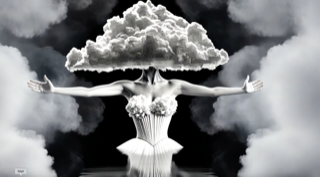
Much of the exhibition centers on Allbright’s long fascination with clouds—both literal and metaphorical. Clouds, for her, became an obsession and an unexpected teacher. “I painted clouds for about a year,” she shared, laughing softly. A self-described perfectionist, she found herself unable to get them “right.” The breakthrough came when she stopped trying.
Instead, Allbright created an entire body of work about not being able to paint clouds. In a series of posters and self-portraits, clouds obscure her face, each of them paired with a recurring “spirit bird” serving as a guide. The pieces are emblems to openness, acceptance, and the understanding that perfection is neither possible nor desirable. “We are perfect being imperfect,” she told the crowd, a phrase that resonated deeply throughout the room.
Poet Mary Oliver is a clear and cherished influence. Allbright referenced Oliver’s writing about clouds breaking open, reforming, and weathering storms—an apt metaphor for emotional resilience and transformation. In fact, the cloud paintings she once struggled with have become her favorites, embodying not mastery but surrender.
One of the exhibition’s most powerful works, Cloud Mother, imagines a mythic creator figure—the being who “made the clouds.” Nearby, a large-scale piece depicts a woman submerged at the bottom of a pool, rendered in soft black and white, slightly blurred. Around her, flowers burst with color and life. The scale is intentional: Allbright wants viewers to feel as though they are in the water with her. The work speaks to rejection, stillness, and abundance—those moments when retreat becomes survival, and quiet becomes strength.
Other works explore themes of belonging and identity. In one poignant series, Allbright resurrects found photographs discovered in a bin at Bon Marché—images of gay and lesbian couples from the 1920s, some taken in Sonoma’s own plaza. By recreating and animating these photographs through AR, she brings these couples back into the present, honoring lives and loves that once existed in the margins. “They are here in spirit with us,” she said simply.
Presented throughout February at the Sonoma Valley Regional Library, the exhibition is part of an ongoing art series organized by Friends of the Sonoma Valley Library President Cathy Coleman, with support from dedicated volunteers. Like the library itself, Allbright’s work is both accessible and profound—inviting the public into layered stories that bridge past and present, technology and tenderness, imperfection and grace.
In a world increasingly shaped by screens, Katherine Allbright reminds us that technology, when guided by empathy and imagination, can deepen our humanity rather than diminish it. Her work doesn’t just ask to be seen—it asks to be experienced.


Be First to Comment