
(Editor’s note: This is the second of two reports on death row inmate Jarvis Masters, a practicing Buddhist convicted of producing a weapon used to kill a prison guard at San Quentin. Masters is a prolific author, writer, poet and media presence with a broad following of supporters who believe he was wrongfully convicted and cite evidence exonerating him. His case is currently on appeal in federal court.)
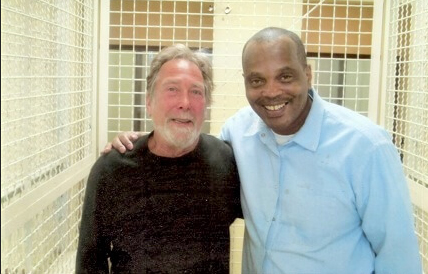
I hook up with Jarvis Masters on that first visit to San Quentin, go through the usual visitor’s procedure after waiting in the designated area building with many other people, white, black, brown and Asian, men, women and children, all milling about in conversation and what have you, all waiting for individual admittance.
Questions from prison officers, passing through the metal detecting machine, and then the long walk up to the visitors building. Along the way, we pass the iconic guard tower generally seen in all photos of San Quentin. It’s about a 10-minute walk that runs along the Bay across from Tiburon in Marin County, as seen from the Richmond-San Rafael Bridge.
On a good weather day, the Bay – sometimes calm and passive – is beautiful in contrast or contradiction to what all are doing; walking up to spend some time with family, with friends or for purposes generally relating to legal matters. A study in experiential juxtaposition.
At this first encounter with Jarvis, and after a bit of palaver about who we are and why I’ve come there, we sense and get to feel that we can trust one another, and that there’s something there that’s brought us together in this unusual time and place. Over time, and many such visits, and telling our stories, sharing a lot of laughter, getting emotional at times and revealing our truths, we start to build this connection between the two very disparate lives we’ve lived.
I come to know his diffuse and piercing sense of humor, his incisive intellect, his wide range of interests. And I begin to understand the things that drive him to know more, and to grow in his practice of becoming more aware of all that transpires in the complexities of the life he lives on a daily basis. A life shared with other prisoners, with guards (referred to as COs, for Correctional Officers), and all that arises in this unique admixture of human beings. In all this, he comes to know me, what I feel brave enough to release, and those things that matter to me and that I hold close at hand. And in these exchanges, we come to know and better understand ourselves and one another.
And so we’ve stayed in this process for some decades now, and have built a friendship – no, a brotherhood – that will last a lifetime and so endure. We share our views and perspectives, our deepest feelings about what’s happening politically, socially, culturally and within ourselves and in our individual lives, and how all these things are impacting us and what we are trying to do in this world, in this time and of this place.
I consider myself so fortunate to have connected with this most remarkable man, to have learned so much from him and to have witnessed a truly genuine practice of Buddhism and a valorous way of going about life in the hardest of circumstances. This is truly a story of a man who has found light in the darkest of places.
If and when he is found innocent, and finally is free of this place and its overwhelming restrictions in almost all respects, he will be free to carry on his life as a living bodhisattva. In Mahayana Buddhism, a bodhisattva is a person who is able to reach nirvana, a state of peace and freedom from suffering, and a path for leading others to it. Jarvis Masters, through the vicissitudes of his unusual life, will be able to give the gift of self-understanding to others and thereby bring some needed change to all who may have the good luck to meet and know him.






Be First to Comment