
Same Plan? Different Plan? How/When Will This Ever End?
By David Bolling
With illustrated display panels circling the perimeter of the Altimira Middle School gymnasium, clots of friends in deep conversation, and a crowd cresting at least 100, the scene of a long-anticipated scoping session to gather public comment on a revised Environmental Impact Report for the Sonoma Developmental Center (SDC) felt at first like a convivial community gathering.
It wasn’t.
Called to order an hour after the announced start time (to provide opportunity, the crowd was told, for perusal of the displays) the meeting was led by Andrew Hill, a principal in the Oakland urban planning company Dyett & Bhatia, and an expert (according to the firm’s website) in community engagement and environmental review.
It was, perhaps, telling, that the meeting was not led by Rajeev Bhatia, president of the firm, who oversaw the first attempt by Sonoma County’s Permit Sonoma planning department to adopt an EIR and a Specific Plan to guide development of the now-160 acres that constitute the campus core. It is in that core, bordering Arnold Drive and ecologically-sensitive Sonoma Creek, that the Dyett & Bhatia-led Plan first proposed – and still proposes – to permit the installation of 990 living units, resulting in a population of approximately 2,400 people, with a statistically probable collection of at least 2,000 cars and 3,030 parking spaces, all in a predominantly rural-village environment, and hard up against the heavily forested eastern flank of Sonoma Mountain.
The developer partnership of Napa-based Keith Rogal and the Stockton-based Gruppe Company, have been accepted by the California Department of General Services – which has control of the property – to take on the development.
The first Environmental Impact Report for that plan was challenged in court by a consortium of local citizen groups called SCALE, and the Sonoma County Superior Court Judge – Bradford DeMeo – who reviewed the case last year, found the EIR so woefully inadequate that he ruled it, and the accompanying Specific Plan, emphatically unacceptable and threw them out.
Among DeMeo’s numerous concerns was the EIR’s contention that, in the event of another wildfire storm like the one that raged through Glen Ellen in 2017, evacuations on two-lane Arnold Drive would only be slowed by a matter of seconds with the addition of the proposed housing.
Local citizens subsequently spent some $80,000 of their own money to hire KLD Associates, an internationally-respected consulting firm specializing in emergency evacuation planning, which conducted an exhaustive analysis and concluded that the projected SDC population would increase evacuation time by hours, not seconds.
The purpose of an EIR scoping meeting is to provide input about what environmental impacts the EIR should study, and how negative impacts can be mitigated. And because SDC sits directly astride one of the most important wildlife corridors in the Bay Area, linking the Marin Coast with the Mayacamas Mountains and into wildlands further north and east, urban-level impacts from a heavily-concentrated population officially set at 2,475 people, demand careful environmental impact analysis.
But not so heavily weighted is the impact of that many people on the cultural, social, aesthetic and even psychological health of the resident population. And over and over again the citizens of Sonoma Valley told Andrew Hill what they thought of the new plan, which seems largely unchanged from the old plan.
When Hill told the assembled sceptics that the current plan was “developed with substantial community input,” there was an eruption of boos and hissing. Hill described what was intended to be a mitigation benefit in the form of a 300-foot wide, 49-acre buffer zone around the outer perimeter of the campus so that development could be better segregated from surrounding open space. But that feature didn’t fly with Hill’s audience. Said a 47-year resident of Sonoma Valley, “A 300-foot buffer does zip in a firestorm. This is an urban planner trying to put urban development in the country. This is not planning for our community. Is there no respect for this community? Somebody’s out of touch here. You don’t know this place. You don’t know it.”
The parade of complaints went on and on. Said Seth Dolinsky, owner of a Valley regenerative land management company, “We’re in the sixth great extinction, and this is about anthropomorphic impact. The Earth is not dying, we’re killing it. This (plan) is a slap in the face of Mother Nature.”
Alice Horowitz, a Glen Ellen activist and board member of the Glen Ellen Forum, described the new-old plan as “magical thinking,” and observed, “I don‘t see anything here that reflects community input. I’m sure there will be more lawsuits.”
Jon Wilson, a Glen Ellen business consultant active in the resistance to the Rogal/Permit Sonoma Plan, turned from the podium to address Andrew Hill, declaring, “This is like Groundhog Day. The same ****ing shit over and over again. This is the biggest pile of shit I’ve ever seen. What are you going to do different from the last time? You have lost the confidence of this valley.”
For his part, Andrew Hill maintained an impressive level of equanimity, choosing not to respond to the mood of his audience, sometimes as though he were in a separate room watching some other show on TV.
Meanwhile, perhaps unbeknownst to most of the audience, Keith Rogal, the developer behind the curtain, sat in the back of the room witnessing the entire tirade. Afterwards, he was genial and approachable outside the auditorium.
The entire experience was more than a little surreal, not unlike that of an emissary from a foreign country, speaking a foreign language, with no knowledge of the local language, history and customs, addressing an assemblage of local people in an effort to convince them to sell their ancestral village.
The only possible conclusion from the evening – the future of SDC is a long, long way from being resolved.
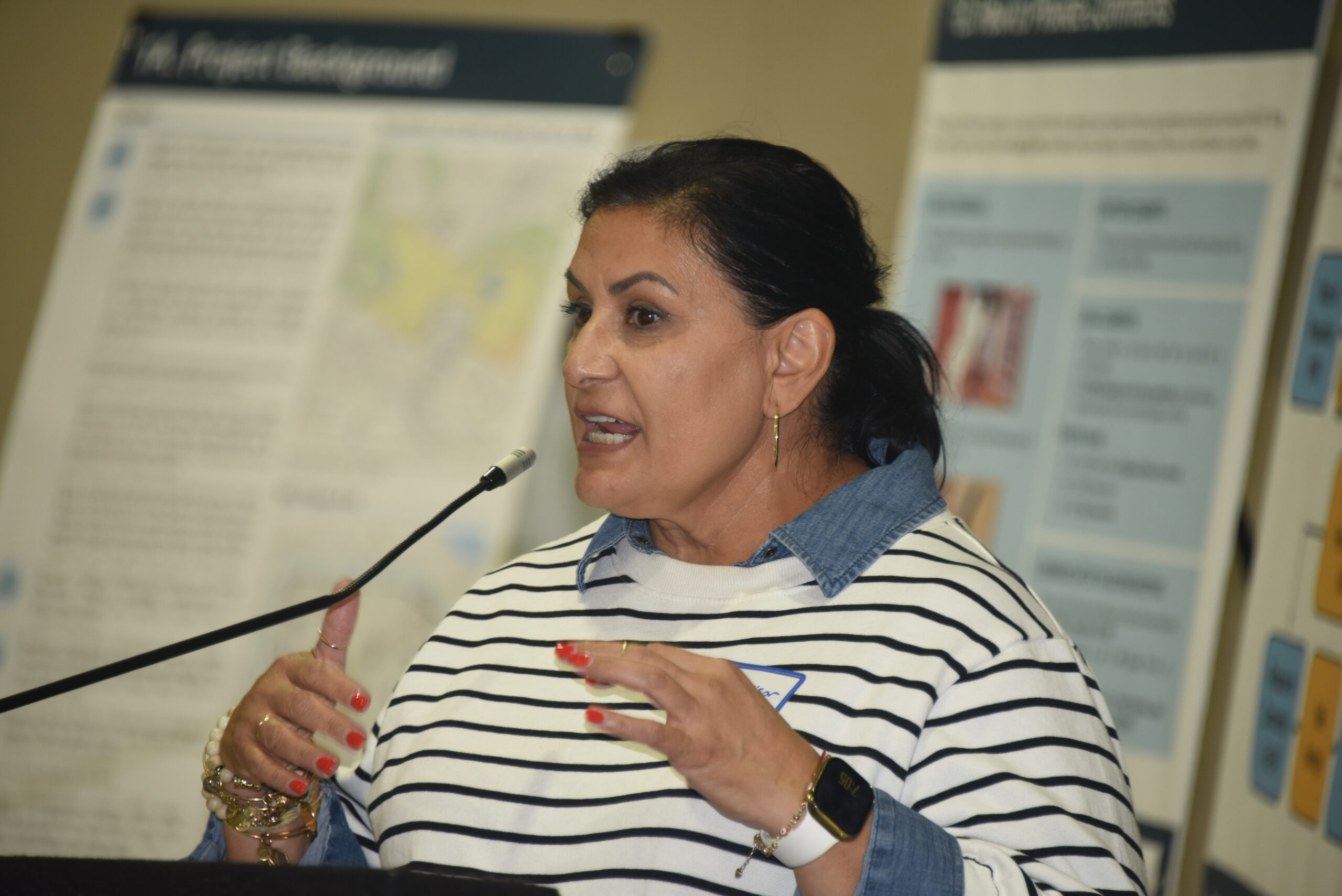
Photo of Supervisor Rebecca Hermosillo, who was in attendance at the meeting, by David Bolling




Brilliant analysis and stunning reportage on the recent dog & pony show to review the current status of the SDC debacle. It leaves the glaring question of why was Oakland-based urban planning company Dyett and Bhatia ever chosen to review the failed EIR after it was summarily thrown out of court by Superior Court Judge, Bradford DeMeo, as being “woefully inadequate and unacceptable”, in the first place? Leaving the stunning matter of the 990 housing units proposed by Napa developer Keith Rogal still in place, and the overwhelmingly stupid and flagrantly dangerous condition of totally inadequate wildfire evacuation of some 2500 additional people in the campus area, locked into a deathtrap bottleneck on Highway 12.
So, what in heaven’s name is the point to these scoping sessions, five of which remain, and what can be expected of those of us living in the Valley in response to what is being presented by the State and the County for our consideration? How can one deal with such idiocy and maintain a semblance of reasonable and rational thinking?
Audience participant, Jon Wilson, described the whole proceeding to a T when he said, ““This is like Groundhog Day. The same ****ing shit over and over again. This is the biggest pile of shit I’ve ever seen. What are you going to do different from the last time? You have lost the confidence of this valley.” Couldn’t be said any better. Are you listening Board of Supervisors? Do you get it yet?