
By Larry Barnett
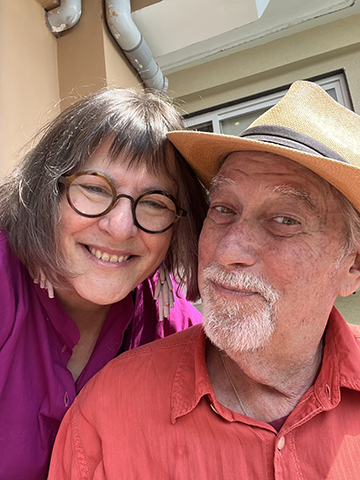
Linda Shore and her husband David Barker, Sonoma residents for the past 20 years, have traveled to Northern India a dozen times to teach science to Tibetan Buddhist monks. The couple bring some unique talents and experience to the task; both were long-term employees at San Francisco’s Exploratorium, the hands-on science museum started in 1969 by Frank Oppenheimer, brother of the noted physicist Robert Oppenheimer who led the Manhattan Project during World War II.
The Science for Monks project was started 25 years ago through a combination of efforts. The Dalai Lama, expelled from Tibet by the Communist Chinese in 1950, has always had an interest in science, and has explicitly expressed his opinion that if Buddhist ideas are proven wrong by science, Buddhism should change. As head of the Galugpa Buddhists, one of a handful of Buddhist schools and considered the most intellectual, the Dalai Lama welcomed the program with open arms.
Backed by the philanthropy of Bobby Sagar, the program began in the year 1999 after Sagar and the Dalai Lama met in Los Angeles and agreed to initiate a program of teaching science in Buddhist monasteries.
As noted in his 2012 book Beyond the Robe, Sagar quotes the Dalai Lama’s thoughts about science and Buddhism: “I believe a close cooperation between these two investigative traditions can truly contribute toward expanding the human understanding of the complex world of inner, subjective experience that we call the mind.” So Science for Monks began.
Linda Shore grew up in San Francisco and has a doctorate in education from Boston University, with an emphasis in astronomy teaching and learning. She originally had intended to earn her doctorate in theoretical astrophysics but discovered a preference for teaching rather than scientific research. While at the Exploratorium, she pursued ways to help teachers engage students in ways that provided them with Exploratorium-inspired inquiry experiences where they could discover things by themselves, rather than simply memorizing facts and figures. She listened to teachers and what they said they needed, and then advised schools by creating curriculum that is now used throughout the Bay Area.
“When I was at Boston University studying astrophysics I discovered that you could get a doctorate in education, in science education, and that intrigued me. I switched departments and the rest of my career was in education. It was always focused on astronomy; I was at the Harvard Smithsonian Center for Astrophysics. From there it was to the Exploratorium,” she explained, “where I spent two decades from 1993 to 2014 running the middle and high school teacher program.” She later became the CEO of the Astronomical Society of the Pacific, a professional astronomy society started in San Francisco in 1889 that supports both professional astronomers and astronomy educators.
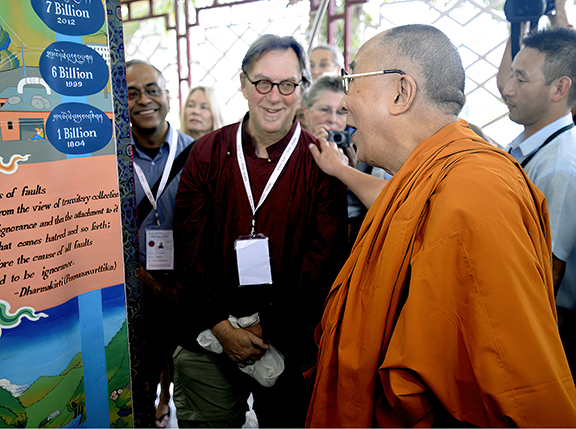
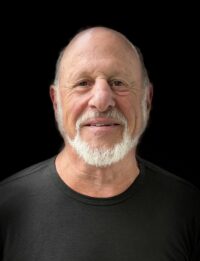
David Barker (pictured with the Dalai Lama) is a musician and graphic artist who has always had a deep interest in science. His role at the Exploratorium included creating display graphics and teaching tools. The style of the Exploratorium is to stimulate curiosity and exploration rather than dictating conclusions and outcomes. The hands-on displays and exhibits are a combination of fun, visual or tactile experiences, and information that contributes to learning. It is those qualities that have been incorporated into the Science for Monks program (which now includes Science for Nuns).
“As a kid, I was always interested in science, collecting pond water to observe under my microscope. I had a home chemistry set, and I idolized Albert Einstein,” David says, “I tried to explain nuclear fusion with ping pong balls in a science project. I was also drawn to drawing and painting and making music. I went to UC San Diego to study physics in 1969 and ended up doing posters for my friend’s band. At that time, physics was becoming more and more mathematical and a lot of physicists were being groomed to go into the defense industry, which was not attractive to me at all.”
After taking some philosophy courses he came to the conclusion that he was an experimentalist, and liked to get his hands dirty. “I shifted over to art, transferred to the University of Santa Barbara, and became a freelance artist. I also played a lot of music. Not long thereafter a girlfriend told me about a job at the Exploratorium. I felt like I’d died and gone to heaven and stayed there for 30 years.”
At the time, The Exploratorium was a collection of brilliant, and as David puts it “strange, creative, opinionated, seemingly otherwise unemployable people” under the direction of Frank Oppenheimer. David loved playing with the exhibits; they were all about perception and basic hands-on science. He did a little bit of everything: exhibit graphics, creating exhibits, and publishing a bi-monthly magazine. “The people there were amazing,” he recalls, “It was in my mind the museum’s Golden Years.”
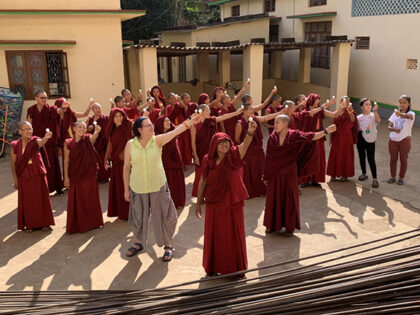
While both were working at the Exploratorium, they became involved with each other, and the leadership of the Science for Monks project soon discovered that their combination of skills and interests were a perfect fit for the project’s goals – to introduce monks to western science, help them learn to use hands-on experiences to teach others, and design science exhibitions that could travel to monasteries throughout India.
“We’d been creating table-top versions of exhibits for next to nothing that kids could explore, and this approach was perfect for the Science for Monks program,” Linda recounted, “they would use native, local materials.”
Bobby Sagar and the Dalai Lama initiated the idea of Tibetan teachers and monks incorporating science into their education. Sagar went on to fund the project, which includes teaching the Tibetan teachers how to teach science. Around fifteen years ago, they approached Linda and asked if she would help with creating the astronomy part. “The monks were primarily interested in cosmology, quantum mechanics, neurology, perception and the environment,” she noted. She invited David to accompany her on her first visit to India in 2009 and they have been back every other year since. Notably, all the monasteries now teach science. “For them, it’s an entirely different way of learning,” David added.
“Discovery appeals very much to their culture; the monks are very playful. And debate is part of their culture. At some point, it ‘clicks’,” Linda says. “Their knowledge of astronomy was thin, for example, but their vocabulary was the same. We all have words for what we’re seeing. Unlike here in America, they have no fear of science and math. Their ego’s are not in it. They aren’t afraid to be wrong and learn new things.”
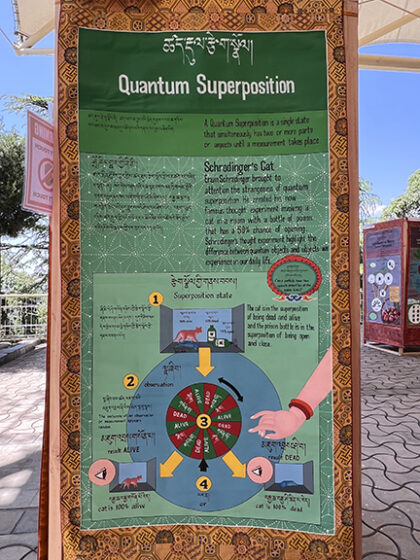
David’s contribution evolved into assisting the monks in creating traveling exhibitions exploring the relationship between Western science and Tibetan Buddhist beliefs, including the Senses, Climate Change, and the Nature of Matter. Creating the teaching exhibition included engaging traditional Thangka painters who would create the final hand painted displays, featuring both English and Tibetan explanations. The two hope that a record of all the exhibitions will be collected and printed in a coffee table book that can be distributed in the West.
Now that the program has been in place for so long, the time is ripe, they believe, for the Tibetan wisdom and understanding of self, culture and society to travel westward. “We have a lot to learn from them,” they explained, “They are the astronauts of the mind.”




Be First to Comment