
by
aw enforcement officers will be banned from interfering with California elections under a new law Gov. Gavin Newsom signed Wednesday, just in time for the June 2 primary election.
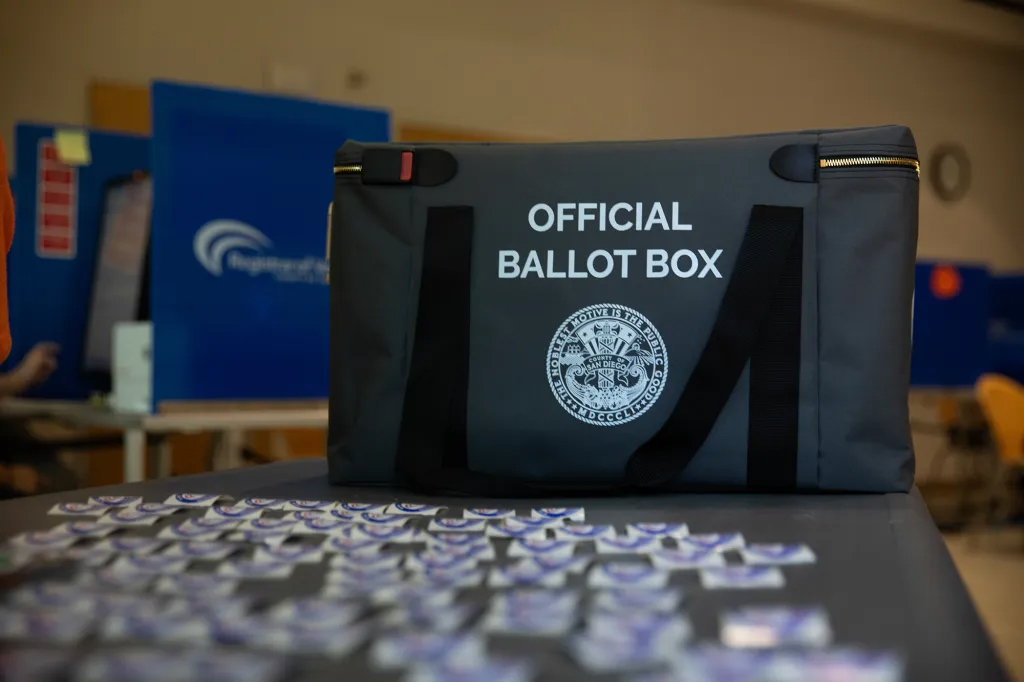
The law, which takes effect immediately, criminalizes the act of taking cast ballots from the custody of a local election official, as gubernatorial candidate Riverside County Sheriff Chad Bianco did earlier this year when he seized more than 600,000 ballots from his own county’s registrar of voters. Although Bianco claimed he was checking for proof of fraudulent voting, there was no evidence to suggest any ballots were cast improperly.
“We have to step up, and we have to draw the line. We have to clarify the rules of engagement,” Newsom told reporters before signing the legislation. “It’s a warning to the folks out there that think they can do the bidding of the Trump administration.”
State lawmakers originally introduced the measure, Senate Bill 73, to guard against potential federal interference with California’s elections, given the Trump administration’s animosity toward the state and the president’s desire to keep Congress in GOP hands.
But Bianco’s decision to seize ballots turned a hypothetical threat into a real one, spurring legislators to seize the moment and rush the bill through so it could take effect before Election Day.
The new law makes it illegal for a county registrar to surrender ballots or voting equipment to law enforcement agents such as Bianco or his deputies. Riverside County Registrar Art Tinoco would have violated the law by allowing the sheriff’s department to take the ballots, despite the search warrant they presented.
“Voters should never wonder whether ballots were improperly handled,” said Assemblymember Gail Pellerin, one of the bill’s Democratic coauthors and a former Santa Cruz County registrar. “And law enforcement powers should never be misused in ways that jeopardize the integrity of our democratic process.”
The law also reiterates that the attorney general, secretary of state or local county elections officials can sue any person, business or entity that takes “a package containing ballots” from an election official’s custody.
Election and voting advocates praised the Legislature for responding quickly to what they say was an “unprecedented” act of local law enforcement seizing ballots from an elections office.
“That never happened anywhere in the country before,” said Kim Alexander, president of the nonprofit California Voter Foundation. She added that the Legislature’s decision to push for this law shows voters “they are aware that something unprecedented has taken place.”
Legislators included safeguards in the law that allow the attorney general and secretary of state in some circumstances to override the authority of a county election official — such as if a registrar permitted armed personnel to stage near polling places.
Those override privileges are pointed, preemptive maneuvers likely spurred by the threat of a rogue county election official such as Shasta County’s embattled registrar of voters, Clint Curtis. The self-proclaimed “elections integrity advocate” lived in Florida and had no experience administering elections before the county board of supervisors appointed him registrar in 2024.
Lawmakers are seeking to ensure state officials are “able to override a local effort to undermine the state’s rules,” Alexander said. “This is not the first time the state is being responsive to events happening in Shasta County.”
Curtis has aligned himself with 2020 election deniers, publicly expressed skepticism about voting machines and significantly reduced the number of ballot drop boxes in the county. He faces several accusations of workplace violence and harassment, including threats to drag staffers out of his office by their hair. Curtis has denied all accusations.
The new law also prohibits any individual from allowing any law enforcement agent to “access, disrupt, modify or take possession of” any voting technology without a court order.
Another provision prohibits election observers from challenging voter signatures. Last fall, the U.S. Justice Department, at the request of the California GOP, announced it would send election observers to California for the special election on Proposition 50, which sparked fears that President Donald Trump was meddling in an effort to change the outcome.
Ballot seizure is just one way outside actors could interfere with California’s elections, Alexander said. Another is the state’s lengthy ballot counting process, which has fueled conspiracy theories and baseless claims that the results should not be trusted.
Advocates are pushing Newsom to include about $55 million in the state budget for county election offices to buy new equipment and hire more staff to speed up counting.
Newsom told reporters Wednesday that funding negotiations are “very, very positive” and “we’re going to land on a number very, very shortly.”
Photo by Adriana Heldiz, CalMatters








Be First to Comment