
Mushrooms seem to be everywhere right now, pushing up from the earth through damp, disintegrating leaves and mud, growing on logs and trees, or popping up in lawns and gravel landscapes.
The abundance of mushrooms has attracted lots of attention from nature lovers as well as warnings from county health officials, because many good-looking mushrooms are poisonous. About 35 people across California have already gotten very ill from eating the wrong types, and several have died, including one person in Sonoma County who officials believe died from ingesting wild mushrooms.
While foraging for wild mushrooms to eat is a special pleasure for many, experts warn that the best approach is to just not eat wild mushrooms. Whatever choice you make, you may want to hook up with the Sonoma Mycological Society at sonomamycology.org. For most of us, admiring and photographing wild mushrooms is the best bet – not eating them.
All mushrooms are fungi, but not all fungi are mushrooms. Fungi comprise a large group of organisms that include mushrooms, as well as molds and yeasts. The usual mushroom that we see is the fruit of the fungi organism that grows mostly underground in the form of tiny branching webs of mycelia. The wonderful film “Fantastic Fungi” delves into the world of fungi in a magical and memorable way.
At the recent 2025 Mushroom Bioblitz on Sonoma Mountain, fungi seekers found 54 species, which is the second highest count for the annual event, after 75 were counted in 2023. Sonoma Mountain Preservation (SMP), based in Glen Ellen, joined forces with the Fairfield Osborn Preserve and Sonoma State University to sponsor the popular mushroom hunt. The full list of species is not posted, but INaturalist shows a total of 537 observations of 144 species of fungi, including lichens, at the Osborn Preserve. You can find the details at iNaturalist.org. More than 1,000 species of mushrooms have been identified in the Sonoma Valley area based on observations posted on iNaturalist.
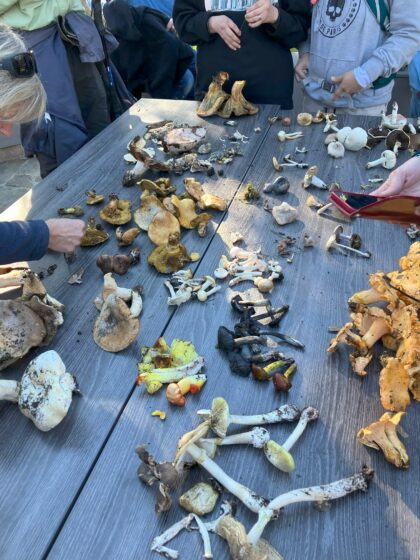
Sonoma CalNaturalist Nancy Evers Kirwan, of SMP, who helped organize the mushroom bioblitz, shared a photo of the multiple mushroom specimens from chanterelles to Death Caps found by the participants and identified by the mycologist from Sonoma State who was leading the walk.
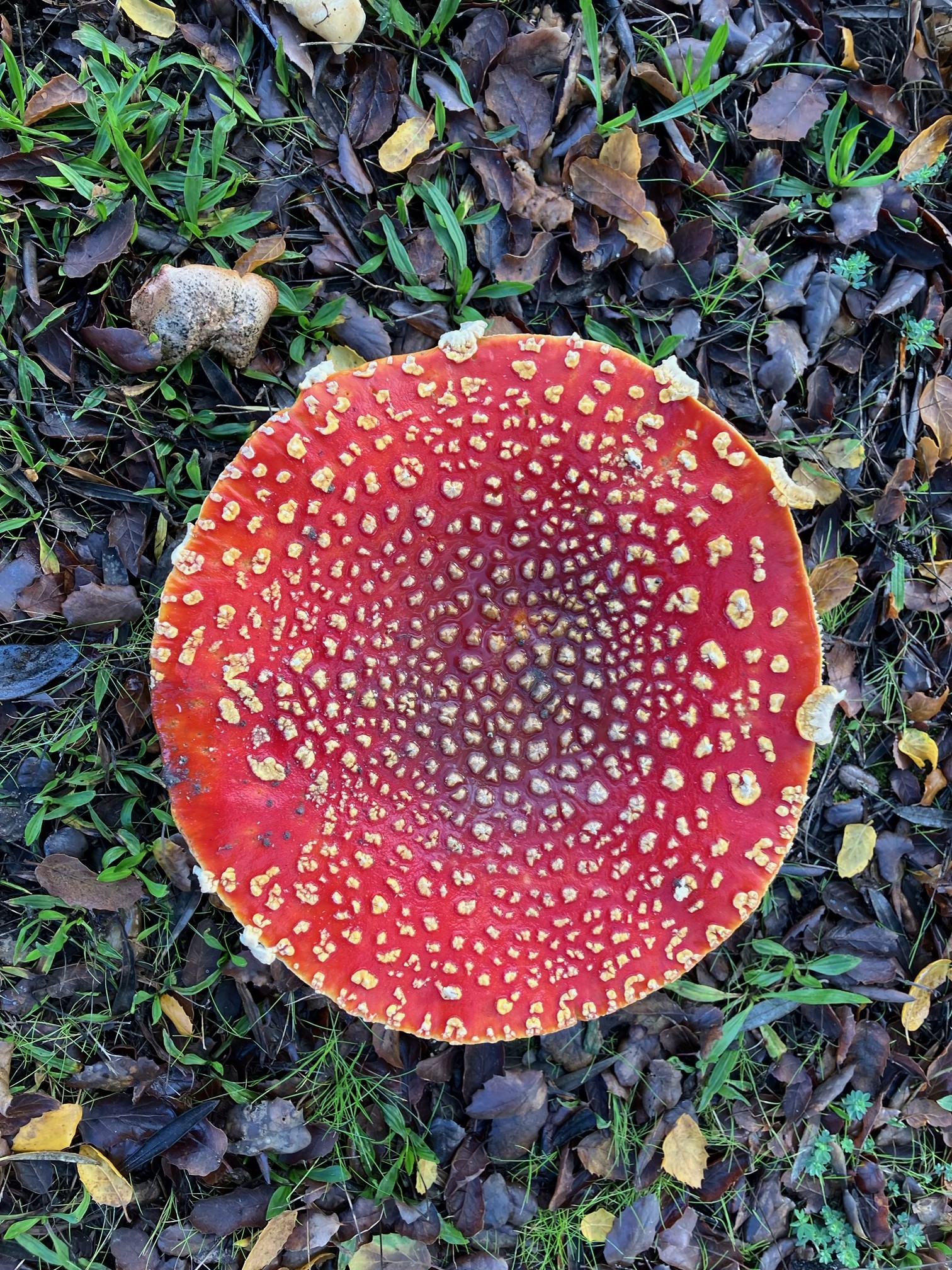
Nancy also took me down one of our rural roads to see one of the flashiest mushrooms around, the big red spotted Amanita muscaria (Fly Agaric). It is native here, but apparently also grows around the world and was used as an insecticide against flies, and was sprinkled into milk in medieval Europe. Do not eat.
While walking through the burned piles at Sonoma Valley Regional Park, I noticed big clumps of caramel-colored fungi flowing in fanlike layers from charred wood that I never noticed before. It turns out that they are Omphalotus olivascens, known as the western jack-o’-lantern mushroom. It grows only on wood and is native to the West Coast of the U.S. Once again, do not eat.
Over on the trail in Maxwell Regional Park, some spindly looking white fungus caught my attention. Like spindly fingers emerging from the soil, they are in fact called Fairy Fingers Clavaria fragilis. They are quite widespread around the world. I wouldn’t eat.
Then of course there is the Death Cap, Amanita phalloides, the deadliest of all mushrooms. It is usually white, and has the classic shape of a mushroom with a short stem and rounded-to-flat cap. Ingesting less than half a mushroom can kill an adult person. It is responsible for 90 percent of all human deaths from mushrooms every year, causing liver and kidney failure. The problem is that the mushroom looks very similar to some types of edible species. The Death Cap is not native and was brought to the U.S. from Europe.
When not poisonous, some types of mushrooms are consumed for medicinal, recreational and even spiritual purposes. Psilocybin mushrooms, aka “magic mushrooms,” grow all over the world. Today they are being used in some therapy treatments. Of course, back in the day, some of us Boomers may have tried them a time or two just for fun; and laughed ourselves silly—after a short spell of vomiting.
In any case, if you are now suddenly in the mood for a nice hot mushroom soup, I can send you an easy recipe from a friend who uses the boring old store-bought white mushrooms.




Right on cue, several troupes of red-topped, white-spotted Amanita Muscaria, those most charismatic of macrofungi, just bloomed in front of the Sonoma Valley Library, right alongside SR12.
Beware galloping reindeer!