
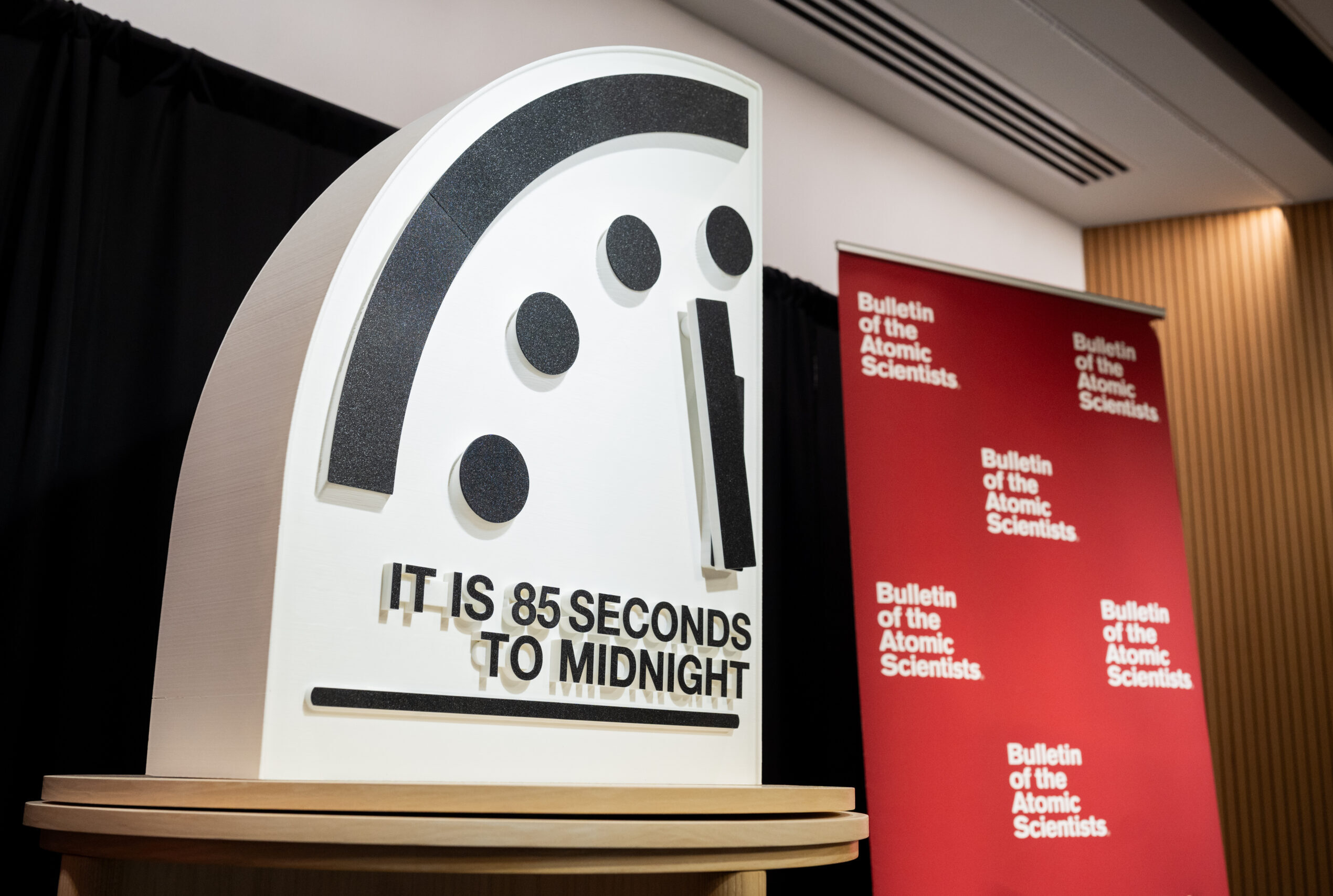
“We’re doomed,” said my therapist.
It was a notable moment that has stayed with me over all these years. He was a Jungian – not a school of psychotherapy known for being pessimistic – and he made this announcement while we were discussing humanity.
I’ve thought about it often, and depending upon the flavor of the day, I alternate between grudging agreement and resistance. It’s not like the doom scenario is a tough case to make. The Doomsday Clock stands at eighty-five seconds to Midnight; global temperatures continue to rise; microplastics litter the insides of our bodies in great abundance; conspiracy nuts and racists hold positions of great power in our government; the yearly value of global arms sales tops $700 billion. You get the picture.
In a way, the thought of Doomsday has been hanging over me since I was in grade school. I’m old enough to have been taught to “duck and cover” under my desk as if it was possible to survive an atomic bomb attack. In 6th Grade my friend Jimmy told me his father had built a bomb shelter under their house. I wondered if my father had a Geiger Counter.
“Doom” is a powerful word that carries more meaning than simply death; it implies dreadful, inescapable suffering. To be doomed is far worse than dead. I’m not sure if by “doomed” my therapist meant the two of us, contemporary civilization, the whole of humankind, or Earth altogether. At the time, I took it to mean humankind, and there certainly are many ways in which we suffer. Just look around.
My resistance to being doomed is more a matter of hope than logic. We seem to be blindly racing towards a cliff despite the many warning signs. It reminds of the succession of New Yorker cartoons I used to collect as boy of men in sandwich boards standing on the sidewalk proclaiming, “The End Is Near” as a passerby asks, “Do I have time for lunch?” It raises the question: Are we asleep or are we woke?
Woke has had a tough time of it as late and has become not just an insult but the rationale behind an entire political movement. For a time, “Better Dead Than Red” was a leading political slogan, but today “Better Dead Than Woke” is driving domestic and international policy decisions. In some strange way, for many Woke has become synonymous with Doomed.
In his fabulous 1949 book All and Everything, Beelzebub’s Tales to His Grandson, the famed Armenian mystic G.I. Gurdjieff wrote that humanity had forgotten about the certainty of death. His fable told the story how higher beings had compassionately placed a mythical organ known as the Kundabuffer within human bodies. Its purpose was to soften the blow of existence which drives us all in a headlong rush towards oblivion. The Kundabuffer, so Gurdjieff’s fable explains, buffers or deadens our awareness and capacity to see our situation clearly. It lulls us and keeps us comfortably asleep, kinda like Netflix, I guess.
Wishful thinking, what we sometimes call hope, is a Kundabuffer. Despite ample evidence of our jeopardy, we cushion our fear and comfort ourselves. Not only do we forget about death, but we also end up ignoring the devastation we are inflicting on our own species and planet earth itself. The civilization we live in is one we have created through our beliefs and behavior, and only by awakening to truth and changing both – and quickly – will we be able to avoid our doom.



Be First to Comment