
By Larry Barnett
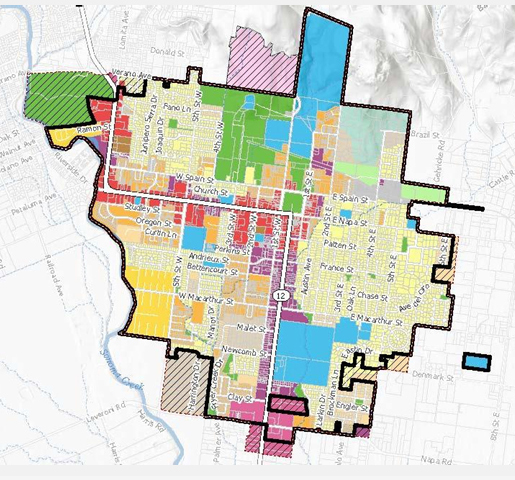
The discretionary decision-making authority of jurisdictions like The City of Sonoma about local land use, particularly housing, is now severely limited by state legislation. What was once a matter of applying community sentiment, political will, and local support is now a matter of conformance with rules, regulations, and costly state mandates.
Historically, housing was created by three means: by market-rate developers, through government subsidies to nonprofit housing developers, and by inclusionary housing requirements. Market-rate developers would acquire land zoned for housing of various types, submit applications and plans, get permit approval, and then build and sell the homes. Development code standards covering building sizes, heights, driveways and construction based on state building codes have always been applied. Some limitations on design applied to historic homes and applications for projects in historic districts.
Subsidized housing was funded by Redevelopment Agency revenues, which itself was provided through receipt of a portion of property taxes collected by the State. In order to qualify for that state funding, the Redevelopment Agency had to be in a “deficit” condition, that is it had to have committed its funds to a future project. On this basis, multiple subsidized housing projects were created, what we now call Affordable Housing.
In the 1990s, the City of Sonoma and other jurisdictions enacted “inclusionary housing” laws that required market-rate developers to dedicate a percentage of the housing (currently 25%) they create for Affordable Housing, using established percentage levels of the Area Median Income of a buyer or renter to qualify, ranging from extremely low to moderate.
When Redevelopment Agencies were eliminated during Governor Jerry Brown’s final term in 2012, the state’s funding for Affordable Housing was eliminated also. This brought down the creation of Affordable Housing locally to essentially zero, except for those units built under the inclusionary housing requirements.
Despite the absence of state funding, California has nonetheless imposed Affordable Housing mandates on every jurisdiction, using what is called the Regional Housing Needs Assessment (RHNA), which in the case of Sonoma and Sonoma County is undertaken by the Association of Bay Area Governments (ABAG). The RHNA sets targets for each economic level of housing covering an eight-year period. All jurisdictions must confirm with the State Housing Authority that they have enough properly zoned land to accommodate their RHNA housing target.
What is now commonly called California’s housing crisis is primarily a housing affordability crisis, and the state has turned to market-rate developers to solve it. The state approach has been to usurp the approval authority of local jurisdictions. Over four dozen new laws regulating land use authority have been passed into law during the past three years.
For example, a large housing project often would require many public meetings to gain final approval. Cities are now limited under SB330 to only five public meetings for the consideration of a project proposal, no matter its size. This is part of a “streamlining” process intended to speed up housing development.
SB9 allows the splitting of residential lots and the creation of up to four units where there had previously been one. As long as an SB9 lot-split application conforms with all its provisions, it is allowed by right. SB35 requires ministerial approval of “in-fill” projects and eliminates public hearings altogether. A variety of ADU (Accessory Dwelling Unit) laws allow for their creation without any public hearings.
These and other laws are intended to stimulate housing creation, but do not address affordable housing specifically, relying instead on market-rate forces of supply and demand to produce housing at various prices.
Another major change imposed on local communities like ours is the state requirement that development code language be “objective” rather than “subjective.” Accordingly, criteria such as “neighborhood compatibility,” “historical context,” and “community character” are no longer legitimate when project applications are considered for approval. Essentially, the idea of identifying and maintaining a sense-of-place has been eliminated in all but historical districts. Objective standards, according to the state, must be quantifiable, meaning not subject to interpretation, in other words, numerical. In some sense, local housing land use planning by the local community has effectively been reduced to a bare minimum.
Despite all the new regulations, statewide housing starts remain flat, basically where they were before all these new laws were passed, at roughly 100,000 units created annually, far below projections. Expectations by the public that local government be responsive to neighborhood concerns and objections, however, remain strong. The inability of the Planning Commission and City Council to control the style, size, density and location of new housing will continue to be an issue in the years ahead.
Larry Barnett is currently a member of Sonoma Planning Commission, its past Chair, served on the Sonoma City Council for 12 years and as Mayor twice. He is the Executive Director of the Sonoma Valley Sun Newspaper.





Be First to Comment