
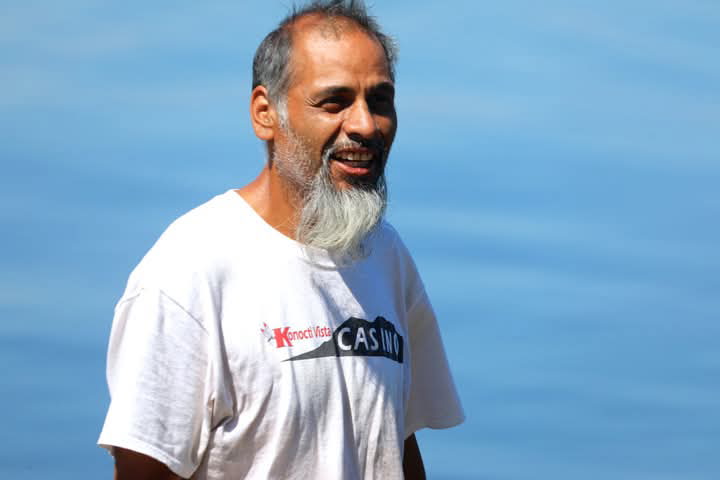
Joe Weber, a Pomo-Lakota native who was raised in Sonoma, and raised his own children here, spoke with Anna Pier about his journey toward understanding the past, and working for the future.
Please talk about your background. My name is Joseph Weber. I’m half Pomo from Big Valley Rancheria, and half Lakota from Pine Ridge Dakota. I’m a Cultural practitioner, tribal member and elder of Big Valley. My connection to Sonoma runs deep. Not just because I grew up here and raised a family in this town. It’s the blood tie to this land through my native side.
I was adopted when I was two and my sister was three. My grandmother had been raising us, and when she died, they took us, and put us up for adoption. I was adopted by a loving family, Fran and Dan Weber, who raised us here in Sonoma. I have three younger siblings, Jason, Marissa and Brian. We were all Sonoma Valley High grads.
After high school I went in the Navy. I served for four years, and was honorably discharged.
My mother, Fran Weber, was a strong advocate in the schools about the IEP (Individual Education Plan) process. My father, Dan Weber, was a commissioner with Schell-Vista Fire. And we kids were all volunteers with Schell-Vista. I went through the apprenticeship program, and was an EMT, while I was a single father of four kids. I have one son, Daniel, and three daughters, Michaela, and the twins – Keena and Desirae. They are all Webers, and I raised them here in Sonoma.
I connected with my native family after my daughter Michaela Weber was born. When I was adopted, I lost my ties to the native side. I wanted my children to have a choice I didn’t have, be a part of the native culture or not.
From there, we learned our culture together. All my children were involved. I love the beauty of our culture. What my mother, Patricia Hopper, and her Uncle Nelson, taught us; and her two sisters, Gen and Paula Hopper; her brothers, Marx, Cal and Gus Hopper; my elders on the Rez, Uncle Ron Montez, Karen Toledo, JoJo and Dave Smith, to name just a few. They taught us to sing, dance, medicine and land stewardship. And balance, and what role our people will play in it.
How did you decide to move to the Big Valley Rez? Moving to the Rez (Big Valley Ranchería, Lakeport) was a hard choice for me. I kept my name, Weber, out of respect for my adoptive parents. Growing up in the white culture of Sonoma has given me a lot of tools which I can use to bring awareness, understanding and connection. I try to bring good medicine.
How did you make the choice? I got involved with native peoples when I knew I was going to have a kid. I wanted her to have a choice. I hired a private detective to find my mom. Almost eight years ago I moved to the Rez. I bought the land where I’m living. In 2020, I was voted into office as the Housing Community Chairman. I served for four years. And as Tule Boat Instructor for 15 years.
Talk about taking care of the earth. To me the heart of Sonoma is the land, and we are just lucky to be able to steward the land while we are here. You can be stewards of this land whatever your ethnicity. The earthquake we just had up in Mendocino, that was just Mother Earth reminding us, “you’re here, you’re alive, it’s not too late.” The Creator woke us up for a reason. Reminding us to take care of the land, all of us.
What about burns? At Schell-Vista, and from my father and my brother Jason, I learned about controlled burns, to keep the fire within a certain perimeter. And now I know about cultural burns. You need the fire to stay a certain amount of time for the plants – for instance, for the hazelnut pollen – to fall, to generate new trees.
What’s the role of the state? We are trying to bring back the Hitch, which was an important fish for our people. The Split-tail Hitch is already extinct. With a group of natives from the seven different bands of Pomo around the Clear Lake area, I went to the Water Board, and to the California Fish and Wildlife Commission in 2022 to testify about it.
We don’t need the blessing of the state to continue our culture, the Missionaries with their message and ideas. They gathered the surrounding tribes to build their Missions and grow their grapes. We bled then for this town. California gave the natives no rights till the occupation of Alcatraz that ended in 1971. Then with passage of the ICWA – Indian Child Welfare Act– in 1978, this affected all of the country, not just California, Sonoma.
When my kids went through the school system we danced for the students. Trying to bring awareness. We danced in the Mission so that our ancestors buried in the street knew their good medicine is still going. The plaque is nice to remember. I have been coming on Thanksgiving to say a prayer and sing a song in our native tongue. I do this so my ancestors know their sacrifices did not go in vain.
The photo in front of the shadow silhouettes on the wall of the Servants Quarters at the State Historic Park on the Plaza. That’s me, and my son, and my daughters as well, they’re in the shadow too. My people are in the shadow.
My uncle and I danced at the Mission. My daughters and I danced at the rally in Maxwell Park in 2020. We’re still here – in the shadows.
Tell me more about trying to bring understanding, connection. We are working to bring awareness. My Uncle Ron and my cousin Grace Martinez are building a museum on the Rez. My daughter and I have been helping, by getting our artefacts back from places like Sonoma State University. We inventory them at the college to make sure we have the right items.
When you bring, say, an arrowhead you’ve found, into your home or a classroom, you’re bringing into the building all the trauma that arrowhead experienced. Maybe it was used by a young man when he shot his first deer; but maybe it was used to kill a white man attacking us.
The archeologists are always wanting to learn about our culture by just digging. They should just knock on the door and ask our people. Find out about their life, their customs. I go to the Basketweavers Association to find out the traditions, to learn which plants were used.
Please talk about the tule. The tule is a way of life for our people. We use them for mats, nets, boats, dwellings. You can even eat it. When it is old, used up, we give it back to the water.
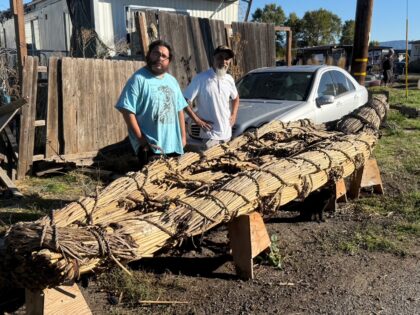
Tell me about building tule boats. I was Tule Boat Instructor for 15 years. I built a boat that won the Tule Boat Relay, I donated it to the museum in Sonoma. There’s an annual Tule Boat Festival – this year July 23-25. The first day is at the State Park, then at the Big Valley Ranchería. Last year, my son Daniel took over as Tule Boat instructor. It is truly an honor to see him following his traditions.
Talk about Sonoma. I love Sonoma. I grew up here. I’m a Sonoma Dragon for life. My kids are all Dragons for life. But, you know, there’s a mass grave of my people between the Mission and the Barracks. That’s why the memorial wall is there. When I come there, I always say a prayer. But that statue of General Vallejo belongs in the Barracks. Vallejo contributed to that mass grave. What they call “servant quarters” at the State Historic Park, we know it was a lock-up. It’s not right that my people have to walk by that statue.
Sonoma has come a long way in helping make a change and started to work with the 1st Nations. From the plaque in front of the Mission, to the Natives in the street. To bringing back the Shake-head dance to the Mission. The Shadow Mural on the Servant Quarters in the State Historic Park. To dancing and lecturing in our school classrooms. The schools have a way to go, some are still building sugar cube missions as their California history project.
Missionaries found out something about indigenous influences. White people only got bits and pieces of our history. If we’re going to teach history, let’s teach the whole history. Let’s teach the truth. I don’t want to persecute Vallejo; but I want to tell my own truth. Let’s be truth-tellers of history.
Growing up in Sonoma. When I was in grade school, I always wanted to be a pilgrim, but they always made me wear the feather bonnet. But I have good friends here that I made all through school.
Talk about your heritage. My father was Lakota, Pine Ridge tribe. My mother was Pomo. When I found her, through the private detective, I asked her how she knew my father. It seems they met at the Alcatraz Island occupation.
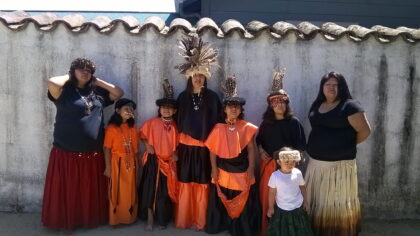
Eight years ago I moved to the Rez, Big Valley Band of Pomo Indians, “A sovereign nation.” We need to understand our sovereignty, act sovereign. That means collaborating with others to steward the earth. We need to be a tribal coalition, come together as one. Working on healing together and helping the public understand historical trauma. It’s still here, but we can take little steps to help. One would be to move the statue of General Vallejo to the Barracks across the street. This way people can view him in his area and not affect your native community that view him in a different light.
Last thoughts? Our traditions will live on in me and my children. Our songs, dance, food, medicine, cultural burns, and Tule Boat festival, will continue to get stronger. Sonoma’s history is not pretty, but if we don’t learn from it then we are doomed to repeat it. I appreciated the land acknowledgment in August 2024.
It’s an honor that the Sonoma Valley Sun wants to recognize the 1st people of this land. We are all looking for that connection in people. All we need to do is look down. It doesn’t matter what race you are, Italian, Spanish, Japanese or Natives. If we don’t take care of the Earth we all suffer the same fate.
A message for our Sonoma community? Work with the Mission and Vallejo’s Barracks on honest history. Once again, move the statue of General Vallejo. Bring education in the schools on local tribes. Work with local ranchers so we can have access to our traditional plants and medicines. Stay Sonoma Strong and have a blessed day from your local Native Veteran Dragon for life.



Be First to Comment