
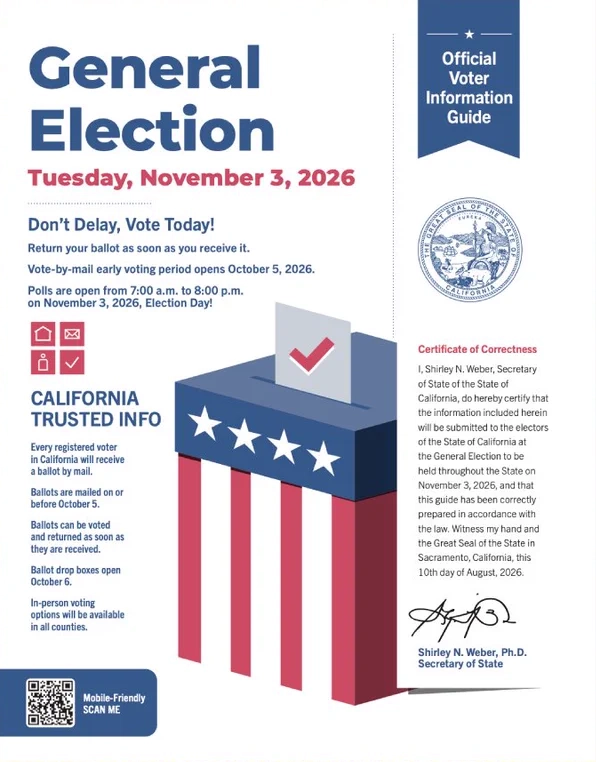
Voters will make decisions on topics of housing, government fee increases, state finances, recall elections and more.
PROPOSITION 1
California’s housing crisis is on the ballot this November, and it carries a multibillion-dollar price tag. If passed, Proposition 1, also known as the Veterans and Affordable Housing Bond Act of 2026, would approve $11.25 billion for low-income families, farmworkers, students, foster youth, and veterans.
+ Proposition 1 – Voter Information Guide
PROPOSITION 2
California voters will decide this fall whether to approve Proposition 2, a measure that would double the cap on the state’s rainy day fund from 10% to 20% of annual tax revenue. California’s rainy day fund, approved by voters more than two decades ago, has helped the state navigate financial challenges, including the pandemic and budget shortfalls, while protecting funding for schools, public safety, and other critical services.
+ Proposition 2 – Voter Information Guide
PROPOSITION 3
California voters will decide whether to make a temporary higher state income tax on California’s wealthiest taxpayers permanent. It’s on this year’s ballot as Proposition 3.
Voters first approved the temporary tax in 2012. It was renewed in 2016. It’s currently set to expire in 2031.
+ Proposition 3 – Voter Information Guide
PROPOSITION 4
Proposition 4 would allow politicians who are running for public office to have their campaigns funded with taxpayer money if they can meet certain thresholds showing the viability of their campaign.
+ Proposition 4 – Voter Information Guide
PROPOSITION 5
Voters are being asked whether they want to change the rules for recalling California state leaders. Proposition 5 would limit recall ballots to just one yes-or-no question: Should an elected official be recalled from office? Currently, recall ballots also have a second section where voters are asked to choose a successor if the recall passes. Prop 5 would eliminate that second section. If the recall passes, a new leader is chosen later in a separate process.
+ Proposition 5 – Voter Information Guide
PROPOSITION 37
Proposition 37 proposes a $25 billion loan program to help California residents overcome the challenge of affording down payments on new homes. The measure, authored by former state Senate Majority Leader and California Assembly Speaker Bob Hertzberg, would allow the state government to issue bonds to help residents borrow up to 17% of their down payment, requiring them to contribute at least 3% themselves, while their primary mortgage would cover the remaining 80%.
+ Proposition 37 – Voter Information Guide
PROPOSITION 38
Voters are being asked to decide if public money should fund research into medical challenges that touch many California families. Prop 38 would direct the state to issue $8.4 billion in bonds for immunology and immunotherapy research.
+ Proposition 38 – Voter Information Guide
PROPOSITION 39
Proposition 39 requires government-issued ID at the polls or the last four digits of the ID number for mail-in ballots. Elections officials would also be required to annually report the percentage of voters with verified citizenship.
+ Proposition 39 – Voter Information Guide
PROPOSITION 40
Proposition 40 asks voters to approve a one-time, 5% tax on the assets of California residents with a net worth of a billion dollars with the goal of raising $100 billion to fund mostly healthcare programs.
+ Proposition 40 – Voter Information Guide
PROPOSITION 41
This proposal is in response to the proposed billionaire tax, requiring strict oversight of how new taxes are used and prohibiting any new taxes that are exempted from the state’s spending limit required under the state constitution, meaning it would cancel out the billionaire tax. The measure with the most votes becomes law.
+ Proposition 41 – Voter Information Guide
PROPOSITION 42
Proposition 42 is meant to defeat the billionaire tax, and if both pass, the one with the most votes becomes law.
+ Proposition 42 – Voter Information Guide
PROPOSITION 43
California voters will decide in November whether to approve Proposition 43, a measure that would make it more difficult to pass new special taxes in cities and counties. Currently, local governments such as city councils or county supervisors can propose special taxes, which require approval by a two-thirds vote from residents. However, special taxes proposed by citizens or special interest groups only need a simple majority to pass.
+ Proposition 43 – Voter Information Guide
PROPOSITION 44
A measure aimed at changing how community health clinics spend taxpayer dollars is heading to the ballot box this November. Voters will decide the fate of Proposition 44. Supporters say it will increase accountability, but opponents warn it could threaten services patients rely on.
+ Proposition 44 – Voter Information Guide
PROPOSITION 45
Proposition 45 would change parts of California’s Environmental Quality Act to speed up environmental review of housing, transportation and other infrastructure projects. It would also limit the ability of lawsuits to stop or slow a project.
+ Proposition 45 – Voter Information Guide







Be First to Comment