
By David Bolling
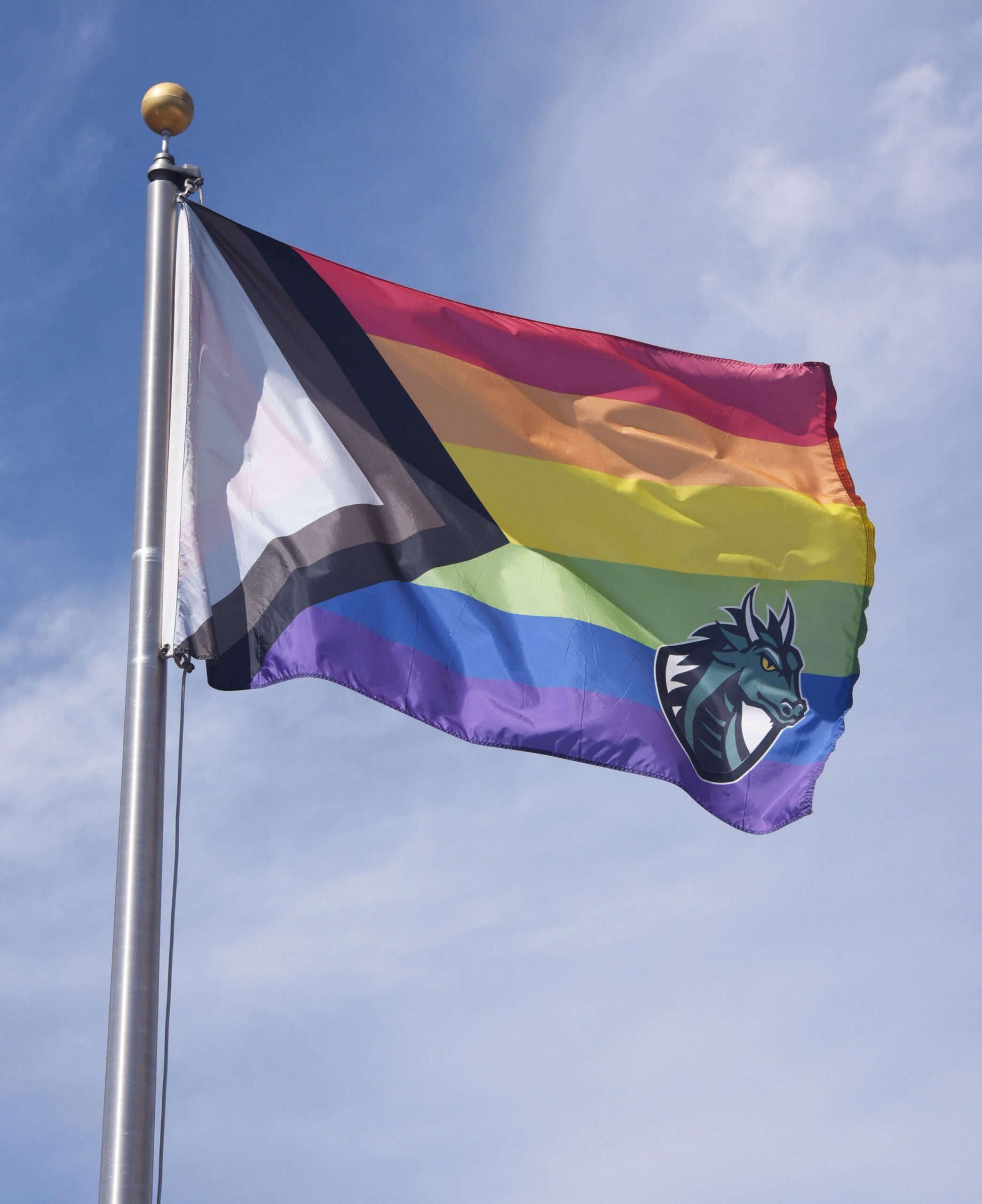
After a marathon meeting on September 10, a sharply-divided Board of Trustees for the Sonoma Valley Unified School District kicked the pride flag down the road, delaying a decision on whether or not the universal symbol of LGBTQ+ rights and alignment – the rainbow flag – could continue to fly over the school.
But the Board’s failure to forge a simple solution left a wake of anger, confusion and distrust.
The pride flag controversy erupted in January, after board president David Bell unilaterally ordered its removal, claiming the decision to fly the flag had never followed District protocol, notwithstanding the fact that the decision was made by then-Superintendent Socorro Shiels and then-high school principal Justin Mori in May of 2019, and the flag had flown during every school day since until Bell ordered its removal.
Opposition to Bell’s action was loud, angry and insistent, with large numbers of both gay and straight students demanding the flag’s return, as did numerous teachers and parents. At the behest of newly hired Superintendent Justin Sutter, the high school leadership team crafted a questionnaire to surface student opinion. The result revealed that 57 percent of the student body – 571 students – responded to the survey, and almost 40 percent of the entire student body supported the flag.
Other findings were sobering, as 27 percent of LGBTQ+ students reported they had seriously considered suicide in the past year, while only four percent of other students did so. And during the past year, LGBTQ+ students were bullied three times more often than non-LGBTQ+ students.
The flag, students and parents repeatedly claimed, was an important symbol of safety and security, proclaiming that difference was defended, that the school stood behind and beside students with different sexual orientation.
Addressing the Trustees on September 10 was a parade of mostly self-identified LGBTQ+ students, along with 25 adults, many of them parents, almost all of whom supported the pride flag.
The actual flag-focused agenda item scheduled for the meeting was to review and approve a set of options developed by newly appointed District Superintendent Jason Sutter, who devoted considerable time before and after his formal appointment to explore the pride flag controversy and craft solutions. After considerable consultation with SVHS administration and student leadership, he brought forth a pair of options for the Board’s consideration.
Superintendent Sutter offered two recommendations: One was that four flags – U.S., California, Pride Flag and School flags – continue to be flown on the school’s four flagpoles throughout the year, with the possibility of other flags flying alongside the pride and school flags. A second recommendation provided more qualified approval of “symbolic flags” recommended by the student leadership group, but with less assurances of approval.
Faced with what felt like a wall of pro-pride flag public opinion, the Trustee sentiment quickly diverged from simple consideration of the agenda choices, and divided into two camps, with Area 5 Trustee Anne Ching and Area 2 Trustee Gerardo Guzman supporting the first option – a flag policy to be worked out by student leaders, with the advice and consent of the high school administration and the Trustees.
Board President and Area 4 Trustee David Bell, who at times appeared to be field testing various positions, was adamant about one thing. “If you fly one flag, you have to fly every flag.” He argued that Christian students might want to have a flag supporting Christianity. That issue prompted a question to Superintendent Sutter, who responded it was his understanding that allowing religious flags would be considered problematic, but not necessarily illegal.
That statement ignores clearly articulated federal and state law holding that religious flags on government buildings violate the Establishment Clause of the First Amendment, which prohibits the government from endorsing a specific religion. Frequently cited on this issue is the U.S. Supreme Court decision in Shurtleff v. City of Boston, that determined flags flown on government flagpoles are considered “government speech.”
Meanwhile, Area one Trustee Catarina Landry expressed ever-growing objection to public comments in the audience, and threatened to have people removed. Landry repeatedly promoted what she considered a “reasonable compromise,” to allow the pride flag to fly during the last few weeks of the spring semester, to coincide with national Gay Pride Month. But she reiterated her complaint that “this whole flag thing is really, really, really messy.”
Less easy to interpret was the position of Area 3 Trustee Jason Lehman who, at one point in the back-and-forth, round-and-round discourse that had veered into how many flags some schools fly, burst angrily out with the statement, “I think this is insane! It’s insane. I won’t vote on it.”
Perhaps the most reasoned and least emotional voice in the room belonged to Austin Cheeseman, the Student Voice – the student representative on the board – who calmly suggested, “I feel the pride flag is not a belief. It’s a representation of no prejudice. You should leave it in the hands of the students it is representing. It says there is no bias in the school system. The pride flag encompasses everyone. Pride is diversity and inclusion.”
Cheeseman added, “I don’t really see our school system wanting more flags. If there is a student that does want to propose another flag, they could do that.”
In the end, the clearly exhausted Trustees voted to continue the decision to the next board meeting, which is scheduled for October 8 at 6 p.m.
Photo by David Bolling



David, this article leaves out an important part of the debate and, more importantly, gets a significant part of the First Amendment law backwards.
You write that *Shurtleff v. City of Boston* stands for the proposition that flags on government flagpoles are “government speech,” and use that to suggest a Christian flag would violate the Establishment Clause.
That is not what *Shurtleff* held.
The Supreme Court unanimously held that Boston’s particular flag-raising program was **not government speech** because Boston had opened the pole to private groups and exercised very little control over the messages. Boston then violated the First Amendment when it refused a Christian flag specifically because it was religious. The Court expressly said that when government is not speaking for itself, it cannot exclude a religious viewpoint simply because it is religious.
That distinction is pretty important here.
If SVUSD declares that these flagpoles carry only messages selected by the District as its own government speech, that presents one legal framework. If it creates a system where students or outside groups propose symbolic flags, that can present a very different First Amendment question. *Shurtleff* certainly does not establish a blanket rule that “religious flags on government flagpoles are illegal.” In fact, the actual holding should make anyone considering an open-ended student flag program think carefully about viewpoint discrimination.
The survey numbers also deserve a little more precision.
According to the article, 571 students — 57% of the student body — answered the questionnaire, and “almost 40% of the entire student body” supported the Pride flag.
That certainly shows substantial support.
But it also means that a majority of the entire student body did **not affirmatively register support for the flag in that survey**. We don’t know what the 43% who did not respond thought. Calling the survey evidence of student opinion is fair. Treating it as a settled mandate from “the students” would go beyond what those numbers establish.
The suicide and bullying statistics are serious too, and they should be treated seriously.
But statistics showing that LGBTQ students report more bullying and suicidal thoughts do not, by themselves, answer the separate policy question of which flags a public school should fly.
There is research associating affirming school environments with better mental-health outcomes for LGBTQ students. There are also important limitations: a major systematic review found the underlying studies were cross-sectional and examined the much broader concept of school climate, not whether putting one particular flag on an official flagpole causes a reduction in suicide attempts.
That distinction shouldn’t be controversial.
Take bullying seriously.
Take suicide seriously.
Provide students with appropriate support and mental-health resources.
But don’t pretend those statistics, standing alone, resolve a constitutional and policy dispute about an official government flagpole.
I also thought it was revealing that the article described the student representative as “perhaps the most reasoned and least emotional voice in the room” immediately before quoting the argument that the Pride flag “encompasses everyone.”
That is an opinion. Plenty of people sincerely believe the flag represents inclusion. Other people sincerely see it as representing a particular movement and set of positions concerning sexuality and gender.
The whole reason there is a controversy is that it plainly does **not** mean the same thing to everyone.
And that gets back to David Bell’s question, which deserves a serious answer rather than being brushed aside:
**If the school creates a policy allowing symbolic or advocacy flags, what happens when students request a flag representing a religious, political, cultural or social viewpoint the board strongly disagrees with?**
That isn’t hypothetical nonsense. That is exactly the sort of distinction the Supreme Court examined in *Shurtleff*.
The Board needs to decide what kind of flagpole it is creating.
Is it the District speaking for itself?
Is it a forum for student expression?
Who selects the flags?
What criteria apply?
Are those criteria viewpoint-neutral?
And do those same rules still work when somebody requests a flag the majority of Sonoma Valley finds objectionable?
Those are the difficult questions.
Calling the Pride flag a “universal symbol,” describing one speaker as the “most reasoned” voice in the room, and misstating *Shurtleff* makes the issue sound much simpler than it actually is.
It isn’t.
Whatever policy SVUSD ultimately adopts, the community deserves an accurate description of both the law and the disagreement.
I have heard some gossip that a White Rights group has been gaining signatures for a swastika flag. They are saying that they have been targeted and their children are having similar issues with being bullied and feeling hated. We better invest in taller flagpoles to fit all the flags for each of these special and equally protected groups.
do people use intelligent logic anymore? Or is that a lost art? Nowadays we just self-victimized and hurl hateful words like, “nazi”, “homophobe”, “maggot”, “racist” and tell people we are suicidal to get preferential and illegal priority and protected status?
CIVIL RIGHTS are under assault. Viewpoint discrimination is a serious governmental violation. CIVIL PENALTIES are the only deterrent to unchecked, illegal government civil rights violations including this pathetic cowering to this very vocal and aggressive special interest group.