
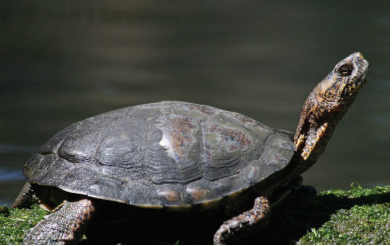
While walking along Sonoma Creek in Maxwell Farms Regional Park recently, Anna and Will Pier looked down and spotted two turtles sunning themselves on the big branch of a fallen tree extending into pooling water. Pleased to see again turtles they had spotted last year, they shared the photos with me. We got excited that the warming creatures were probably Western Pond Turtles. It seemed perfect timing to find out more about these local reptiles.
The Western Pond Turtle (Emys marmorata) is California’s only native freshwater turtle. They range along the West Coast from Washington to Mexico. These turtles can be found living in ponds, lakes, waterways and wetlands in Sonoma Valley and across the county. When it is time for nesting and laying eggs, the turtles venture on to land to dig a hole and deposit 5-10 hard-shelled eggs. When the turtle hatchlings break out of their shells, they are on their own to make a run for the nearest water source to eat and grow.
Easily disturbed, you can only spy one if you are quiet and observant. Relatively small at 6 to 8 inches in length and one or two pounds, they blend easily into surroundings with an olive to dark brown hard shell that is low and broad. The shell, or carapace, is smooth and made up of individual scutes or plates, sometimes with darker spots or lines. Like many other turtle species, the Western Pond Turtle is long-lived – up to 50 or even 70 years.
Western Pond Turtles are omnivores but eat mostly meat and are “ambush predators.” Field Notes on these turtles explain that “they feed only in the water and their diet includes fish, worms, crustaceans, amphibians (egg masses, tadpoles and adults), adult and larval aquatic insects, terrestrial grasshoppers and aerial flies off the water’s surface, beetles, and – infrequently – aquatic plants, including algae, willow and alder catkins, tule, and cattail roots.”
When winter or cold weather comes, they bury themselves in the mud in a modified hibernation called brumation. Then return to the surface waters when spring comes.
Sadly, populations of Western Pond Turtles have declined by 75 percent in recent decades and continue to be threatened by habitat loss and fragmentation, invasive predators, and other human causes. Pond turtles experienced a population decline across their range due to commercial hunting during the late 1800s and early 1900s, when they were harvested for use in soups and stews. The invasive red slider pond turtles that entered the wild as escapees of the pet trade remain a major threat as they tend to take over areas and displace the native turtle. Nonnative bullfrogs also take a toll by preying on young and small turtles.
Designated as a “species of special concern” in California as of May 2024, Western Pond Turtles were being considered for listing as endangered under the federal Endangered Species Act.
Locally, the massive development proposed for the former Sonoma Developmental Center lands poses a threat to habitat used by the Western Pond Turtle. The SDC Conditions Report highlighted that the reservoirs, ponds and creeks on SDC support suitable habitat for pond turtles. The report also found that these turtles are found well upstream of the SDC near Oakmont as well up on top of Sonoma Mountain. Sightings have been recorded in and around SDC, including in Butler Creek. If you see one, please take a photo if you can and report on INaturalist, or to the Sonoma Ecology Center.
Many of us revere turtles, whether pond turtles, sea turtles, land tortoises that live in the desert or the famous giant Galapagos tortoises. Pet turtles, too. I have at least one friend (Maggie B.) whose nickname was “turtle” while growing up. For years I worked to protect endangered sea turtles and collected many turtle books, artworks and tchotchkes that I still enjoy.
Turtles are embedded in stories and mythology throughout human history. The concept of Turtle Island appears in many Native American stories as an origin story where North America was formed on the back of a turtle.
Keep an eye out for the precious Western Pond Turtle when you are out and about and you might be lucky enough to see one sunning on a branch or swimming methodically across a pond or creek.





Be First to Comment