
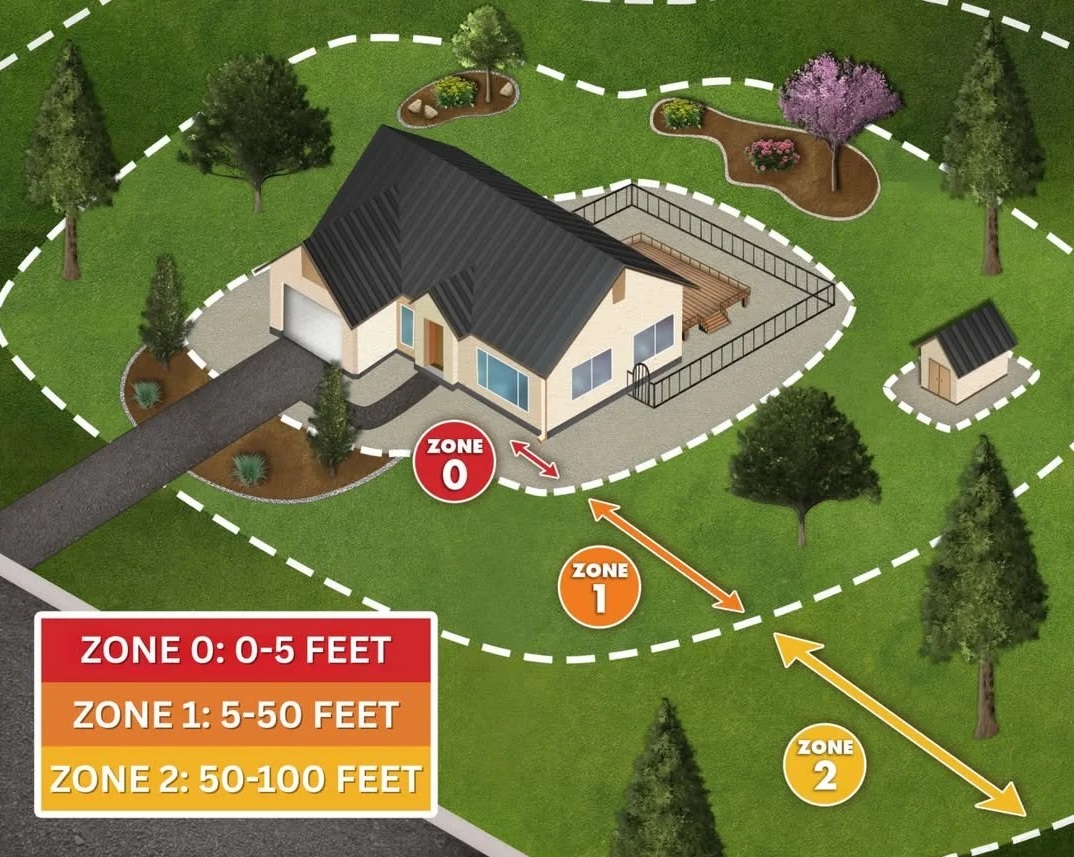
In August the California Board of Forestry and Fire Protection finalized its rules about landscaping around California homes in High-Hazard fire severity zones. The Northernmost section of the City of Sonoma and much of Sonoma Valley beyond it is designated as High-Hazard risk. The new rules will impact all new homes and eventually all existing homes in High-Hazard risk zones.
The California Board of Forestry and Fire Protection adopted strict Zone Zero regulations for homes located in designated high-hazard fire severity zones.
- The 5-Foot Buffer: The area 0 to 5 feet directly surrounding a structure must be clear of highly combustible items like wood chips, mulch, dead plants, and stored firewood.
- Plant Restrictions: No plants or woody shrubs are allowed within 1 foot of the home. Lawns, flowers, and non-woody plants under 18 inches tall are permitted in the rest of the 5-foot zone, provided they sit safely away from the immediate roofline.
- Fences and Sheds: Wooden fences cannot directly attach to the house, and wooden outbuildings are restricted in Zone Zero.
- Timeline: New construction must comply immediately; existing homeowners in high-risk zones have up to five years to phase in the changes
These are among the strongest regulations ever imposed on homeowners, and will substantially transform the way homes are landscaped in High-Hazard zones. Given the widespread use of wooden fencing for privacy, its removal will require the development of alternative materials that are fire resistant or uninflammable.
There’s no question that wind-driven, fast moving fires are events that, given climate change, will happen more frequently than in the past. Here in Sonoma Valley we’ve experienced this first hand since 2017, and it’s likely that a wildfire will happen again. Whether or not these new rules will reduce the loss of homes is uncertain; what is certain is that it will not make the situation worse.
Up until now, homeowners have had complete discretion in how their homes have been landscaped. The use of highly flammable plants like Juniper for hedges next to a home, trees planted close to the house that overhang the roof, and wood chips used as mulch have been common. Even homes that are not in High-Hazard areas would benefit from the removal of such material.
These new rules mark a sea change in landscape planning, but of course if a wildfire happens the problems will be well beyond home damage. Safe and timely evacuation remains an enormous challenge, and developing strategies to insure public safety go well beyond landscaping regulations.
On an entirely different topic, we are pleased by the success of the Sherpa community’s Nepal Relief event, during which over $100,000 was raised. You can read about it in this edition of the paper. Given the severity of destruction, $100,000 is welcome, but reconstruction and repair will require much more. Donations will continue to be accepted until the end of September, so if you have not contributed yet, there’s still time to do so: Use Zelle to donate to the California Sherpa Association using 415-996-4010.
Sonoma Valley Sun Editorial Board






Be First to Comment