
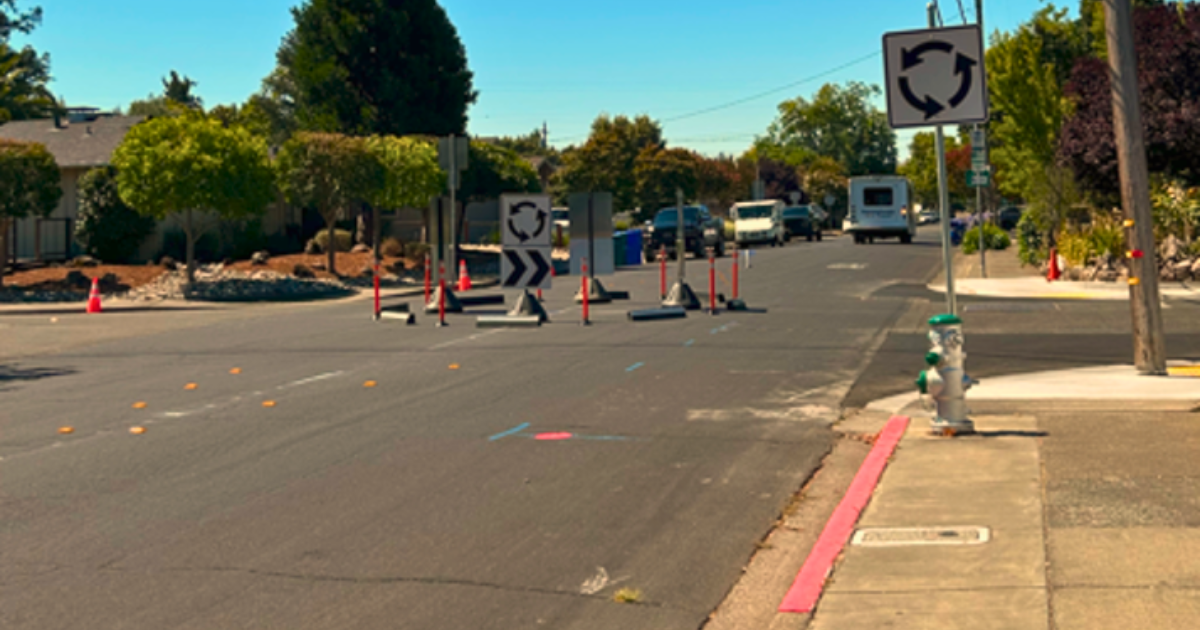
The proposed traffic “circle” on Third Street West was such a hare-brained project it prompts the question, “How did it happen?” It’s not like the residents and neighbors on Third Street West asked for it, nor was it expected. So what’s the story? Why is it that government – national, regional and local – goes off half-cocked?
Part of the answer is that those who work in government often don’t have their feet on the ground, which is to say, they know little about the places they administer. Another element is money; when government money is available, it goes looking for a project, even if it has to make one up.
Planners and traffic engineers love having projects to work on; it’s their job, and like any workers, they like to keep busy. Planners in the City of Sonoma are intelligent, competent, and hard-working, but they don’t live here. In fact, less than 20 percent of city employees live in the City of Sonoma, a reflection of the present reality of commuting, housing costs, and job opportunity. If they lived here, however, they might understand why the residents are upset with plans like the Third Street West traffic “circle.” Anyone who lives on Third Street West knows that traffic is not a problem there, and that it’s already a safe route for bicycles.
The idea of a bike route headed north from Leveroni Road, via the Fryer Creek Trail that connects to Third Street West, the Vallejo State Park and the adjacent east-west bike trail, makes sense. It makes sense because it already exists. Would stripes in the road make it a better, safer bike route? Maybe, but a traffic circle adds nothing.
The idea of striped bike lanes and making non-auto transportation safer is popular with planners. But the complicated changes to Broadway a number of years ago do not seem to have made it any safer for bicycles, however, and bicycle traffic on that corridor is rare to begin with. The same is true for Fifth Street West, where bike traffic is sparse, at best. Combining autos and bikes will always be a lousy combination, whatever the striping. It feels good to planners, though. Perhaps they should be required to commute to work on a bicycle on Broadway.
The development of SDC is another example of government planning gone haywire. Despite a decade of public meetings, and a clear indication that Valley residents want affordable housing over the market-rate development planned for SDC, the actions of county government and its planners have produced a plan that’s exactly the opposite. We wonder, do any of the planners working in Sonoma County government in Santa Rosa actually live in Sonoma Valley? If they lived in Sonoma, or Glen Ellen, or on Arnold Drive, perhaps they might see things differently.
This brings us to money. When government money is available for the development of public recreation, for example, local jurisdictions try to identify appropriate projects. Planners look for ways to apply for use of the money, since no one wants to see “free” money slip away. But too often, free money results in ideas that make no sense or that, if developed, never serve their intended purpose.
There is no substitute for having feet on the ground, and the ones who do are neighbors and residents. Before hatching big plans for a community, government needs to listen to the people whose interests it serves. If it does not, it serves no one but itself.





Spot on distillation of the issue. Excellent analysis.
The ignorance conveyed by this “half-cocked” editorial might be excusable, but not its smug tone.
First some facts. The staff member claimed to “know little about the place[] they administer” happens to have grown up right here in Sonoma. For at least the past decade, the City Council has committed multiple times to traffic calming infrastructure improvements (in our General Plan Circulation Element, our Climate Emergency Declaration, our Capital Improvement Plan Budget, and our recently updated Active Transportation Plan). Five years ago Sonoma’s share of countywide transportation sales tax funds were on the verge of being lost to another more nimble jurisdiction when former-Mayor Agrimonte stepped up to secure them for our own local use. The specifics of this capital project were presented and refined in at least 5 public meetings prior to the installation of the temporary “circle” element. And then this “quick build” pilot functioned absolutely as staff intended: 1) To confirm that it would significantly reduce maximum and average speeds, and 2) To get the neighborhood’s attention and feedback before committing to a final design.
Local leaders in traffic safety, bicycle/pedestrian advocacy, climate action, and tourism promotion — plus the widely representative Sonoma Valley Collaborative — have all spoken in favor of making West 3rd Street into a “bike boulevard” that is more friendly to cyclists and pedestrians. Even many neighborhood opponents of the temporary set-up admitted they were driven by fear that the proposed change at Perkins St. might actually be more dangerous than the status quo, despite the City Traffic Engineer’s professional opinion that this would not be the case and hard data confirming slower speeds. The truth is that what the community wants, and what the City has actually been doing, really aren’t that far apart; community input has been received and the project will be completed in the best manner possible.
But The Sun has a choice: Keep indulging in knee-jerk government-bashing clickbait, or cover local transportation safety issues with the journalistic integrity they deserve. You can’t do both.
“Hard data” in the form of videos presented to the City documented the more dangerous conditions created by the roundabout and supports what neighbors have been telling the city’s Public Works, City Council, and Traffic Safety Committee for months. The street isn’t large enough to accommodate a roundabout, so vehicles had to swerve onto the crosswalk areas and sidewalks to go around the obstruction in the middle of the intersection, not always at a slower speed. This endangers pedestrians and wheelchair users, many of them elderly since this neighborhood includes medical offices and the hospital, in addition to the many dog walkers, numerous parents pushing baby strollers, and a few bicyclists. The City’s communication with the affected residents was lacking. Otherwise, we could have informed them of these issues ahead of time. I support bicyclists and slower traffic, but the roundabout was more of a hazard than a benefit to anyone.