
How the Wildland Urban Interface Code (WUI) Is Changing Housing
By Larry Barnett
The State of California is justifiably worried about wildfires and the property damage they cause. After the massive destruction in Southern California, legislation was passed to regulate the type of landscaping that can be used in new housing developments, extensively remodeled existing homes, and may be applied to existing residences as well. Called WUI (Wildland Urban Interface) regulations, they will drastically alter the way landscaping is done.
Pieces of the WUI regulations have existed within the California Uniform Building Standards for a long time but have been scattered among differing portions. Now all the “fire safe” regulations have been gathered in one codified document.
Behind WUI is the idea of creating defensible space around homes in very high risk fire zones to reduce the risk of damage to the homes. State estimates are that creating such defensible space around homes can reduce property damage by roughly seventeen percent.
AB48 WUI regulations were passed in 2024, but have yet to be fully implemented. Each jurisdiction – counties and cities – must codify local regulations that meet the goals and standards of AB48, and that process is now ongoing. Matters of enforcement are complicated; few jurisdictions will undertake responsibility for the inspection of every home in California if it becomes necessary to determine whether its landscaping is fire safe, but homeowner insurance companies are already doing just that by denying coverage if a home appears non-compliant.
AB48 already requires sellers of homes to prepare a fire mitigation report about defensible space, which requires hiring an inspector to prepare that report, a regulation that will take effect next year. This makes it easier on banks and insurance companies when evaluating participation in a real estate transaction and shifts the cost to homeowners.
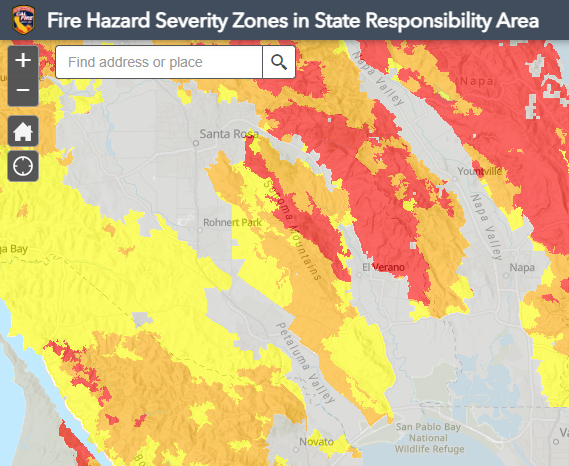
Each jurisdiction must adopt local regulations, and they are in large part based upon the fire risk maps for each area. The Sonoma Valley and the City of Sonoma, for example, use maps that designate fire risk zones ranging from extremely high to zero, and the WUI regulations reflect those risks.
In extremely high zones, new WUI rules mean that new homes must have clearly defensible space and the type of landscaping allowed must be fire resistant. Accordingly, highly flammable plants like Juniper, Cypress, Camphor, Italian Cypress, and Palms will not be allowed near homes, nor will be organic mulch that can burn. Where they currently exist, their removal may be required, at least to obtain homeowner insurance. In Southern California, the widespread use of Bougainvillea for landscaping next to homes has created a social firestorm of its own, since it is considered objectionable under the WUI regs.
The first five feet from a home, designated “Zone Zero,” is now considered the most vulnerable area, making the planting of almost all plants impossible. Succulents, for example, are considered safe. Within thirty feet of a home and adjacent to a “wildland” area, planting trees with a height less than six feet from existing older trees above them are discouraged due to the “laddering” effect in spreading fire to taller existing trees.
Some jurisdictions have gone so far as to list acceptable species and types of vegetation that can be used in landscaping for new homes. How such specificity will or will not apply locally remains uncertain, as does its application to existing landscaping.
Even home design and construction are affected. Local architect Bill Willers notes that attic vents, historically installed to provide air circulation under roofs, have been shown to provide a way for embers emitted during a fire to find their way into homes, essentially creating conditions that burn the home from the inside out. Similar issues have been identified with foundation vents. Under new construction regulations, attic vents are now less acceptable. In addition, construction must now include non-combustible materials that meet WUI regulations in soffits under roof lines, and siding. All windows in new construction must now be tempered glass. Wood privacy fences pose a fire risk, and it’s likely their use in new construction will be eliminated.
Wood can still be used in new construction; cedar and redwood are naturally fire-resistant. Pine must be treated before being used. Fire-resistant siding can be made of cement composition board, although it does transmit radiant heat which can ignite wood beneath it.
Deputy Fire Chief Trevor Smith serves as Fire Marshal for the Sonoma Valley Fire District and is addressing the WUI code adoption process. He notes that WUI is part of the California Building Standards and will be adopted in 2026 by the City and County of Sonoma. Modifications to or amendments of the code may be made by each jurisdiction.
Chief Smith also noted that the State Board of Forestry is currently involved in rulemaking related to the “Zone Zero” defensible space law requiring a five-foot ember-resistant zone immediately surrounding a home in a high fire risk zone, and its implementation. The Board is currently holding hearings to determine the extent of their regulations and how they may affect existing homes with established landscaping. At present, the inclination of the Board is that three years after the codification of WUI, regulations will then be applied to existing homes in the very high fire hazard zones. In Sonoma Valley, such high fire hazard zones are extensive.
Smith notes that “insurance companies are already making people comply with this if they want to keep or maintain their insurance or get insurance if they don’t have it already. The insurance companies are enforcing this themselves, even though it is not a law. The Insurance Institute for Business and Home Safety has done the research and proven Zone Zero saves homes. That’s how this Zone Zero thing started.”
From the fire department’s perspective, Smith advises “there should be nothing flammable within five feet of a home, no matter what level fire hazard zone it is in.”



Be First to Comment