
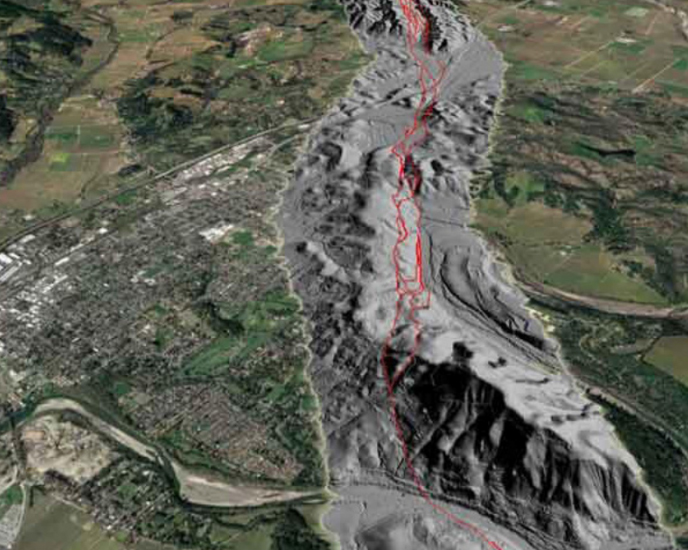
Rogers Creek-Healdsburg Fault Likely Source
By David Bolling
The United States Geological Survey (USGS) has not yet identified the source of the series of small earthquakes that rattled homes in Glen Ellen on Sunday, December 14, but the likely suspect is the Rogers Creek-Healdsburg fault system that is increasingly overdue statistically for a major seismic event.
The three December 14 shocks felt by residents in the Glen Ellen-Kenwood area, registered 4.0 magnitude at about 3:30 p.m., followed by a 3.31 aftershock some eight minutes later, and a 2.6 magnitude aftershock at about 6 p.m.
There was no significant damage reported by emergency authorities, although some containers fell off shelves at the Glen Ellen Village Market, and this writer’s home and detached office on the town’s southern perimeter shook vigorously in a rolling motion for a matter of seconds with the first two temblors.
The latest USGS probability analysis for a major earthquake – with a magnitude of 6.7 or higher – in the San Francisco Bay Region from 2014 to 2043, is 72 percent. And within that probability window, the Hayward-Rogers Creek-Healdsburg fault system – running under the East Bay, under the Carquinez Straits and up into Sonoma County parallel with the left flank of Sonoma Mountain – has a likelihood probability of 33 percent.
Seismologists are unclear as to whether or not a succession of small quakes like those on December 14 are foreshadowing precursors of a major quake to follow. Some scientific evidence suggests there is some increased likelihood if the precursor shakes are numerous in quantity, like a swarm. That was not true of the recent shaking on the edge of the Sonoma Valley.
Two other Bay Area fault systems have a significant probability for a major earthquake by 2043. The San Andreas – the grandaddy of all California fault systems, has a 22 percent probability, while the Calaveras Fault system, which runs north-south along the eastern edge of the East Bay as far north as Oakland, has a 26 percent probability.
Detailed analysis of these earthquake probability statistics, and detailed maps of the fault systems addressed, are available from the USGS website – pubs.USGS.gov.
In March of this year, Sun Editor David Bolling asked whether the fault was ready to become active, and voiced his concerns. “Given the announced, if fluctuating, 33-percent likelihood of a 6.7 or greater earthquake on the nearby Hayward-Rogers Creek fault between now and 2038, it would seem wise for Sonoma Valley residents to know what to expect and what to do about it.”
To read the entire article, CLICK HERE





Be First to Comment