
By Larry Barnett
The City of Sonoma began its affordable housing program in 1992. At that time, annual Redevelopment Agency funding required that 20 percent of that funding be dedicated to the creation of “subsidized” housing – deed-restricted and income-qualified units, either for sale or rent – what is now referred to as Affordable Housing.
Numerous projects were approved and funded until Redevelopment funding ended in 2012. The City’s most recent large Affordable Housing project was Alta Madrone on Broadway, approved in 2018 and consisting of 48 low and very low income units. The land for that project, which had been previously acquired by its Redevelopment Agency, was contributed by the City.
It was not until 2018 that the City established its Housing Trust Fund, which is intended to facilitate the creation of Affordable Housing. One percent of the City’s collected Transient Occupancy Tax (TOT) revenue, roughly $500,00, is contributed to the Housing Trust Fund each year. At present, roughly $2.8 million is held in the fund, but given the high cost of land and construction, that amount is too small to make a meaningful difference going forward. Accordingly, the only Affordable Housing currently being built is that required by the City’s Inclusionary Ordinance, which requires twenty-five percent of units in projects of over five units to be designated as Affordable, amounting to only a handful over the past few years.
Although successive City Councils have always placed the creation of more Affordable Housing as a top priority in their annual goal setting process, no large Affordable Housing developer or project has come forward for approval since 2016. As Matt Franklin, President and CEO of MidPen Housing explains, its creation requires not just community support, but sufficient financial assistance by local government.
“Resources are an issue, but there are a lot of ways that cities or counties can help us do our work; it’s not just money,” he noted. “Any contribution of land can really help, as does the reduction of predevelopment costs.” It takes, he noted, between two and five years for a project to be completed, and this if the community is not only willing, but supportive. Franklin is hopeful that there may be a $10-billion Affordable Housing bond on the November 2026 state ballot.
The State of California offers a system of funding that credits local impact fees; this can be in the form of delaying payment or even providing full waivers. “All of it helps,” Franklin said. Moreover, he noted that the County of Sonoma also invests in city projects. “Creating a project in smaller cities is not impossible, even without a city’s financial help,” he said. “It’s a steeper hill to climb, but it can happen.”
“A rural allocation of state credits includes a lot of smaller cities. Every community has its own spectrum of tools,” he added.
The City of Healdsburg, for example, provides no-cost pre-application meetings, offers fast-track processing for ADUs and affordable housing projects, and has established formal written pre-application procedures. Furthermore, Healdsburg prepares Program Environmental Impact Reports (EIRs) to reduce environmental review costs and timelines for projects covered under these programmatic assessments. The city actively applies state housing laws.
Similarly, the City of Rohnert Park offers optional pre-application meetings with multidisciplinary staff to provide early project feedback. Upon formal application submission, projects undergo a structured review process, typically involving three-week cycles for staff feedback. Larger multifamily projects generally necessitate Site Plan and Architectural Review, a process taking approximately 90 days from application completeness to approval. While most projects receive administrative approval, Planning Commission review may be required under specific circumstances.
In order for a project to be financially viable for MidPen, it needs to include about forty units. “The low income tax credit, which is a federal program run through the state, is a very powerful financing tool that we use on every single one of our projects,” he explained. “It can give you forty to fifty percent of the money you need to build. When you go below forty units, using that program begins to get very tricky.”
This also means enough land must be available to accommodate forty units or more, and large enough parcels within the City of Sonoma are not widespread. The city’s Urban Growth Boundary allows expansion for one-hundred percent Affordable Housing, but one potential location already within existing City limits is the vacant parcel at Broadway and MacArthur, the former site of the Truck and Auto lot that has been lying fallow for many years and is up for sale. Other parcels near Four Corners also offer potential. This brings us to ways in which the community can support Affordable Housing creation.
If, for example, a community-wide effort was made to acquire a parcel for donation to the Housing Trust Fund, it would represent a meaningful contribution to developers like MidPen. In some respects, land can be more valuable than cash, Franklin said. “The value of the land is fully credited within the transaction,” he pointed out, and helps MidPen leverage more tax credits. “Every little bit helps a lot.”
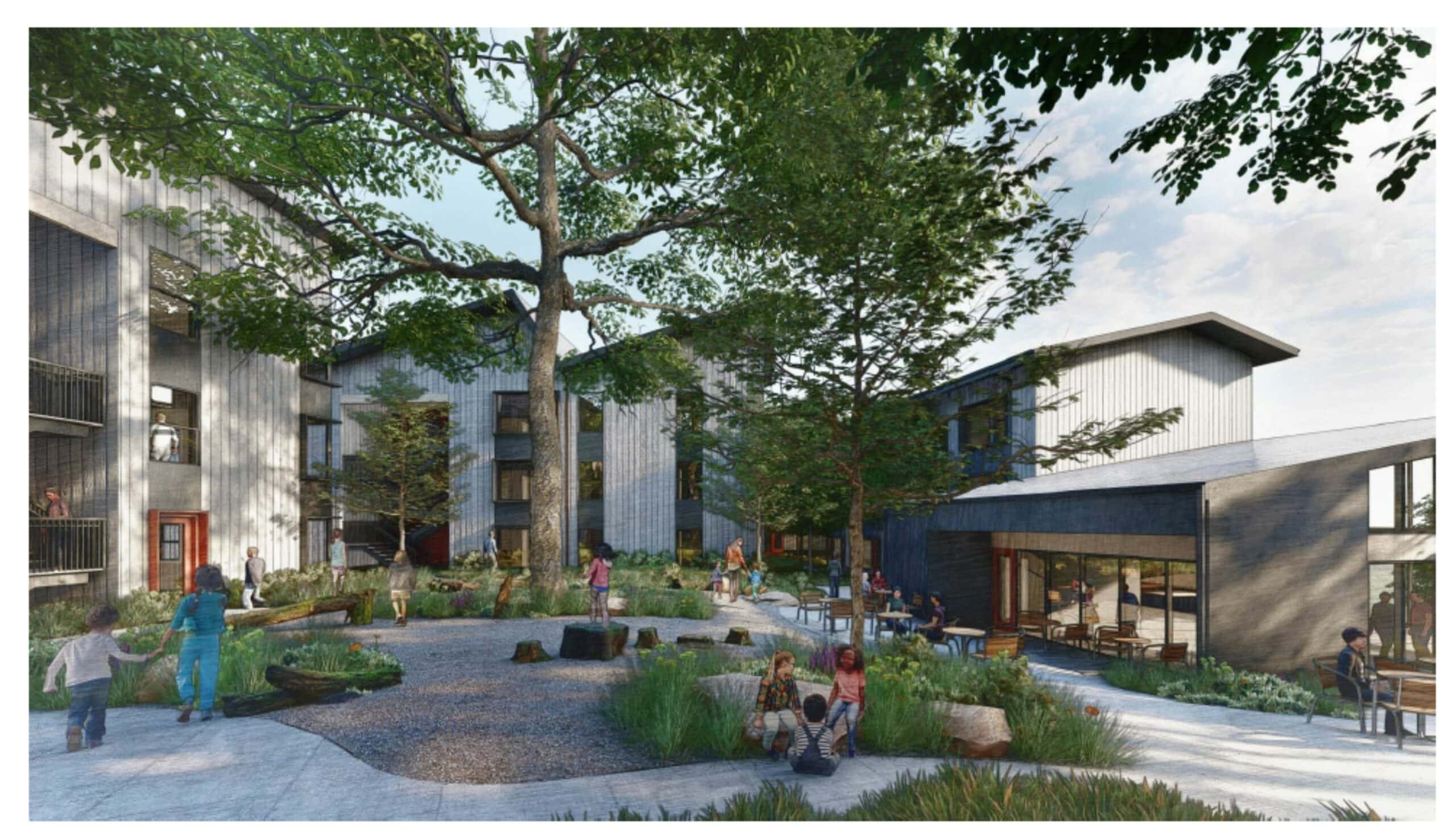
MidPen is currently building a 72-unit project on Verano Avenue across from Maxwell Park (rendering above). A hotel is planned on an adjacent parcel. As for the demand side of the Affordable Housing formula, it is in Franklin’s experience, “overwhelming.” He reported that for their recently opened 99-unit project in Santa Rosa, Midpen received two-thousand applications.
MidPen would be delighted to work with the City of Sonoma. “It’s on our radar,” he said.
Larry Barnett is currently a member of the Planning Commission, its former Chair, was on the City Council for twelve years, and the City of Sonoma’s Mayor in 2000 and 2005. He is the Executive Director of the Sonoma Valley Sun newspaper.






The Overton window has shifted so far away from the left i.e. public housing that it’s not even part of the discussion anymore. We’re talking about how cities can subsidize developers to encourage them to come up with a little bit of affordable housing.
Sonoma’s problem is a “fractal” as local activist, Fred Alibach put it, of our nations malaise.
The United States is in a housing crisis, yet federal law still forbids building more public housing than existed in 1998. Aging buildings are crumbling, waitlists stretch for years, and Congress can’t even fund repairs for the units that remain. Advocates argue for repealing the Faircloth Amendment and building millions of new homes, while skeptics point to the failures of the past. NIMBYs, maintenance costs, and political gridlock complicate everything. This video examines whether public housing can — or should — return.
In order to put public housing back on the agenda in American politics, we first have to understand how public housing was destroyed — especially by Bill Clinton’s Hope VI program. The “hope” in Hope VI stood for “housing opportunities for people everywhere.” In fact, it was a neoliberal project to end public housing as we know it and remake cities for capital and the well-to-do.
https://www.msn.com/en-us/money/realestate/what-really-killed-public-housing-in-america/vi-AA1RCrOF?ocid=socialshare
I wonder if the city and county really have the will to make a big push towards affordable housing.. Look how long the old Chanate hospital property and SDC has been up in the air..
Larry – Thank you for lending your expertise to this topic. Sonoma Valley Commons, the outcome of Sonoma Valley Collaborative’s roadmap project, is launching this year as the vehicle for exactly the kind of community-based efforts you describe. While we’ll start with smaller projects like ADUs and multi-family acquisitions, we also plan to partner closely with Midpen, Burbank, and other LIHTC developers to advance affordable housing through fundraising, community engagement, and land acquisitions.
Similar organizations in St. Helena, Oakland, Fresno, and elsewhere have found success by staying deeply community-engaged, avoiding early overextension, and connecting private philanthropists, charitable landowners, public agencies, and local banks. We aim to do the same.
Stay connected by signing up for our updates on this form: https://forms.gle/tL7n2KGXUqNnGSP2A
P.S. We’re also hopeful SB 417/AB 736 passes in CA, adding much-needed funding to the affordable housing pool and replenishing BAHFA programs that have run out of money.
While ADUs are considered “affordable by design” compared to new single-family homes, studies show they are frequently rented at market rates, contributing to an increase in property values and rising rental costs, which can accelerate gentrification.
The state of California allows local governments to classify secondary units as low-income based either on actual or anticipated affordability. Let that sink in for a second. ADUs can be counted as affordable housing based — not on what they will actually rent for — but on what they might possibly rent for at some future date.
https://www.sacbee.com/opinion/editorials/article277933433.html
Mastering Year-15 LIHTC Exits: Key Strategies
Low-Income Housing Tax Credit (LIHTC) developers can legally exit affordability restrictions after 15 years, a pivot sometimes driven by market-rate incentives. Year 15 often triggers a Qualified Contract (QC) process allowing conversionIf a property is located in a gentrifying area, owners may choose to convert units to market rate to maximize profit.
https://www.lument.com/mastering-year-15-lihtc-exits-key-strategies-for-affordable-housing-owners/