
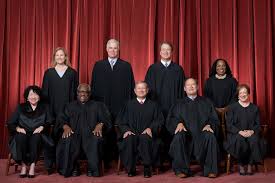
Are Supremes Mentis Sans Compos?
There is a growing sense that the U.S. Supreme Court has become – to use a legal expression – non compos mentis.
That sentiment results from its seemingly politically-inspired decisions, changing what lawyers refer to as “settled law.” That can occur when the Supremes decide that the law they un-settle was not based on the original intent of its drafters, and thus wrongly unsettled previous law that previous Supremes previously declared was settled.
Follow? No? Good. You’re compos mentis.
Americans typically conduct their affairs in reliance on laws as created by Congress, state legislatures and/or as previously “settled” by The Courts. When the Supremes change their minds, confusion arises. Fortunately, most disputes are resolved in lower courts or ‘out of court,’ especially if the police can never find out.
Cases reaching the Supremes often involve important Constitutional issues and pricey lawyers skilled at blowing smoke up the Judicial Robes. [Full Disclosure: Having graduated Sine Cum Laude from law school, your correspondent was sworn into practice before the Supreme Court but never argued a case there; the drive to DC is way too long.]
FYI, there is no ‘right’ to have an appeal heard by The Supremes. Before an appeal is accepted, a party must request a Writ of Certiorari. Writ-requesting rules (https://www.law.cornell.edu/rules/supct/rule_14) should not be read by young children.
Four Justices must agree to hear an appeal. With 7,000 to 8,000 appeals filed annually, the Court hears arguments and issues written opinions in only 70 or 80 cases a year. Most appeals are rejected with a simple: “The petition for a writ of certiorari is denied.”
The Court’s calendar is at: https://www.supremecourt.gov/oral_arguments/calendarsandlists.aspx. It seems the Supremes aren’t deciding many cases, but having read some of their decisions, that’s not necessarily a bad thing. Besides, if all appeals were accepted, argued and decided, they’d have to work through lunch and maybe week-ends.
They therefore resort to the so-called emergency, or “shadow,” docket to deal with the workload. Many appeals only ask the Supremes to temporarily block the effect of a lower court decision (e.g., a prisoner’s execution) until appeals can be exhausted. But Justice Elena Kagan has said the shadow docket isn’t used just for real emergencies but as “only another place for merits determinations — except made without full briefing and argument.”
A discussion of shadow docket shenanigans and chaos can be found at https://www.brennancenter.org/our-work/research-reports/supreme-court-shadow-docket, and in professor Stephen Vladeck’s book, “The Shadow Docket.”
Dockets aside, upset with the Supremes rose following their 2010 decision in a fully-argued case, Citizens United v. FCC, holding that the Right of Free Speech prohibits the government from restricting political expenditures by corporations. Cynics summarize it as, “Corporations are people, too!” It protects a t$unami of political dark-money graftibutions. See: https://campaignlegal.org/update/super-pacs-are-continuing-hide-secret-money-wealthy-special-interests-heres-how.
Then came Dobbs v. Jackson Women’s Health (2022), another fully-argued case reversing a 50-year-old decision in Roe v. Wade which had recognized a woman’s right to abortion. Since Dobbs, each state’s politicians (flush with graftibutions) decide if/when abortion is a crime.
Then came Trump v. United States (2024), declaring our President immune from prosecution for crimes he commits while performing his official duties, which is (supposedly) what the Constitution’s framers had in mind. England’s King George III – His Majesty – was immune from prosecution, so now is His Presidency, Mr. Trump.
The Constitution’s ban on “cruel and unusual punishments” should prevent women who get abortions from being burned alive as witches, but – hey – with our Supremes, you never know.
Sine Cum Laude, indeed.








Be First to Comment