
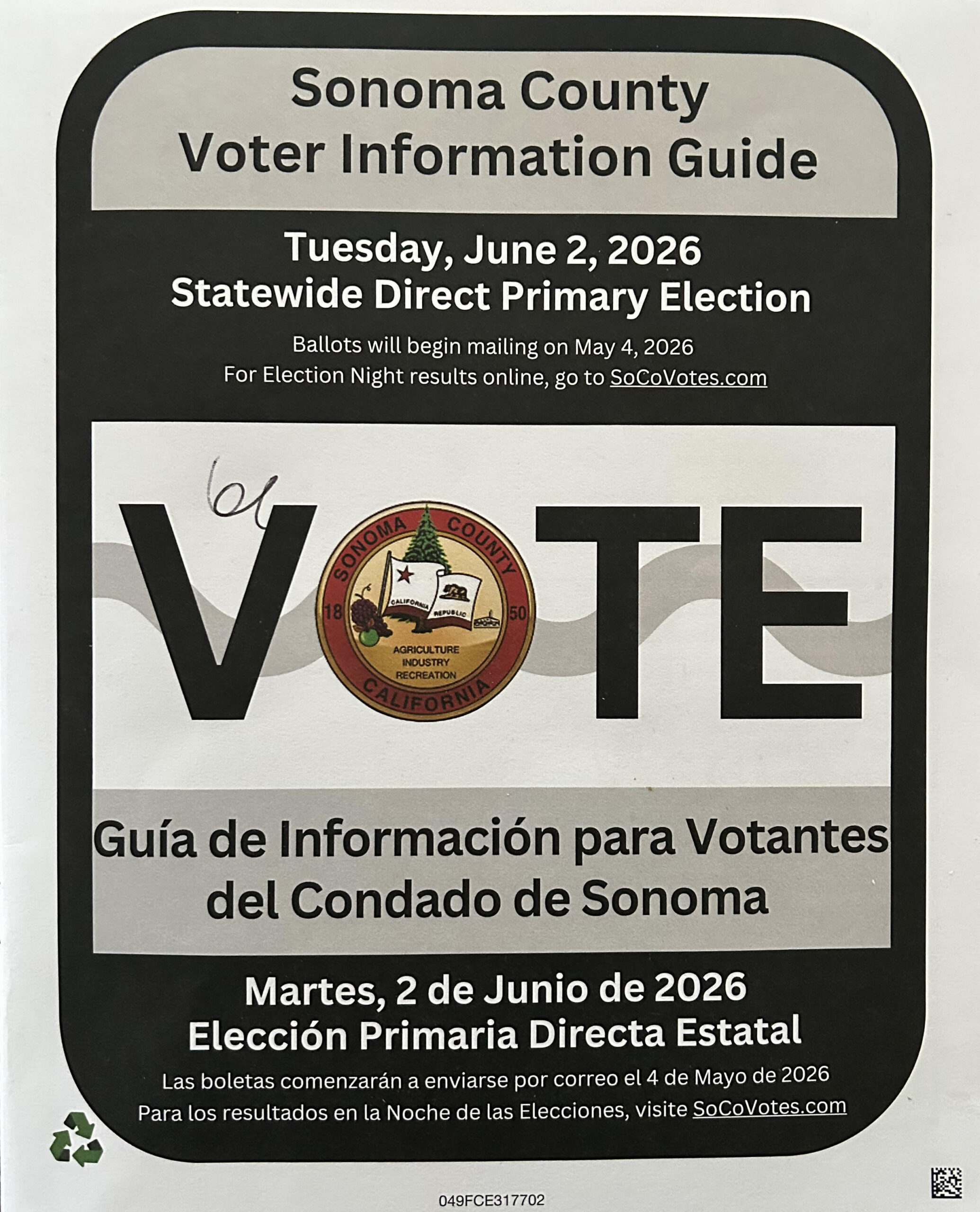
California‘s 2026 Election Season officially began with the arrival of the “Primary Election Offical Voter Information Guide” at every Valley household harboring a registered voter. For those not registered to vote, or just needing something to read while in detention, it’s also available on line at https://voterguide.sos.ca.gov/pdf/.
That rigidly nonpartisan publication from the office of the California Secretary of State is also available by request in Spanish and eight (yes, 8) Asian languages. It contains everything readers might want to know about the primary election scheduled for Tuesday, June 2. That includes how to register to vote; how to find a voting place; how to get mail-in ballots; when early voting starts; how to find out if your ballot was counted; etc., etc. Supposedly, the booklet and other election stuff is studied in our Valley schools, but your correspondent has not confirmed that.
For first-time balloteers and veteran political junkies alike, the most interesting part may be pages 8 thru 56, containing the names, pictures and statements from candidates for state offices who will appear on the June 2 primary ballot. Not included are pictures or statements from candidates who have not agreed to abide by campaign finance limits (see below) or who did not file as of the Guide’s publication date.
But pages 8 and 9 list all candidates for office who filed by that date. That list includes all sixty-two (yes – 6 with a 2) candidates for Governor, but only two for Attorney General, neither of whom, praise Jesus, is Pam Bondi.
Other offices on the ballot are: Lieutenant Governor; Secretary of State; Controller; Treasurer; Insurance Commissioner; Board of Equalization members; and Superintendent of Public Instruction.
To make voting easier, voters are not required to know what any elected office actually does. Which is good, because few voters know what the Controller controls, what the Equalization Board equalizes, whether the Secretary of State must know shorthand, or if the Lieutenant Governor can be promoted to Captain.
Fortunately, candidates’ pictures and written statements (pp. 10-56) can help voters make their choices. To avoid body-shaming, photos are head-shots only. However, to have their photo and statement in the voters’ guide, candidates must have agreed to limit their campaign expenditures to the spending limits set for each office. With those limits ranging from $1,961,000 for Board of Equalization candidates to $11,767,000 for Governor wannabees, all billionaire and PAC-backed candidates opted out. They’ll be on the ballot, but not in the Voters’ Guide.
With statements limited to 250 words each, public official wannabees try to pack them with critical voter information, such as: “I was a champion chess player,” and “Your vote is your voice.” Many took full advantage of that 250-word limit to detail their backgrounds, qualifications and objectives. Others took a “less-said-the-better” approach, as in: “Mother, Builder, Entrepreneur solving California’s problems!”
The Guide may have some readers wondering: “How can I get my name on the ballot as a candidate for state office?” Detailed steps can be found at https://elections.cdn.sos.ca.gov/statewide-elections/2026-primary/qualifications-requirements/2026-governor-lt-governor.pdf.
Those instructions should be read by anyone who thinks they might like to become a Public Servant. After all, Democracy – at every level – requires capable people willing to do the hard work of governing. Despite the often-clownish drama, elections are what make that Constitution stuff work (or not) to give us an Abe Lincoln or Donald Trump, a Road Runner or Wiley E. Coyote.
As my old-to-the-point-of-dead civics teacher once said, “Elections are a test of We The People, to see if we still give a damn about all that democracy crap.”






Be First to Comment