
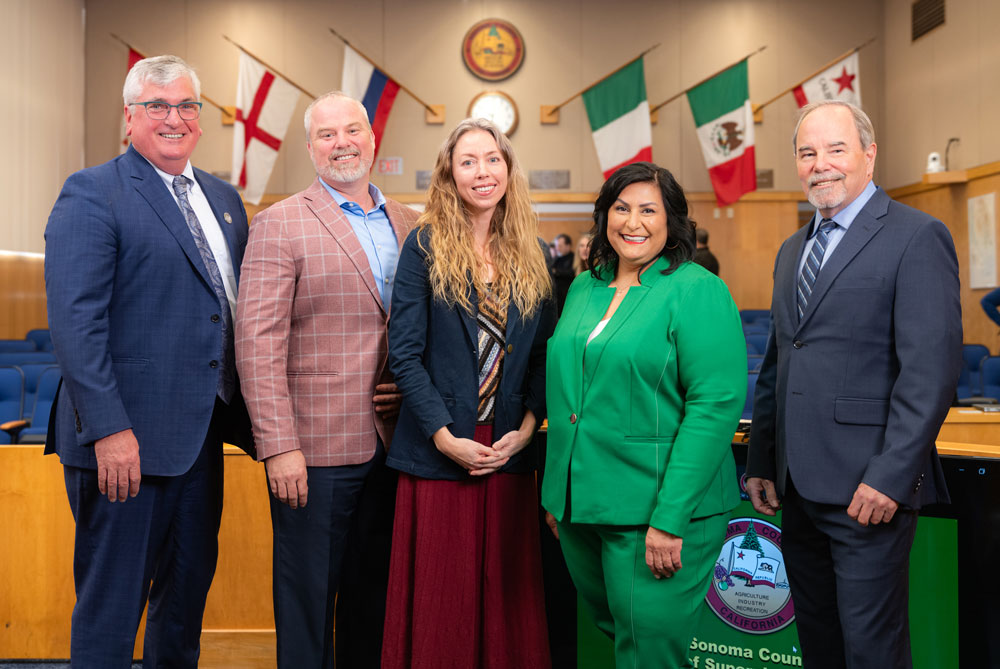
After receiving many racist, derogatory online public comments, the Sonoma County Board of Supervisors is joining other jurisdictions in calling on the state legislature to adjust provisions of a law that requires government bodies to accept remote public comments.
SB 707, an update to state open meeting regulations that went into effect July 1, requires public agencies to provide an opportunity for the public to comment via a two-way telephonic or audiovisual platform. Sonoma County, which has streamed
Board of Supervisors meetings on the Zoom platform since 2020, accepts comments during meetings via Zoom or telephone.
The remote public comment format, however, has been exploited by a few individuals who insist on disrupting public meetings with language that violates the County’s policy of civility. While commenters who violate the policy can be muted, their vitriolic language is still heard by Supervisors, County staff and the public.
Adjusting the two-way remote participation section of SB 707 would still allow ample public participation in public meetings. The public would still be able to watch meetings online and send comments via mail or email. Those wishing to address the Board could still do so in person in the Board Chambers.
The press conference will include North Bay Supervisors and nonprofit leaders, and will call for adjustments to online public comments. It will be held on Monday, September 28, at noon, in front of the Sonoma County Administration Building, 575 Administration Dr., Santa Rosa.








Civility is not a license to silence
The Sonoma County Board of Supervisors is asking the Legislature to weaken SB 707 — the state law that guarantees the public a real, two-way voice in public meetings. Their stated reason? Some commenters are rude.
Rudeness is not a legal standard. The First Amendment does not protect only speech the Supervisors find pleasant. The whole point of public comment — and of the First Amendment — is to let citizens criticize the very officials who would prefer not to hear it.
The Board wraps this in its “commitment to civility.” But civility is a courtesy officials may model — civil rights are a duty they are legally required to uphold. When a government body lobbies the state to restrict how citizens may address it, it has confused the two: it is trading the public’s constitutional rights for its own comfort. A commitment to civility that only runs one way — citizens silenced, officials keep their microphones, podium, and press conferences — isn’t civility. It’s thin skin with a letterhead.
Remote comment is not a loophole. For working parents, the disabled, the elderly, and rural residents who can’t take a midweek day off to sit in the Board Chambers, it is the only realistic access to their own government. Punishing every resident for the words of a few isn’t civility — it’s collective punishment, and the public has a right to say so, in person or by phone, however uncomfortable that makes the people in power.
If the Board wants civility, it should model it — not legislate the public into silence.