
Currently at Sonoma Valley Museum of Art
By Anna Pier
The marvelous new show at the Sonoma Valley Museum of Art, The Real-Life Art History of M. Louise Stanley, is huge in every sense of the word. This grand collection of the petite artist’s works, from 1991 to the present, includes giant canvasses, tiny ink sketches and drawings from her sketchbooks and journals, protest posters, and much more. It requires a thesaurus to attempt to convey the richness, ebullience, erudition, grandeur, humor, and glory that this Bay area artist’s works offer to the viewer. Fortunately, it will be on exhibit until January 3 next year, because you will want to go back again and again.
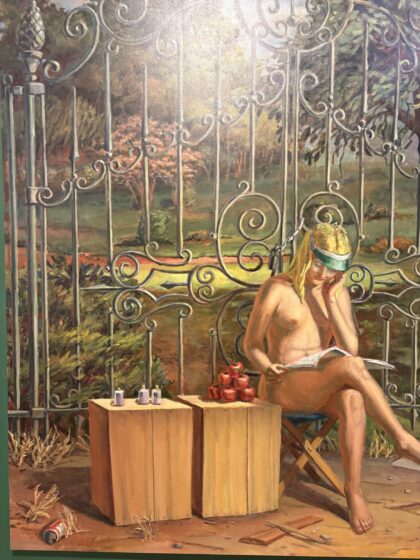
The artist, whose studio is in the Emeryville Artist’s Co-op, has often used the Greek myths. As she asserts, Zeus and Juno’s squabbles make “better copy.” She sees this as a great way to “monumentalize the trivial.” Stanley explained that she doesn’t try to be funny. Things just come to her. For instance, after painting “Truncis naribus” (Faces without noses) which depicts damaged Roman statuary, “it just came to me to add the Groucho nose.”
Her father was a professor of chemistry at UC Berkeley, and she and her sister grew up in part on the Berkeley campus. She also grew up near The Huntington Museum, and would go there on her bike daily, where she especially loved seeing the Gutenberg bible, and the Gainsborough paintings.
When she was at Laverne College, a Brethren school, and also taking painting at Scripps College, the LaVerne dean called her in to reprimand her about the drawings of nude women in her dorm room. It was then she realized that art is her religion.
Graduating from LaVerne in ’64, she discovered California College of Arts and Crafts (CCAC). As the artist described her days at the East Bay college, “We went to the graveyard at night, and smoked dope. We had to invent ourselves – and this was long before the Women’s Movement.” The going school of painting at the time was Abstract Expressionism – black and white, big, oil, no figures. So, Stanley explains, “we had to rebel.”
She continued, “At CCAC I felt I needed to develop a persona, and I started caricaturing.” Stanley went on to explain that she wanted to capture the “flavor of a person after they left the room – not what they look like.” Another way she discusses this is, “You don’t paint what you’re seeing, you paint how you feel about it.” She holds a BFA and MFA from CCAC.
Stanley tells her students, “The things you don’t like about your work is who you are – get used to it.”
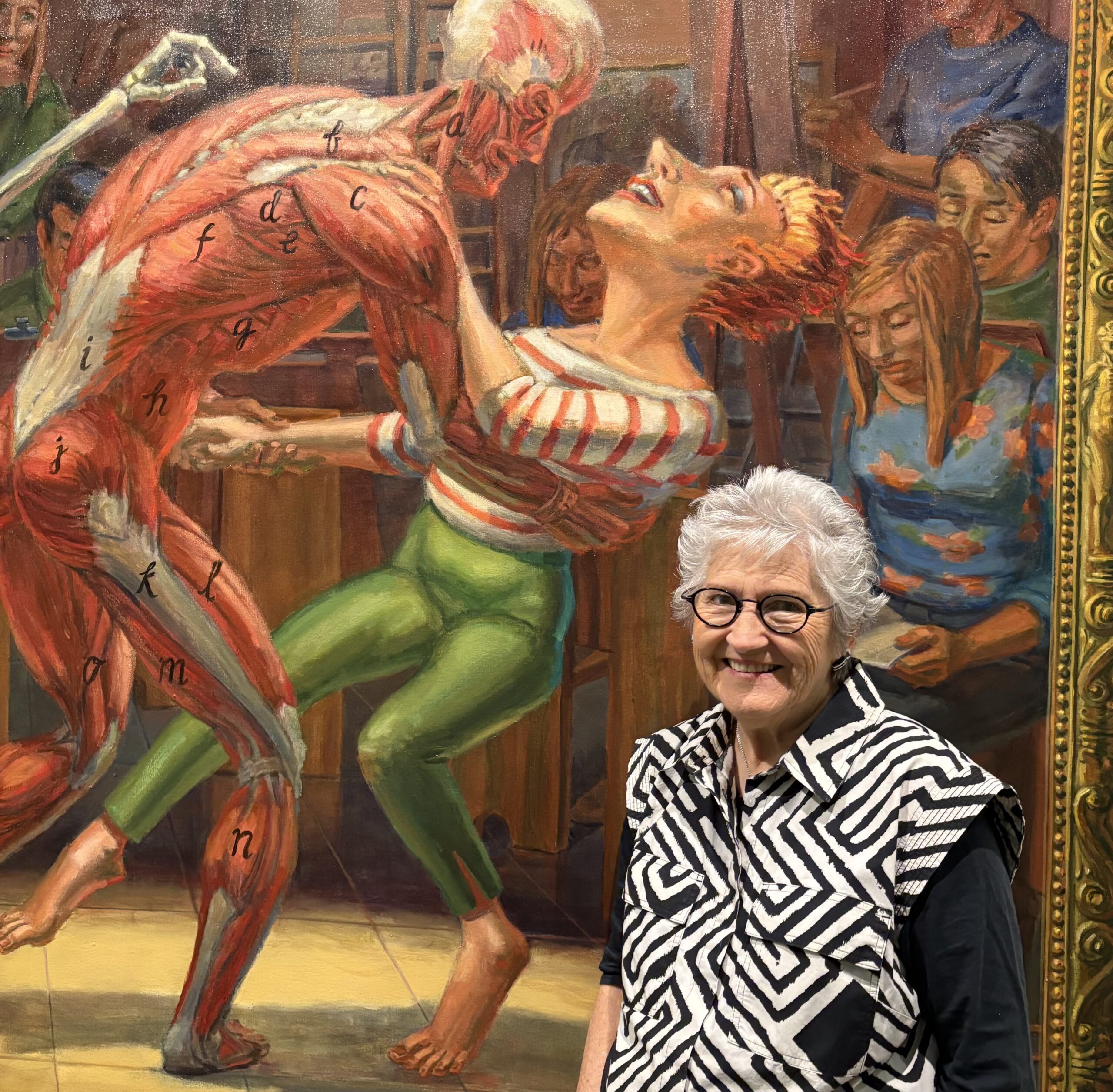
In 1981 she developed a character who inhabits her paintings – and Stanley points out adamantly that her alter-ego figure predates ‘Where’s Waldo’ – as the ‘Archetypal Artist.’ With spiky red hair, dressed in a red and white-striped jersey and bright green Capri pants, the figure participates in many paintings; when not present, sometimes her clothing appears, as in a laundry basket. She is the dancing partner in “The Anatomy Lesson”; Stanley taught human anatomy for twenty years and was popular with students for dancing with the skeleton.
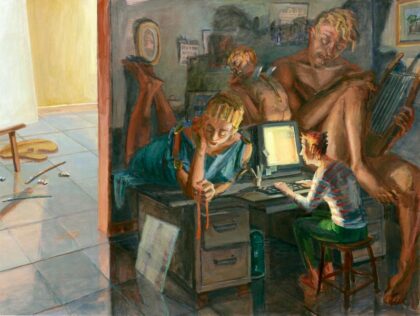
Using humor and wit, Stanley paints in the tradition of history and narrative painting, documenting current and fictitious events using myth and allegory. With her wry scrutiny, she examines the foibles of contemporary society and political issues. “Remote Access” is a commentary on how technology can keep us away from the creative process.
Louise Stanley is thrilled with Sonoma Valley Museum of Art’s presentation of her work, crediting Margie Maynard, Deputy Director, Engagement & Exhibitions, for her brilliant vision and organization of the show.
Maynard reminds, however, that the work of curating a show is a team effort. Maynard elaborated, explaining that from the time she and SVMA Director Linda Keaton first visited Stanley at her studio in Emeryville, “Lulu was a dream to work with, “answering in detail, making suggestions, listening carefully.” At her studio, Maynard discovered that Stanley was not so much a creative storyteller as, for the most part, a keen observer of human behavior. She combines this with her ability to capture the scenes in pen and ink unfolding before her in nearly real time.” Hence Maynard came up with the show’s title, The Real-life Art History of M. Louise Stanley.
The Opening reception at SVMA, 551 Broadway, Sonoma, is Saturday 26 September from 5:00-7:00.


Be First to Comment