
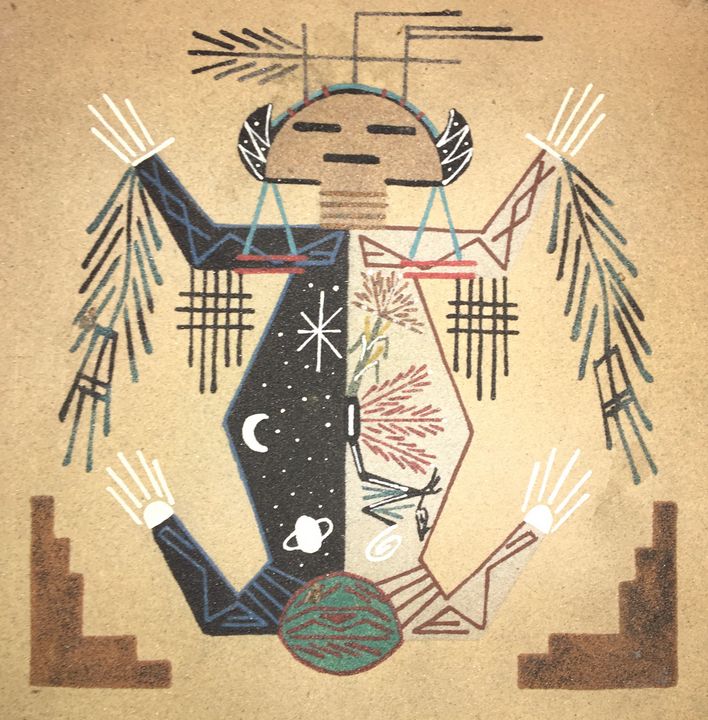
I’m a triple earth sign, astrologically, Sun, Moon, and Rising Sign all in Virgo. Whatever its implications, the fact is I’ve spent thousands of hours with my hands in the dirt growing and caring for plants. The life energy of Earth’s living system resonates deeply with my own, even thrills me at times with its power and persistence.
I believe it is a sacred power; it’s the power that not only sustains life, but is the power of consciousness itself, a universal consciousness. In this respect, I’m a Spinosan. Spinosa, for those of you unfamiliar with him, was a Dutch philosopher of the 17th-century who believed that God and Nature are the same expressions of a divine reality. If you’ve ever stuck your nose into a beautifully blooming red rose, you’ve experienced the divine.
The Zuni people of the southwest, one of the few indigenous communities that overcame territorial threat and have remained on the same land for over one-thousand years, adorn the outside walls of their homes with iconography representing Father Sky and Mother Earth. Despite cars, internet and cell phone technology, they still connect to the sacred.
Desire for a connection to the sacred has fueled any number of religious and spiritual traditions and institutions, although the bigger the institution the more tenuous the connection. A deep connection to the sacred is heart-to-heart, the heart of individual self in communion with the heart of Mother Earth, that in turn connects to all living things at various levels. The institutional mode is always more conceptual and intellectual, dealing with fixed hierarchy, prescribed rituals, personification and often dogma. In monotheistic religions, their primary connection is to the Father, which is why their God has been regularly pictured looking like a man, or a king on a throne.
Just as phototropism directs plant growth towards the sun, reaching towards the father naturally inclines striving for heaven and high places. In this way mountains attained spiritual significance for people, the sacred placed well out of reach of easy attainment, rarified and reserved for gods and the worthy few. An emphasis on the masculine Father archetype is typically replicated in our social structures. The feminine Mother Earth is subordinated or actively suppressed. Those who find sacredness in Mother Earth are dismissed as “tree huggers” for example.
Masculine and feminine principles together comprise the sacred; we live between Father Sun and Mother Earth. Active and receptive respectively, opposition to each other produces turmoil. A living system is complex and requires balance, and when that balance is disturbed – the Hopi people call it Koyaanisqatsi – the system will adapt over time to restore balance. From a human perspective, such restoration can be and often is disruptive. Alterations in weather patterns, disease vectors, and speciation are indications of living system adaptation, and it can take tens, thousands, or millions of years to restore balance.
Ours is a very old living system and the heart of Mother Earth is resilient. We on the other hand, are a young species, ignorant and impatient. Cultivating plants and gardens is a practice of patience, however, which is why I find it appealing. It connects me to the pace of our living system, the cycle of seasons, and the myriad life forms that abide in the soil. Amen.








Be First to Comment