
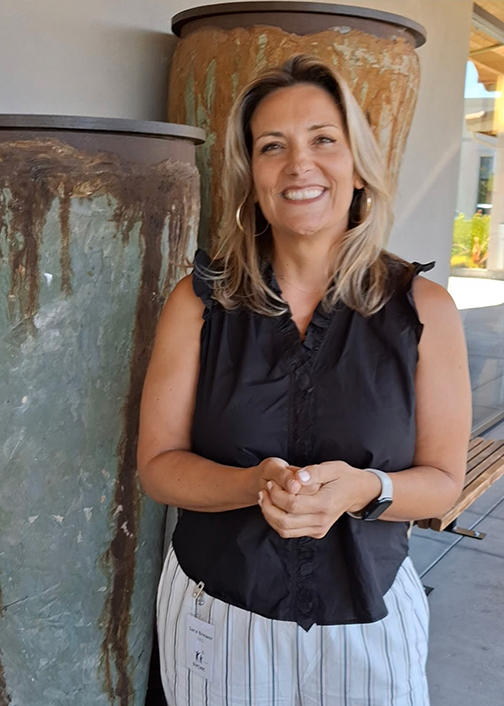
CEO Sara Brewer brings impressive education and work experience, and a passion for addressing health care disparities, to her new job at Sonoma Valley Community Health Center. Anna Pier sat down to talk with the young (46) leader about how she got to Sonoma, her goals and ambitions for the local Health Center, and the challenges she faces.
What’s your background? I was raised, with my two sisters, on a small farm in western Petaluma. My father was a journalist who wrote for the San Francisco Chronicle for almost forty years, his last job at the international desk. I studied international relations with a focus on environmental studies at San Francisco State.
What brought you to the health care field? I was working on a MSF (Master of Science in Finance) in New York when the pharma industry sued the government of South Africa for producing a generic AIDS drug to help their people. It was particularly upsetting because I’d been in the Bay Area for the AIDS crisis, when there wasn’t a drug. So I was drawn to the health industry. I went to the University of Amsterdam where I got an MS – Masters of Science, focused in International Development. What would be called Global Health today.
As part of it, I spent four months in India, in the post-disaster period following the 2006 tsunami. I saw all this well-intentioned money pour into the country, so many NGOs working, but not really working together, or at least, often at odds with the other’s priorities and without meaningful consideration of people’s wants and needs. People later said they didn’t want the help they received. For example, no one would use the village that was rebuilt with many modern conveniences as it was built too far from the sea where they earned their livelihoods, and they couldn’t afford transportation. Plus the village they built was in a flood zone that filled with snakes when it rained.
So that’s the big challenge we who purpose to help must constantly face– how do we leverage resources, being mindful of the people they’re meant to benefit?
Other background? I also got an MA in Medical Anthropology, in Amsterdam, on a scholarship from the Dutch government. I stayed and worked there for seven years in global health consultancy.
And other work experience? Since 2015 I have been working in community health in Santa Rosa, at SR Community Health Center and the Sonoma County AIDS Network.
When did you start here? June 9. Outgoing CEO Cheryl Johnson stayed to overlap with me until June 30.
How did you decide to come to SVCHC? Coming to Sonoma is like I’m coming home. It feels like Petaluma felt to me growing up. And I have a passion for addressing health care disparities, which is what SVCHC is about. And I wanted to come here because of the exceptional commitment to quality patient care. Our clinical excellence is evident in our consistent ranking in the top 5 out of 127 organizations within Partnership Health Plan. This reflects dedication to evidence-based care and positive health outcomes. These quality metrics aren’t just statistical achievements—they mean real improvements in the daily lives of our patients and families throughout Sonoma Valley.
Give me an example. As an example of current metrics, when 77.8 percent of our patients with hypertension achieve controlled blood pressure and 80.3 percent of our diabetic patients maintain optimal blood sugar control, it means fewer heart attacks, strokes and complications that can devastate families, the community and economies. By consistently achieving high quality benchmarks in controlling high blood pressure, diabetes management, cancer prevention, and childhood immunizations, among others, we’re not just treating individual conditions – we’re building a stronger, healthier Sonoma Valley community where families can thrive and our neighbors can live their fullest lives.
Can you comment on how it has been for you to transition from the global to the local, rural health scene. It’s a lot of the same work and focus. I just have other innovative, grassroots solutions and alternative systems to compare ours with and draw from, and a global network of people with whom to share ideas.
Challenges with the new federal administration? Our ability to offer our services at a sliding scale is supported by a $1,791,357 HRSA (Health Resources and Services Administration) award that is subject to new restrictions and compliance requirements. But there is a tension between those, and our status as a Federally Qualified Health Center (FQHC), a legislative mandate to serve all people, making us liable for turning someone away. A different challenge is the extraordinary list of words that we cannot use, including “community” and “women.” That’s why we use “SVCHC.”
And right now it’s still wait-and-see what happens to California’s expansion of care to all. With regard to other actions of the federal administration, Health and Human Services (HHS) has given no guidance, just “you can’t ––.” Meantime, the suit brought by California’s Attorney General and 22 other AGs bought us two months.
Can you describe in a sentence what you imagine will be the effect on SVCHC of the Medicaid cuts? We are going to continue to see patients, but will likely have to get very creative and lean to do it, and people will have to make hard choices again between healthcare and everything else. We’re mostly funded by reimbursement, either to Medi-Cal, Medicare, private insurance, or self-pay. We rely on grants and donations and that dependence is about to increase as available Medicaid funds start to go away in 2026 and 2027. We will definitely see an impact on our ability to provide services in-house. We will still provide Behavioral Health, Dental, Optometry. I am determined that we remain true to our mission, serving the underserved with quality health care.
Family? I have four-year-old twin boys. They keep me very busy. We live on the 5-acre organic farm where I grew up. They love helping their aunt with her organic produce business, washing vegetables and hanging them to dry, digging, all of it.
I expect you don’t have much free time. You’re right. But I do enjoy the outdoors when I can – hiking, camping, kayaking, walking. I also enjoy watching documentaries, learning about history and interesting historical figures, listening to podcasts about politics and current events. I have a regular meditation practice. Also I exercise regularly – which I finally figured out is more about my mental health than physical health.
Dream as a girl? I think I wanted to be an actress but realized I’m too shy for that kind of exposure. As I got older, I realized I just wanted to help, but spent many years figuring out what that meant for me. I’m pretty happy with where I ended up!
What gives you hope in this new job? There is an extraordinary group of people working here. Dedicated to each other and to the community. That’s why I wanted to come here. It’s clear they have very deep roots in the community. Everyone in the Clinic has a role in the care of our patients.
Is there any last thing you would like to tell our readers, the community? This is our chance to work together and think outside the box for our community. The consequence of public health funding cuts is a public health crisis, and I believe Sonoma has and will again work together to show up for one another to avoid that.
And I’m trained at looking at resource-poor systems. We’re going to get through this. And I hope that the larger community understands what we are facing, and shows up to help – to volunteer, offer ideas, join the board, give money, help us think outside the box. I want to shout from the rooftop, “We have the best quality healthcare nationwide! Help us keep bringing it!”



Be First to Comment