
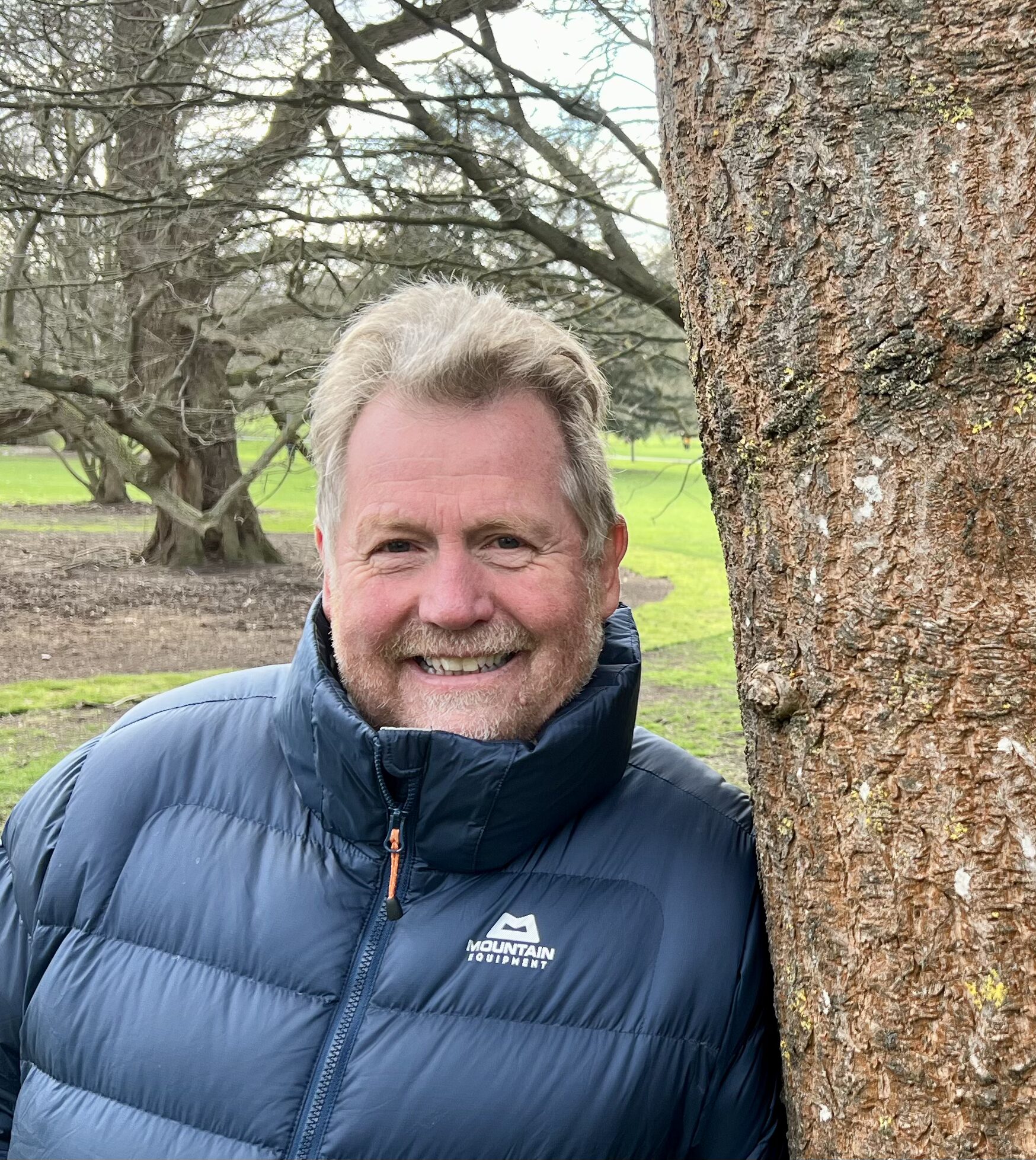
Friend and Collaborator of Sonoma Botanical Garden
An authoritative figure in tree health, conservation, and education, Tony Kirkham, MBE, VMH, has helped shape public understanding of trees’ importance to ecosystems and human culture. Between 1996 and 2011, he partnered with Sonoma Botanical Garden (originally Quarry Hill) on approximately a dozen botanical expeditions to document, study and collect wild plants in East Asia that today form a significant part of the Garden’s collection. He will speak at the SBG Garden Gala in October. Anna Pier had the pleasure of a long virtual visit with Tony in his home in England.
How did your connection to Sonoma Botanical Garden begin? I was working for the Royal Botanic Gardens, Kew, and I was invited to Sonoma, where I met Jane Jansen, founder of what was then called Quarry Hill (QH). I was invited to join the QH Advisory Board, with many eminent biologists and horticulturalists. I got to know many Board members, and to form a relationship with the Garden. Between 1996 and 2011, I partnered with the Garden on approximately a dozen botanical expeditions to document, study, and collect wild plants in East Asia that today form a significant part of the Garden’s collection. This includes the amazing opportunity to visit and collect seeds in China.
Why China? China is nicknamed “the mother of gardens.” So many of our familiar garden flowers originated there – peonies, chrysanthemums, just to name a few. Jane Jansen had a vision of a garden with Asian plants, particularly Chinese. When China became open in the 70s, Jane put up the money, and Kew got the difficult-to-obtain permits from the Chinese government. We formed a relationship, actually a partnership, with the Institute of Biology in Cheng Du, and they helped us with vehicles, drivers, etc. My first expedition to China, with Bill McNamara, the Director of Quarry Hill, was in ’96.
How many expeditions to China have you been on? Five total. Before China, I collected seeds in South Korea and Taiwan. In China, I witnessed some fantastic places, visiting “undisturbed forest.”
Why seeds, not small plants? It’s better for conservation efforts than digging up something. And we are on long expeditions, so seeds are light, small, and store easily. And can survive. Every seed is potentially a different genotype. For a formal ID, we take a “herbarium voucher.” We would collect three specimens of each tree – one for Kew, one for UC Berkeley, and for Cheng Du. When you collect, you give each seed a number which corresponds to your field notes. It’s an exact location that you could find with GPS.
Can you describe a typical collecting day? The work starts in the early morning, and we collect 30-to-40 seeds that we are drying, changing papers. We keep detailed field notes. We are gathering as much information as possible for the grower, about the soil, the aspect, the tree’s companions. I have many journals for each trip. We work on the day’s collection until late at night, and often a bottle of whisky would help.
What happens when you return from joint expeditions with the seeds? We would split them among the sponsoring gardens, Kew, Quarry Hill and Northumberland. We’re very competitive to see who can grow what tree. The trees are like my children.
Among your contributions to the Botanical Garden? I collected and planted the remarkable, rare Chinese tree, Emenopterys Henry, that had a spectacular bloom this season at SBG. My wife Sally and I came to Quarry Hill to see the first flowering of it.
Many visits to Sonoma? Yes, we’d come over for holidays – Sally and our two children. We stayed in the cottage at the Garden. I got to know the Garden trees. The incredible thing about SBG is the ‘borrowed landscape’ behind it. The Mayacama Mountains. I love Sonoma Valley, I love Glen Ellen. And on those trips we would visit Yosemite, Armstrong Redwoods, and other California parks.
Do you have role models? Ernest Wilson is my hero. Between 1899 and 1910, he did four expeditions, two for Kew and two for the Arnold Arboretum at Harvard University in Boston. He has a book of photographs taken between 1908 and 1910, “Wilson’s China.” Not a lot has changed. And he wrote “A Naturalist in China.” The trip he describes, which took 13 days’ travel, now would take only three hours.
You are an author as well. I have written ten books on trees – despite failing twice my English language classes as a boy. Many of them have become international arboricultural reference books.
Where did you grow up? Where do you live now? I grew up in Lancashire County in rural Northern England. There were lots of trees. And I was in the Scout movement. I knew at a very early age that I would work with trees. When I left home at 16 years old I moved to Surrey in southern England. I now live in Twickenham, south of London, with Sally, my wife.
Formal education? I left school and home at 16 to do an apprenticeship in forestry. That’s when I realized I needed to study more to do what I wanted to do with trees. I have always loved trees. So I did a three-year intensive program at Kew, which has one of the world’s most diverse tree collections. When I graduated, I took a post as a Manager in Kew. Eventually I moved up to the top job.
In your career you have been acknowledged with amazing accolades, including the MBE and VMH (Victoria Medal of Honour) from the Royal Horticultural Society, in recognition of your contributions to tree preservation and education. Can you talk about receiving the MBE. I was presented with the British Empire Medal by Prince William at Buckingham Palace. It was a magical moment as I was with Sally my wife, Jennifer my daughter and Robert my son, so a real family occasion.
Can you talk about climate change? The escalation of global warming is unimaginable. Arboric culture – tree culture – is so necessary, but it is very different to establish trees now. A resilient landscape requires diversity. Botanical gardens are really important for tree selection for diversity and resilience. Seed collecting is easy, however, in the U.S., as there are no permits, you just need the permission of the owner. That opens the possibility of distribution worldwide.
You retired after 47 years at Kew. I don’t think I’ll ever retire. I am busier now than before, with consultancy, helping create new arboreta. I am a trustee of four horticultural organizations, including the Royal Horticulture Society.
Plans for after you are in Sonoma in October for the Gala? Sally and I will drive up the coast to Seattle, tree-hugging all the way. You can never do that enough. I’ve hung up my collector boots. But we will visit coastal redwoods, and Glacier National Park.
Last thoughts for our readers? It is so good that Sonoma Botanical Garden has opened its door to the public, and offers lots of activities to draw people, to raise awareness of plants in the wild. And especially their programs for children, who are the custodians of this planet. They need to learn the importance of plants far and wide, including trees and their important role on the planet.



Be First to Comment