
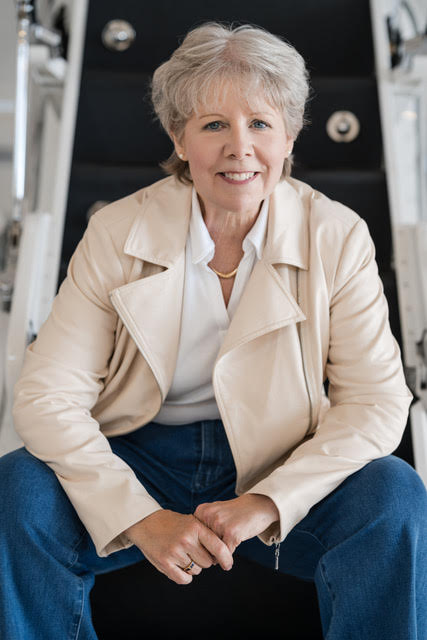
By David Bolling
When Heidi Porch was four years-old she almost drowned in a neighbor’s swimming pool. “There was no pulse,” she says, “I was clinically dead.”
She was saved by her 16-year-old lifeguard godmother who had just learned mouth-to-mouth resuscitation. Ever since she has had a tenuous relationship with bodies of water.
That fact holds a particular irony when Heidi followed her dreams to fly, became a licensed private pilot, and eventually landed a job delivering small planes across the open Pacific. On one of those flights the oil pressure on her Cessna 182 began to drop when she was still hours away from Hawaii.
Heidi had grown up with airplanes, her father was an avionics engineer, had a small plane when she was a child, and on weekends they would go flying. Proximity to propellers and airfoils came early and the direction of her life unfolded automatically. “It was as if there was no conscious choice, it was ‘That’s it,’ I had tunnel vision my whole life, and I never wanted to be anything else. In high school, kids didn’t know what they wanted to do. I did. I just didn’t realize I was a freak.”
She put herself through college, taking flying lessons when she could afford it, started in gliders and worked into prop planes at a glider ranch near the Nut Tree resort outside Vacaville. As she amassed prop time a small ferry service moved into the nearby Nut Tree airport with a contract to deliver planes from the Cessna factory in Wichita, Kansas to Australia and New Zealand.
“I went over and said, hey, I’d love to be a domestic ferry pilot for you. I’m not interested in doing water stuff, that’s really stupid. But I’ll do as many domestics as you want.”
Pretty soon Heidi was flying domestic deliveries full time. “We’d fly them to California as hard as we could, because if something was going to break we wanted it to break over land. We’d go max power, low to the ground. We worked everything, flip the radios around a lot, just give it a good workout.”
The overland trips were good runs with lots of hours, and Heidi racked up 32 deliveries before she thought, “Yeah, I think I’d like to try an over-water one, maybe they’re not so nuts.
“I’d hear these guys talking about Pago Pago and Fiji and Hawaii. I’d been to Montreal once, and Detroit. I hadn’t even been to Disneyland. So it sounded pretty exotic and I thought, I’d just like to try it once, see what it’s like, and say I’ve done it and check off that box.”
And then there was Bob Grantham, the dapper, veteran ferry pilot who mentored Heidi as both friend and then lover, who shared his vast experience, trained her on multi-engine airplanes and offered to share his life.
“I wanted to become a commercial airline pilot. All he wanted to do was ferry-fly. That was it. He wanted to get married and I’m thinking, I don’t know where I’m going to end up. But he’s happy to see me have my dreams, maybe this will work. So we had a dinner date set for Christmas eve, and I was going to tell him then, that I think this will work. And it was that Sunday night, a ways from Hawaii, that he ditched and died.”
The pain of losing Bob did not stop Heidi from flying over big water. It was a challenge, but Heidi had been crushing challenges all her life. She did five convoy crossings – with companion planes – in the first seven weeks.
“We were doing something that only a handful of people do in the world as a profession. You get to see things nobody else sees. People think flying over the water is going to be really boring, but every hour and a half it looks completely different, the angle of the sun, the clouds…”
Heidi flew five crossings in her first seven weeks, all convoy fashion with other pilots on her wing, but she knew what lay ahead. “They were grooming me for a solo flight.”
Her first solo involved one leg of 2,256 miles to Pago Pago, an 18-mile long needle in the Pacific haystack with an airstrip on the back side of a mountain range, “So you didn’t want to get in there after dark.” Navigating by dead reckoning is not like following the friendly, disembodied voice of a GPS recording. And, says Heidi, “There’s no auto pilot on these things, so you’re constantly kind of drifting. But then you have to take your wind velocity and direction, and plot what is that drift, how many degrees is that going to drift me left or right, and then set up a correction, and that gives you your compass course.”
Miscalculate by less than one degree over 2,000 miles and you join Amelia Earhart, searching for Howland Island as your gas burns away. But Heidi nailed it, coming within 17 miles of Pago Pago when she got a course correction from the island and landed safely.
For her tenth ocean delivery, she flew a convoy with her boss Earl, and, explains Heidi, “That Cessna 182 was the first used airplane I had taken across. They had done an oil analysis and there was nothing unusual, except that I was going to be powered down a little bit to stay even with Earl, who was in a slower plane.”
“Across” was of course the Pacific, and the first leg was 18 hours from Vacaville to Hilo on the Big Island of Hawaii.
“About 11 hours into the flight I noticed the oil pressure had dropped a little. Normal operating pressure is 60 psi. Quite commonly it would drop down to 55 psi because your engine’s hot and the oil thins out. That’s no big deal. But 20 minutes later it had dropped down to 50 psi. So I called Earl – we were side by side – I said the oil pressure’s dropped. He said it normally does. I said no, it’s dropped some more.
“He said, what do you want to do? ” I thought about it and said, “Well, I think I’ll try and call a May Day.” He said, ‘Well, go ahead.’”
So Heidi got on the radio and called Honolulu. “Because it was still so surreal, I said this is Cessna blah, blah, blah, I have a possible May Day. And there was a Navy airplane in the area, the pilot hears that, and he says, possible May Day? You’re either pregnant or you’re not.”
There was no GPS then, Heidi flew by dead reckoning, so she gave the Navy plane – a Lockheed P3 Orion headed home to San Francisco – her position as close as she could tell, and their response was, “Do you want us to turn around and see if we can find you?” She said yes, and within 20 minutes the Orion had her in sight. But meanwhile, the oil pressure kept steadily dropping, Hilo was more than 500 miles away, neither the Orion nor Earl could land on water, and there was no boat nearby. The Cessna kept on flying but its vital signs were beginning to look terminal.
“The uncertainty just drove me nuts,” Heidi remembers. “My hands shook a little and I was constantly thinking, am I going to make it or am I not? And then finally, after 10 minutes, I was mentally exhausted and I said, just make up your mind, are you going in or not? And I said, yes, I’m going in.”
First Heidi took the plane up from 6,000 to 8,500 feet so she’d have a longer glide path when the engine quit. Then she made a checklist and stowed as much loose equipment as she could while preparing for impact with the sea.
An immediate problem was the 90-gallon auxiliary fuel tank stuffed into the entire front passenger space of the airplane.
“The edge of the tank was right next to my head. And my concern was, when you stall it you have no control, and if one wingtip drops lower than the other, it’s going to cartwheel. And if it cartwheels the wrong way, I’m going to hit the edge of that tank right at my temple.”
Heidi opened the door so that, if the fuselage twisted on impact, it wouldn’t jam shut. Then she pulled the life raft bundle onto her lap and tied it around her waist with a lanyard. That kept it close and doubled as a makeshift airbag. But then, she couldn’t reach the rudder pedals, she couldn’t see over the nose anymore, and could only look out the left window.
In the following moments, Heidi firmly believes, Bob came back to her. She thought she could hear him laughing, then there was a reassuring pressure and what felt like the warmth of his hands on her shoulders. He was there for a while, and then he was gone. And very soon after that, so was her engine.
“When the engine finally quit, it was just a big glider, and my first response was, it’s so beautiful out here. It was the first time I had been up there with no noise. The prop was still windmilling, but by the time I got down to 4,000 feet it seized too.”
Heidi began the long glide into the Pacific and just above the surface, traveling at 63 knots – or about 72 miles an hour – her main landing gear touched the water, the plane bounced in a straight line, and then the nose hit, grabbed and pitched over, ending up in a 45-degree inverted angle.
As the plane pitched over onto its nose, she remembers hearing herself take a deep breath, and in that breath she had water.
“It was an explosion of water, instantly, and I remember graying out from the deceleration.” Heidi had tightened her four-point shoulder harness before impact, and although she was bruised, she wasn’t broken. But she was upside down, very disoriented and on the verge of drowning again. The childhood memory was as clear as yesterday and she heard herself saying, “get out, get out. No one’s going to save you this time.”
She reached to unbuckle her harness and the raft was gone. She found the door, it moved open and somehow she flailed to the surface and climbed on to the overturned wing. The still-bundled raft was floating nearby, she pulled it close, triggered the inflator and watched it fill with air…upside down. Frantically she managed to flip it right-side-up before it was fully inflated.
A wave knocked her off the wing and after a struggle in the water Heidi heaved herself into the raft and then pulled herself back toward the plane by the lanyard to retrieve a radio, some water, food and extra flares. But before she could get there, she discovered the lanyard was both wrapped around one ankle and snagged somewhere on the slowly descending Cessna. She quickly pulled an emergency knife off the raft to cut the lanyard before the plane carried her into the deep.
“Everything went down with the airplane. I just had the minimum supplies in the raft. The last thing I saw of the airplane was the inverted tail sticking up like a cross.”
Heidi was in the water at 2:40 p.m. and her ordeal was far from over. While Coast Guard planes repeatedly flew overhead dropping marker flares, she could no longer communicate with them. She knew a ship would come to her rescue, but she didn’t know when. As day turned to night the swells grew from 2 feet to 12 and she was afraid the flimsy raft would capsize. At one point the tension inside her broke free and she screamed into the wind for 10 minutes straight.
And it came to her, during her long wait, that she was in the Pacific less than 50 miles from the spot where Bob Grantham had disappeared two years before.
Her ordeal ended in the dark, around midnight, when a Russian ship on its way to the Middle East followed a pathway of flares dropped by a spotter plane, sent out a launch that almost missed Heidi in the heaving seas, but heard the rescue whistle she blew until her cheeks ached, and hauled her into safety.
Transferred to an American destroyer she made it to Hawaii some two days behind schedule and without an airplane. She was an instant international celebrity and mobbed by reporters and TV shows, to whom she said with no hesitation and a radiant smile, “I’m looking for a job with a commercial airline.”
Heidi, who lives in Kenwood, got that job, and flew for years for Delta, taking early retirement in 2020 because of COVID, after “having a ball flying Captain of an Airbus 330.” A year later she took a job flying a private business jet – a Gulfstream 500 – for a Sonoma family with homes on the East Coast. Then she decided to finish writing the book she had started (“Ditching The Sky”), and which she will share with the public at Readers Books in Sonoma on September 30 at 6 p.m..
Of note – Heidi narrated an audio version of her book, and it was nominated as a finalist for the 2025 AUDIE AWARDS in New York City, in the category of Best Narration by Author. The previous year’s winner was Whoopie Goldberg. She is currently working with a producer to turn her book into a film.




Be First to Comment