
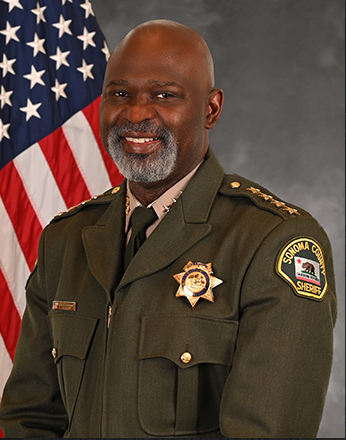
The people of Sonoma County deserve the strong civilian oversight of law enforcement they’ve asked for, delivered by government agencies that work together in good faith to deliver just that. Achieving this goal is possible but must be done responsibly and with deference to constitutional rights and respect for California law. To that end, I have declined to issue an order compelling deputies to interview with the Independent Office of Law Enforcement Review and Outreach (IOLERO).
Some critics have portrayed this decision as resistance to oversight. The reality is exactly opposite. I fully support transparency and accountability, but not at the expense of constitutional rights, state labor law, and court rulings. Since becoming Sheriff, I have increased the Internal Affairs budget, added an Internal Affairs investigator position, and changed several policies based on IOLERO recommendations.
All public employees, including deputies, retain constitutional rights. Chief among these is the Fifth Amendment protection against self-incrimination. In law enforcement, that right is safeguarded through a Lybarger admonition, a process based on case law which allows an officer to answer questions in an administrative investigation without those answers being used in a criminal case.
Lybarger protections apply only when the interviewing agency can discipline the employee. IOLERO cannot fire, suspend, or demote deputies, so it cannot provide these protections without an agreement with the Deputy Sheriff’s Association (DSA). Forcing deputies to participate would almost certainly be challenged at the Public Employment Relations Board, as Measure P was when it was passed. The deputies prevailed, and key sections of Measure P were ruled unenforceable. If deputies were compelled to give statements, those statements could be used in criminal proceedings, potentially violating their constitutional rights. The absence of current charges from a district attorney does not preclude the California Attorney General from filing charges in the future, and no responsible law enforcement leader would expose their office to such a risk.
Beyond constitutional concerns, labor law also applies. The Meyers-Milias-Brown Act (MMBA) requires that any change in working conditions, including ordering deputies to participate in IOLERO interviews, must be negotiated with the deputies’ union. This “meet and confer” process is mandatory under the law. I am not a party to these negotiations; that responsibility lies with the County and the DSA. Failure to do this when Measure P was passed is what invalidated many sections of Measure P in the first place. Until a lawful agreement is reached, I cannot unilaterally impose new requirements. Doing so would violate labor law and risk costly litigation for the County, all toward an outcome that is entirely predictable based on previous rulings.
IOLERO has suggested I am alone in this approach. That is incorrect. Out of California’s 58 counties, only nine have any form of sheriff’s oversight, and most of those are advisory. San Francisco is the only county where deputies are compelled to participate, but that voter-approved oversight provision was negotiated with labor groups before placement on the ballot. In San Diego, deputies are invited but not compelled; in Los Angeles, negotiations are ongoing. In neighboring Marin County, labor groups are preparing to negotiate compelled testimony following a recent oversight ordinance.
IOLERO has also cited Berkeley and Oakland. But in those cities, police chiefs are subordinate to city councils, which can direct officers to participate in oversight interviews. Even there, these arrangements were negotiated with the employee associations.
The reality is quite clear: where compelled oversight exists, it is the product of labor negotiation and respect for the law, not unilateral orders.
When Measure P was placed before voters in 2020, its supporters promised greater independence and accountability. What they did not address were the inevitable and serious constitutional and labor law conflicts. It defies both the plain language and intent of Measure P to suggest that, after granting IOLERO independence and subpoena power, its director should rely on the Sheriff to compel testimony and provide Lybarger protections. That interpretation undermines Measure P’s core purpose and has led to five years of costly litigation and repeated court battles.
I am not opposed to oversight. Meaningful oversight must be lawful, fair, and sustainable. This discussion has too often devolved into either/or soundbites rather than public servants acting in good faith to deliver what the voters believed they were adopting. My decision not to compel deputies to interview with IOLERO is not a rejection of accountability and oversight, it is a commitment to protecting constitutional rights, following court rulings, and ensuring that any system of oversight is built to last.
As a candidate for Sheriff, when asked about Measure P, I always said I would enforce the provisions of Measure P that were lawful. That has not changed. Ordering Deputies to interview with IOLERO violates their rights under MMBA.
-Sheriff Eddie Engram







Legal summary: He can’t compel the deputies to talk to IOLERO because they murdered the guy..
I am currently in the process of watching a recording of the IOLERO town hall of 9-25. A lot of what I am hearing from the IOLERO director in this town hall does not fit with what Sheriff Engram states here. After I finish watching the recording I will meet with the director to make sure I understand the total scope of what this all means. At that point I will write my next column on this subject. I do wish I had not had to work and could have attended the town hall on Zoom. But, the director has agreed to talk with me, after I watch the recording.