
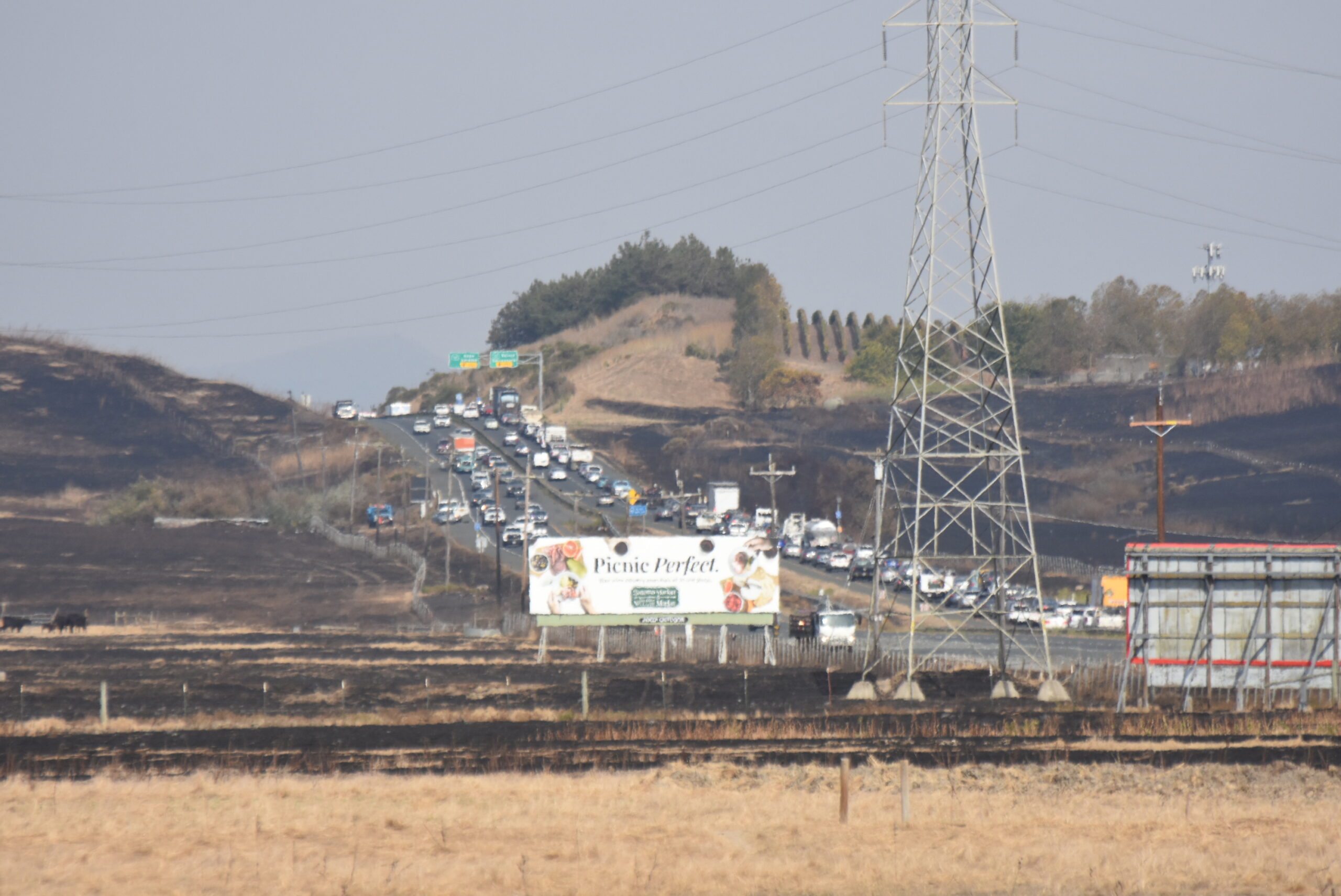
Risky Evacuations in the Valley of the Moon
By Carolyn M. Scott
Highway 12, the scenic route that slices through our Valley, is essentially a rural road. During commute hours, it requires patience; under smoke-filled skies, it requires a miracle. As five major developments converge on the Valley of the Moon, the miracle we need is being replaced by a bureaucratic process that threatens to dismantle the very foundation of our community.
The Missing Big Picture
The county currently has plans for five major developments in the Sonoma Valley pipeline. They include the Sonoma Developmental Center (SDC), a Boyes Hot Springs mixed-use project at the Boyes Food Center site, Elnoka – a 275-unit senior housing project between Kenwood and Oakmont, Kenwood Ranch – the Soho House property in Kenwood, and the Verano Hotel, 120-room hotel, combined with 71 deed-restricted affordable apartments – off Verano Avenue across from Maxwell Village Regional Park. By law, the County is required to perform a cumulative impact analysis to determine how these projects, when taken together, affect our infrastructure.
To date, no such comprehensive study has been conducted to see how these five projects combined will strain an evacuation route that – as a community-funded study released last year concludes – is already at a breaking point. Without this data, we are flying blind into a future of unprecedented density.
The Math of an Evacuation
While developers speak in terms of “units,” and “profit margins,” the local Glen Ellen community and nonprofit Valley of the Moon Alliance (VOTMA)-funded Fire Evacuation Study speaks in terms of minutes and miles. The results are a sobering reality check.
The study found that full evacuation of a wildfire storm in Sonoma Valley involves 27,300 people and 25,000 evacuating vehicles, joined by 9,000 others traversing the corridor. The projections are stark: just one hour after an evacuation order is announced, traffic on Arnold Drive and Highway 12 effectively stops. Speeds drop from 45 mph to a grueling 1–2 mph.
Most alarming is the total clearance time. The study predicts it will take five to seven hours for people to get out of the Valley during a wildfire. Adding thousands of new residences would add at least another hour of gridlock, pinning thousands of cars in place while a fire approaches.
“People Will Die” – A Stark Warning
This data provides the backbone for chilling testimony from veteran firemen featured in the documentary Small is Beautiful. Their assessment was blunt: projects like Elnoka and the SDC are being greenlit without infrastructure matching our fire-prone landscape. One retired fire chief labeled the SDC’s environmental impact report, “a joke,” adding a haunting prediction: “People will die” if these dense developments are built.
The Death of Local Control
The heart of this crisis is the expanding scope of centralized land-use decisions. Large-scale housing requirements have prioritized raw numbers over the complexity of regional safety, forcing a fragmented approach that bypasses local oversight.
When we lose local control of our land, we lose the ability to protect our neighbors. Local planning is about intimate knowledge of terrain and wind patterns. Distant bureaucrats see only “underutilized” parcels. This “strip-mining” of local democracy centralizes power away from the people who actually live here, erasing the unique nuances of Sonoma Valley.
A community is a social contract – an agreement to respect community values and build a safe environment. When the state overrides the California Environmental Quality Act (CEQA) and ignores safety concerns, that contract is torn up. We are left with the responsibility of surviving the fire, but none of the authority to prevent the congestion that makes survival impossible.
The Road Ahead
City planner Kristinae Toomians recently reminded a local crowd that Elnoka is still in its early stages. Burbank Housing’s vision for 275 units includes open space, but the infrastructure timeline remains the sticking point. The flaw remains: external pressure demands we build more while taking away the power to ensure residents can actually escape.
For those of us who call this Valley home, this isn’t just about resisting growth. It is about the fundamental responsibility of government to ensure growth doesn’t come at the cost of lives. We must decide if we will fight for our safety or allow the loss of local authority to bypass the measures that kept us standing after the Nun’s Fire in 2017. The stakes are life and death. If we do not maintain control over our land, we forfeit the ability to protect our lives.
To better understand the gravity of these findings, Glen Ellen resident Dr. Bean Anderson has animated a short presentation of the evacuation study that VOTMA commissioned. The visualization shows exactly how long and where traffic will be during a wildfire evacuation.





The need for more housing and the need to maintain fire-escape safety are clearly at odds in our valley, where Hwy 12 and Arnold Drive are the only — and quickly clogged — escape routes. What, if anything, can be done to have both?
There may be lessons to take from the far-larger horrors of London — in WWII — and the current war in Ukraine, where ‘escape’ on even wide roads was/is not an option at all to survive death raining from the skies.
Possible solution to The Perfect Storm:
Some or all of each new housing development of a certain size might include built-in & fireproofed underground “fire shelters,” (not unlike bomb shelters) stocked with limited water & other supplies where residents who would otherwise be forced to evacuate on clogged roads could safely shelter from fires overhead until it was safe to come out.
Yes, it would drive up the costs of these projects but the alternatives are no or reduced new housing (which is badly needed) or senseless deaths on roads clogged with burning cars.
Shelters worked in the deadly ‘blitz’ of WW II London, and in Ukraine. Properly built, equipped and ventilated, they would work now in the Valley. Yes, added cost must be dealt with perhaps by “creative financing”/state assistance, but it seems a way to meet both objectives.
I live on the east side of Arnold Drive. My driveway is around the corner. Already hard to make a left turn on to Arnold at almost any time of day. More than enough traffic as it is. Another 2,000 cars a day from the development center is not acceptable and in the case of emergency – disaster!