
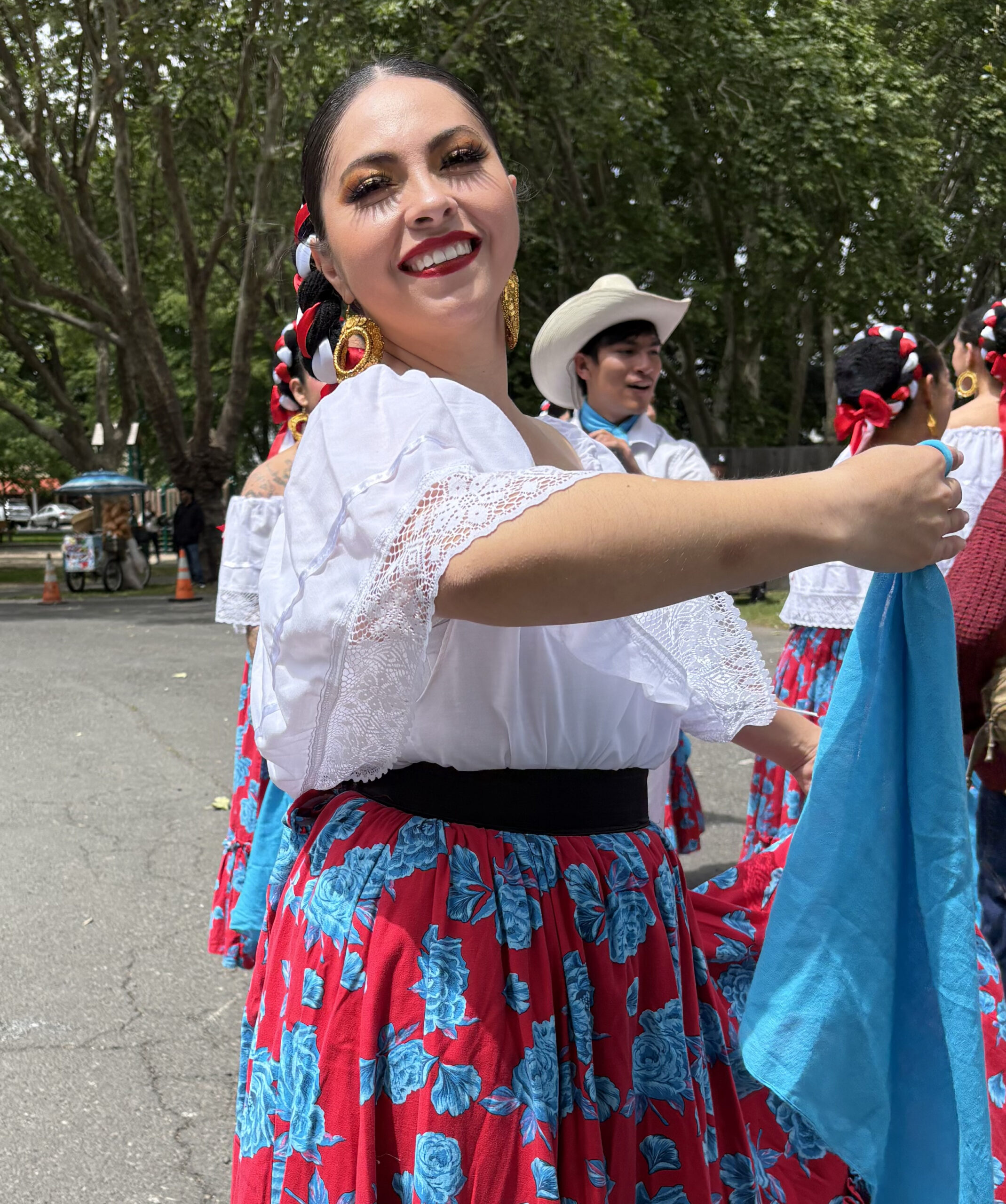
Anticipating the celebration of Mother’s Day, Anna Pier sat down to speak with 34-year-old Carmen Farías, who gracefully combines her roles as wife, mother, integral supporter of Quetzalén folkloric dance group, and educator committed to the migrant community.
You were dancing at the Cinco de Mayo event in the Plaza. Yes, with the adult dancers of Quetzalén. Many of us are parents of children who dance with Quetzalén. For me, it is something I have loved since I started in 2011, when it was only young adults. My husband, Víctor Ferrer, is the Executive and Artistic Director of the folklorico group, and he danced today as well.
It’s an important endeavor for the community, especially in these difficult times. I can see that it benefits the community, and provides an opportunity to “de-stress.” And it was wonderful for Víctor to be recognized as Treasure Artist of 2024 for his creation and direction of the school-age dance group, a benefit to the whole wider community.
Where were you born? In Mexico, in the state of Michoacán, in Santa Clara del Cobre (which means “copper”), near Pátzcuaro. I went to “primaria” there, grade school. I was one of the only girls who played soccer with the boys. And I loved playing marbles. There were five children, I was in the middle between an older brother and sister. Our father had been working in Napa, first as a day laborer picking fruit for years, and he came back and forth between there and our little town in México. When I was eleven, my family moved to Napa.
What was your status as immigrants? We were very fortunate. My father had applied in 1992 for himself and the whole family to become citizens. We crossed the border with papers. He became a citizen in 2002, and we children automatically became citizens too. My four siblings all live in northern California.
I first met you when you applied to be a teacher in English Camp, the summer program run by the CommonBond Foundation, which I directed. That’s right – in 2010. The summer before I had worked for SAY (Social Advocates for Youth). I worked with the pre-kindergarteners in English Camp. It was the only program in Sonoma for Spanish-speaking pre-Kinder children then. And that’s when I met Víctor Ferrer, who was the Coordinator for English Camp and Spanish Camp. I came back to work at English Camp the next summer, in 2011, and that’s when I started dancing with the young adult folkloric dance group Quetzalén, which Víctor was part of.
And, as they say, the rest is history. Yes. Víctor and I married in 2015. I had finished Napa Valley College, then I graduated from Sonoma State University, with a degree in Spanish. In 2016 I started working with Migrant Education. And of course, I was still dancing with Quetzalén.
Besides dancing, what do you do for Quetzalén? I am the Family Coordinator, responsible for all communication with the families, scheduling, events, etc. Currently there are about 90 students from Sonoma Valley School District. We also have dance groups in Santa Rosa, Rohnert Park, and Napa. Also, in Sonoma, we have a collaboration with the Sonoma Conservatory of Dance for about 45 of our students to study some classic ballet. The program is called BECA (Ballet En Cada Alumno – Ballet for every student). I am also the Wardrobe or Costume Director, responsible for all the costumes. We have costumes for 25 different regional dances from Mexico.
What did you dream of being when you were a child? I wanted to be a teacher. Although I am not teaching right now, everything I have done and do is related to teaching others.
Tell me about your work with Migrant Education. I was first a tutor with MiniCorps, when I was at Napa Junior College. I work now as a Family Recruiter, finding families who work in agriculture and have recently moved to Sonoma County, to be able to provide them and their children the services the federally-funded program offers. The focus is on supporting their children’s education.
Talk about your children. Our daughter Nikte was born in May 2018. Her name means “flower of May.” She’s wanted to dance since she could walk, and she’s been dancing with Quetzalén for three years. Our son, Víctor Antonio, was born in January 2023. He has grown up around the dance group. Víctor would keep Antonio with him, even as a baby, for the mornings while I was at work with Migrant Ed. Víctor once said that our son is truly the “hijo de la comunidad,” a son of the community. He gets happily passed from dance group parent to parent during classes and even events. He already has boots for dancing.
Talk more about your parents. After picking fruit, my father worked in construction, and finally in tree trimming. My mother had a licensed day care, then worked in Sonoma at a hotel, and finally as a custodian in the school district. He and my mother have moved back to where I grew up in México, and also live part time in Oroville as well.
What language do you and Víctor speak at home? We speak Spanish, which is our native language, and because we want our children to speak more than one language.
How do you cook for your family? Most of the time I cook Mexican food, because it is a part of my roots, and what my mother taught me. But I also like to try food from other cultures. My children love Hindu food.
What do you dream of for the future? I dream that my children will be successful, and that they enjoy whatever it is that they decide to be – dancers, doctors, engineers or whatever they wish. And that they always know we support them as much as we can. I also want to have a peaceful old age, in which I can decide where I want to live, without having to think about having to work for necessity.
Last thoughts? Quetzalén takes a lot of time, but it is something that lets us all be together, Víctor and I and our children.





Be First to Comment