
By Anna Pier
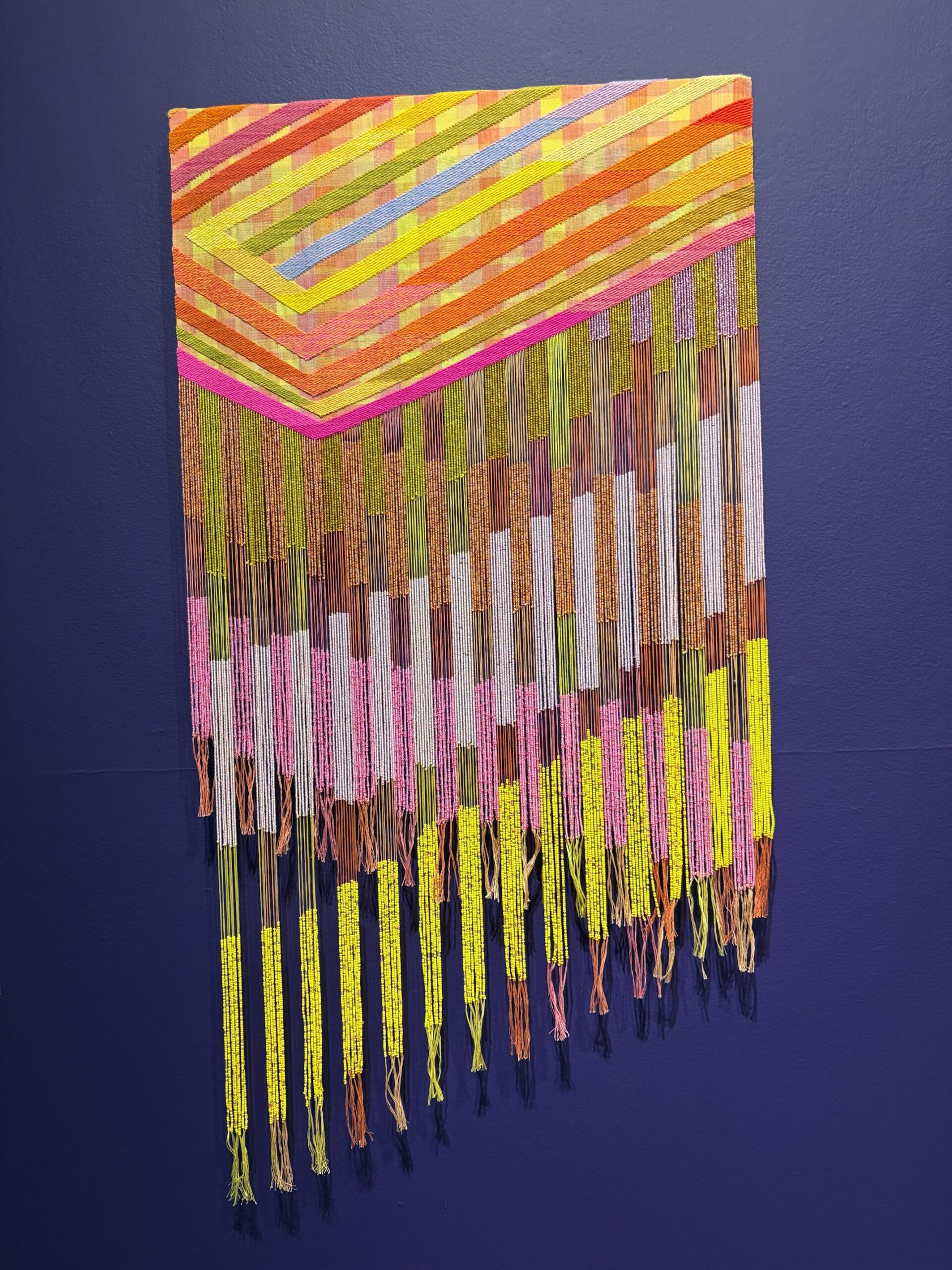
The current exhibit at the Sonoma Valley Museum of Art (SVMA) showcases remarkable and remarkably different bodies of work by two northern California artists. Each unique and compelling exhibit is a reflection of the artist’s lived experience, translated through their medium – woven tapestries by John Paul Morabito, and black and white photographic portraits by Norma I. Quintana. This is a show to be savored slowly the first time, and revisited. Spending time in one portion alone is a more-than-sufficient treat for a gallery visit; really viewing them both is a full meal.
First the visitor sees the stunningly beautiful tapestries woven of thread and beads by John Paul Morabito, comprising a collection entitled Dancing in the Night. The artist explained at the opening reception for their show that “aesthetically it’s nice to conjure up those spaces,” the discos, cabarets and bohemian dance clubs where in the ’20s, in Paris, the queer, gay and trans community found acceptance. The San Francisco artist emphasizes the more recent influence on their work of the AIDS epidemic, which devastated their community in the City, including taking the lives of many artists. Morabito pays particular homage in a tapestry to the performing artist Sylvester who died of AIDS.
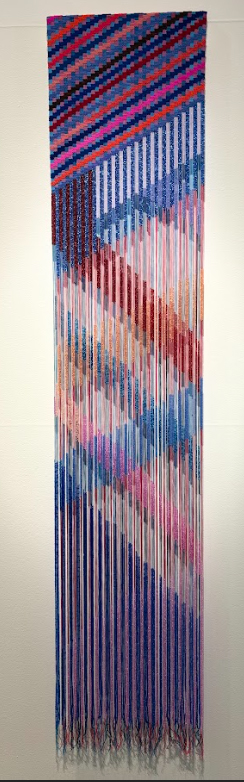
Morabito elaborates, writing as a preface to this collection, about the experience of creating their art. “At the loom, thousands upon thousands of threads are aligned moving in response to one another like bodies on the dance floor.” Their works are inspired by the animated, rhythmic movements of dancing bodies and the colorful ever-moving lights and reflections present at dance clubs since the Gay Liberation movement of the ’60s through the ’80s.
These tapestries will mesmerize the viewer. Their colors and patterns are electric, vibrant, dramatic, and painfully beautiful, expressing the joy, courage and pain of the queer experience.
Puerto Rican photographer Norma I. Quintana’s collection, Paraíso de la Memoria/ Paradise of Memory, presents a great variety of compelling photos of a single subject, most shot in front of the same painted seaside backdrop, in the style of itinerant photographers of her native Puerto Rico. These are culturally significant photos of people young and old, working-class and professional, clearly chosen deliberately by Quintana to represent their variety and their sameness. The uniqueness of each subject is accentuated by the shared experience implied by the same painted background.
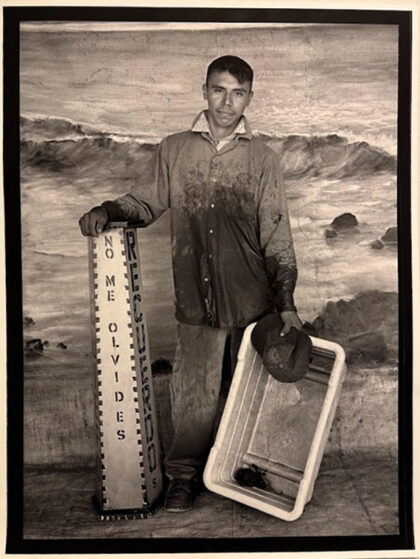
At the opening reception, the artist affirmed, “Photography helps us to understand memory not just as something we inherit, but something we build, piece by piece. … Photography for me is not just about preserving truth, as it was; it’s about tracing what remains, the gestures, the spaces, the light, the emotional resonance.” The show includes vintage and contemporary photos taken both in Puerto Rico and in Northern California. The portraits taken on the island are from the earlier years, and those in and around Napa and northern California from the 2020s.
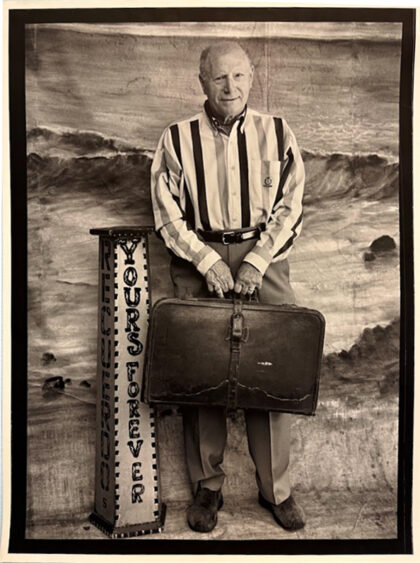
The portraits, both vintage and contemporary, have a powerful storytelling character, enhanced by the title of each work, and fleshed out by identification and details for each subject. The pair of photos of two girls with Down syndrome are deeply moving, a feeling confirmed by the note that the advocacy in the schools by the older subject’s mother for her daughter had smoothed the path for the younger girl with the same disability. Noteworthy are the pair of photographs of self-described “twin gender” Jennifer/John Marx of San Francisco, who posed at the Opening in front of the photos. They talked about the “girl glow” which enlivens them as Jennifer, explaining that Jennifer enjoys talking about this with their daughter.
The shows will be at SVMA, 551 Broadway, Sonoma until September 6. The museum is open Wednesday through Sunday, 11- 5. Admission is free every Wednesday.







Be First to Comment