
In the late 1960s, as a junior reporter in Washington, D.C., I had the great good fortune of living in an apartment, at the intersection of 23rd and G Streets Northwest, about a 15-minute walk from the Lincoln Memorial and the now infamous reflecting pool that has had the full attention of President Trump, apparently exceeding his interest in his personal War on Iran, the U.S. economy and the persistently incomplete release of the full Epstein files.
I took many a late night walk down 23rd Street to visit with Abe in solitude, to stand before his solemn and stately presence and ponder what advice he might have given about the tragically misguided war his beloved republic was then mired in across the Pacific in Vietnam. Another war built on both a failure of political courage and a transparent lie, resulting in somewhere between 1.5 and 3 million deaths.
Lyndon Johnson’s fear of being tarnished by the rhetorical weapon commonly brandished by opposition Republicans – that leaving Vietnam would mean he was soft on communism – led to his fabrication of the transparent lie, that two U.S. destroyers had been attacked by three North Vietnamese torpedo boats. We now know that the so-called Gulf of Tonkin “incident” never happened, and that the then-National Security Agency fabricated evidence to defend the lie. And the lie was the key to unlocking a massive increase in military operations in an utterly needless war that America ultimately lost. Sound familiar?
On my nightly visits to see Abe, if the sky was clear, I could look across Memorial Bridge and the Potomac River to the grounds of Arlington National Cemetery where, up the dark flank of that hallowed ground, there was a flickering flame, sometimes just barely visible, permanently burning at the grave of President John F. Kennedy.
Now Donald Trump, who seems more comfortable destroying historic monuments and building new ones to honor himself, then governing the nation or even winning the war he unilaterally started in Iran, wants to build a 250-foot-tall “triumphal” arch in the traffic circle in front of that cemetery, blocking the view of the Lincoln Memorial in one direction, and Kennedy’s eternal flame in the other. Naturally, it would somehow carry his name, as does lately the United States Institute of Peace, which sits on the corner of Constitution Avenue and 23rd Street, across from the Lincoln Memorial, which has thus far escaped a Trump-hyphenated rebranding.
But the rebranded “Donald J. Trump Institute of Peace” is a particularly personal insult, because my father, a prominent academician, foundation executive and peace activist, worked hard to help facilitate the Institute’s creation and the private funding that shared the stunning building’s expense. The Institute’s mission is (or at least was) to explore, pursue and promote non-violent strategies and methods for conflict resolution. Trump’s exceptional venality and intellectual vacuity, his near-total ignorance of U.S. and global history, and his pathetic obsession with winning a Nobel Peace Prize, are (so far) the most visible monuments of his presidency.
Trump, who has the demonstrated emotional maturity of a pubescent 12-year-old, has managed to link his eightieth birthday with the nation’s 250th anniversary, making a national celebration marking the world’s oldest democracy and, arguably, the most successful form of government, in history, fundamentally about him. All of which has caused countless recalibrations about how to honor the nation while being honest about its past, and how to counter the catastrophic impact Trump has had on the U.S. and global economy.
It is a fundamental part of American DNA that we are critical of our government, regardless of who or which party is in power. And while the freedom to do that is enshrined in the First Amendment, it is a thorn in the side of a president so pathologically insecure that he can’t tolerate criticism or dissent from any quarter, and has successfully surrounded himself with a Three-Stooges collection of sycophantic Cabinet members and political enablers who spend Cabinet sessions heaping preposterous praise on a president while he sits there like the naked emperor dressed in invisible new clothes.
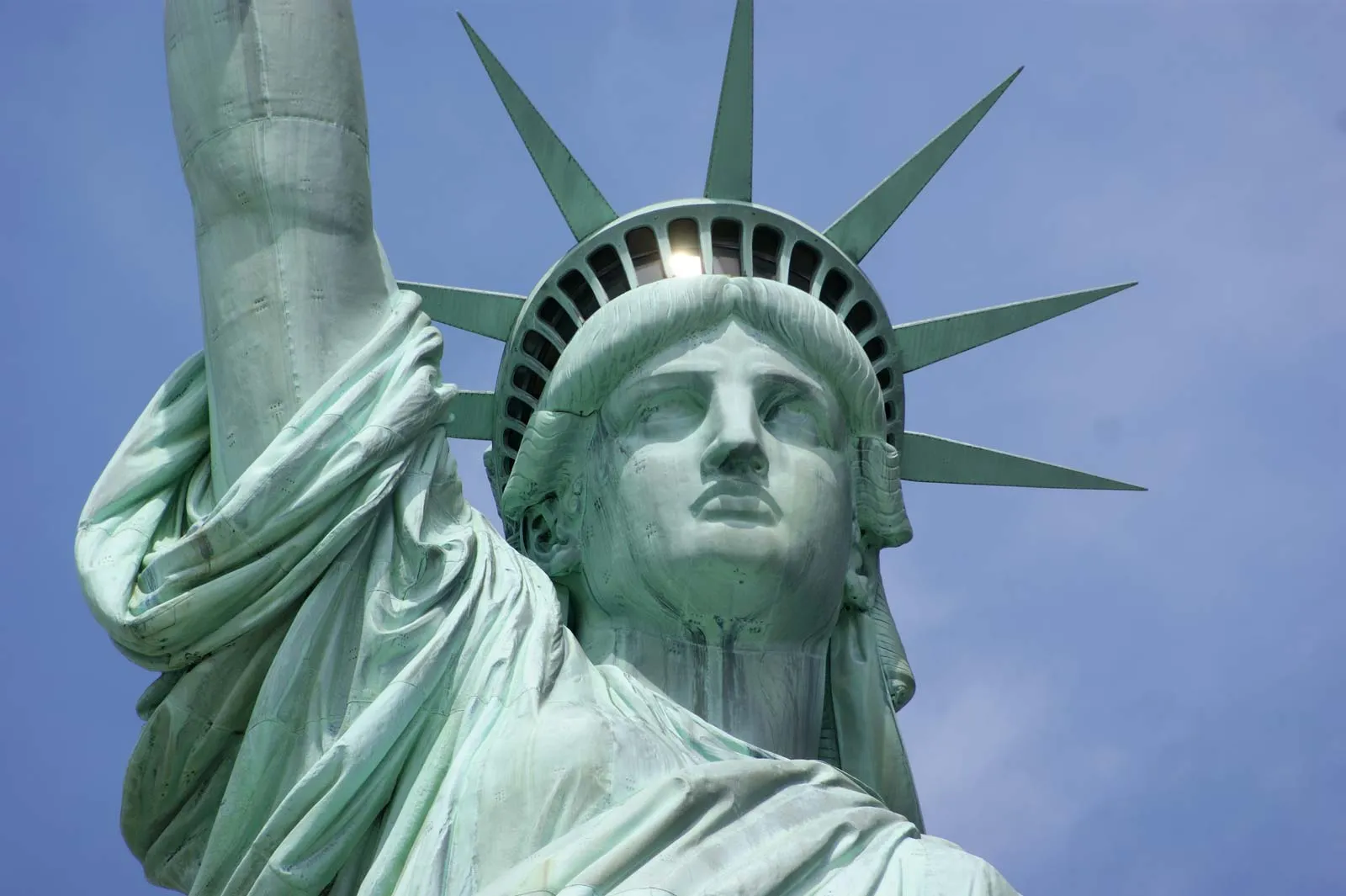
One notable sycophant, White House Deputy Chief of Staff Stephen Miller – who has both the appearance and the disposition of some feral creature birthed, perhaps, from the improbable union of a naked moll rat (look it up) and a wolverine – is the principal architect of the brutal, inhumane and frequently illegal campaign to erase millions of immigrants from residency in America. And yet, on this fundamentally important anniversary, it has never been more important to recognize, celebrate and enshrine the one word that most completely defines our country: Immigrant. That’s what all of us are. And no one has ever captured that truth better than the Jewish immigrant Emma Lazarus, who wrote the 1883 poem with the famous words now attached in bronze to the base of the Statue of Liberty. That poem – “The New Colossus” – should be read on July 4, in every home in America.
Not like the brazen giant of Greek fame,
With conquering limbs astride from land to land;
Here at our sea-washed, sunset gates shall stand
A mighty woman with a torch, whose flame
Is the imprisoned lightning, and her name
Mother of Exiles. From her beacon-hand
Glows world-wide welcome; her mild eyes command
The air-bridged harbor that twin cities frame.
“Keep ancient lands, your storied pomp!” cries she
With silent lips. “Give me your tired, your poor,
Your huddled masses yearning to breathe free,
The wretched refuse of your teeming shore.
Send these, the homeless, tempest-tost to me,
I lift my lamp beside the golden door!”



Be First to Comment