
Like a lot of journalists navigating the evolving digital landscape, I found myself out of a job after Whole Earth, the national magazine for which I was publisher, closed its doors in 2003. The offices were in the historic Dollar Mansion, also known as the Falkirk Cultural Center, in San Rafael, more or less the dead center hub of Marin County.
Not too long afterwards I learned that a publisher who had once offered me a very attractive job in Palo Alto, that I ultimately declined, had recently purchased the Pacific Sun and was looking for someone to manage it. That Sun (there must be something about the name) was a once-revered alternative weekly, by then in decline (and now a component of the Weekly news group), and because we knew each other and he had been a fan of my work, he agreed to an exploratory lunch in Mill Valley.
When we sat down together and quickly dispensed with the pleasantries, the first question he asked me was, “So David, you’d be perfect for the job, but where do you live?”
I told him I lived where I have lived for years and years, in Glen Ellen.
“Oh,” he said. “Too bad. You’re not local.”
I said, “Yes, but I just spent three years working in San Rafael. That’s pretty local.”
He smiled a “We’re done here” smile. “True. But you don’t live here. You live in Glen Ellen. Glen Ellen is not local.”
It took me about 30 seconds to stop arguing, because I knew he was right. I wasn’t local, I did not live among the readers of the Pacific Sun. I did not know them, I didn’t see them in the local market, the local restaurants and bars. Glen Ellen was about 45 miles, which might as well have been a world, away.
We had a pleasant lunch, he paid, and I went back to Glen Ellen.
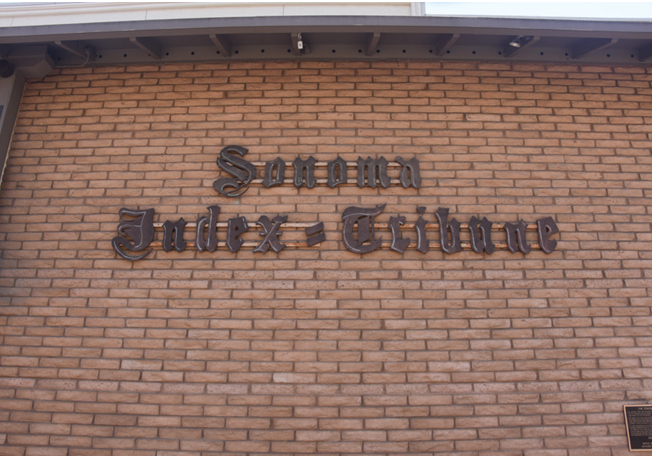
Not too much later I walked into the Sonoma Index-Tribune to apply for a job, which I was given, and six months after that Bill Lynch took me aside and asked if I would like to be editor – the first one in the IT’s storied history not a member of the family.
I was honored and humbled, and I still am. Bill and Jim Lynch extended enormous faith and trust with their family treasure, truly the voice of the community. I quickly became so familiar with so many people I often had trouble remembering their names and which story of mine they had been in. And I rapidly became more local than I ever had been in all my years as a Valley resident.
But time marches on, the Lynch brothers had reached the point in their lives when the appeal of some form of retirement outweighed the pull of breaking news, City Council meetings and profit/loss sheets.
Darius Anderson – entrepreneur, investor, deal-maker, lobbyist – bought the SIT building and the newspaper and magazine inside it. Anderson made me Editor and Publisher, paid me a little more and gave me more or less free rein, until he subsequently orchestrated the purchase of the Santa Rosa Press-Democrat/Petaluma Argus Courier publishing package and folded them into a corporate entity – Sonoma Media Investments (SMI) – along with the Index-Tribune.
From that point forward, the siren call of economies of scale led to the elimination of corporately-redundant departments, and the transfer of fundamental newspaper services like ad sales, circulation and ad design to Santa Rosa and the far larger departments of the Press-Democrat. In the space of a year, by my calculations, the Index-Tribune had lost more than 100 years of staff lives and relationships in Sonoma. Which meant that if a subscriber had a circulation problem, they couldn’t solve it at the I-T office near the Plaza, they couldn’t drop by the front desk and talk to Barb, who probably knew them personally, they had to call Santa Rosa. And if an advertiser needed to make a last-minute change in an ad, they couldn’t come to the office, sit down with Yvonne or Laurie and make changes on the spot, as they once had; they had to call someone in Santa Rosa they didn’t know and might never meet or talk to.
And if they wanted to talk to the editor, they could come right over and see me; I did not have an office in Santa Rosa.
As the pattern of transferring operations out of Sonoma escalated, I tried to rein it in, ultimately concocting the naïve plan to ask Anderson to sell the paper back to a nonprofit board I would assemble.
He didn’t take the offer seriously, so I quit. That was in 2014. Last May, after investor loans had long since been paid back, Anderson engineered the surprise sale of SMI to one of the media subsidiaries of Alden Global Capital, a New York hedge fund described by critics as “vulture capitalists,” famous for “strip mining” weak and failing newspapers by slashing staff salaries, selling off real estate and inventory, and extracting punishing levels of profit at the expense of liquidity and staff size.
The Alden formula played out according to script last week when the Sonoma Index- Tribune announced the closure of its Sonoma office, in the iconic Lynch Building, which was, ironically, purchased in 2012 by Darius Anderson.
As a former editor, publisher and grateful participant in the last secure era of that historic and outstanding community newspaper, I am deeply saddened.
Readers are urged to anticipate no change in coverage and quality with the absence of an office. But the harsh reality persists: The Sonoma Index-Tribune does not live here anymore. It’s in Santa Rosa.







Be First to Comment