
By Kate Schertz
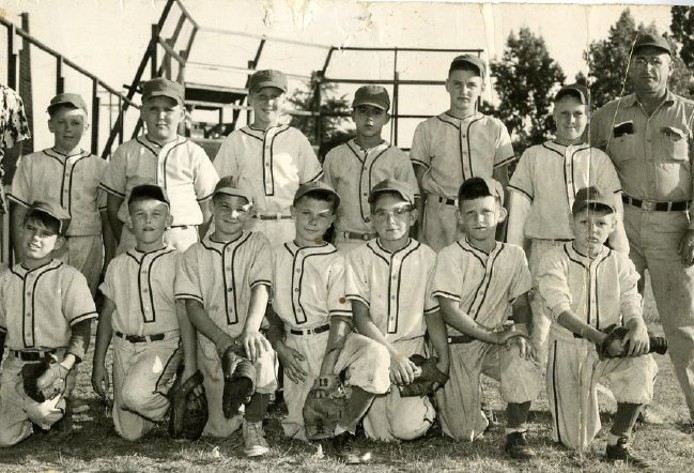
There was a time when Sonoma was a raging baseball town. Everyone played, including kids, women, druggists, plumbers and butchers. One summer in 1970, there were more than 50 active teams playing baseball and/or softball in Sonoma Valley. And they were playing baseball, not watching it!
The first record we have of a live baseball game in Sonoma Valley was May 8, 1887, as “A game of base ball was played last Sunday in the Glen Ellen Park between the ‘Gibsons’ and the ‘Crofits,’ the former coming out victorious.” By 1890, there were organized teams competing against one another, such as the Shellville Embarcaderos and the Sonoma Baseball Club. By 1897, teams from Sonoma were playing teams from Petaluma and Bennett Valley. The sport was gathering fans as well as players.
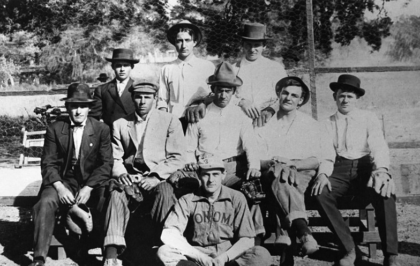
Soon, teams got sponsors so they could pay for uniforms and equipment. At least eight Sonoma Valley teams had formed by 1912. But maybe the fanbase was being spread too thin, because on June 6, 1917, the Sonoma Index-Tribune baseball columnist, Al Joyess, chastised the fans for not showing up: “Remember! Columbus took a chance, and remember the boys will play twice as good when there is a large crowd to watch them. And if you don’t show up there is something radically wrong with you as every American should stand by the good old American game.” In just 30 years baseball became the good old American game.
The Game Gets Serious
In 1925, Ray Tynan – though still in high school – was a star center fielder for the Vineburg All Stars. Two years later he formed a new baseball team – the Vineburg Cubs – and began competing against every team in the region. The Cubs ran an ad in the Sonoma Index-Tribune every Friday before Sunday games, when the admission fee was 25 cents. The Vineburg Cubs dominated the baseball scene in the Valley until they were absorbed by another Tynan-created club, the Sonoma Merchants. They in turn went on to outplay almost every other team in the Valley.
Numerous benefit baseball games became popular, such as Donkey Baseball – where all the players except the batter were mounted on donkeys – and games of the singles vs. the marrieds. Competition for fans emerged with the re-emergence of fast pitch softball.
In 1939, the Sonoma Valley Athletic Club was formed to promote all sports in the Valley. Tynan disbanded the Merchants in 1940 and formed a new team, but found it hard to find both players and an audience as Sonomans embraced fast-pitch softball. An even bigger challenge lay ahead as World War II was coming.
Baseball goes to War
The draft in Sonoma started on April 4, 1941, and although baseball and softball continued to be played throughout the war, many of the star players were in the service. Among them, Emil “Pop” Chelini to the South Pacific; Gene Dominichelli in the Marines flying Corsairs in the South Pacific; Dave Eraldi in the U.S. Navy in Panama and beyond; Charles Bacigalupi in England and later France; Joseph “Babe” Mazza in North Africa and Italy; Ray and Andy Barrachi in the South Pacific; Frank Wedekind in Guam; Ernie Man-giantini in North Africa, Sicily and finally Italy; Ezio Mangiantini, a paratrooper wounded in Belgium; and Franck Benedetto in the Aleutian Islands and Alaska. One never came home.
Ray Barrachi was an original member of the Vineburg Cubs and followed Tynan to the Sonoma Merchants. He was a strong hitter and second baseman. He joined the U.S. Marines in January 1942. His parents received a telegram in April 1943 that Ray was Missing in Action in the South Pacific. In April of 1944 he was awarded the Purple Heart. His name is engraved on the memorial in Veterans’ Memorial Park in Sonoma, a star by his name indicating he was killed in action.
On March 26, 1945, a baseball sports night was staged at the Sonoma Mission Inn, which had served as a Rest and Recuperation center for the U.S. Navy throughout the war. A movie of the 1944 World Series game between the St. Louis Cardinals and the St. Louis Browns was screened, accompanied by popcorn, peanuts and cokes. There was a sense of victory in the air. And the return of baseball! Well, actually…
Fast Pitch Softball Emerges as King
“Hutch” Whitehead took over the Ford dealership in Sonoma in late 1947 and began sponsoring a softball team in 1948 called the Fordy-Niners, who won the league title two years running. A new team emerged to challenge them in 1950—Our Resort. These two teams battled out for the championship for the next 15 years. The names of the teams changed constantly, but many of the players remained the same. In 1978, the Sonoma Index-Tribune’s sports writer, Jim Lynch, deemed them “Sonoma’s Boys of Summer:” Emil ”Pop” Chellini (56), Don Eraldi (51) and George Block (50) reminding readers of just how long these guys had been playing ball.
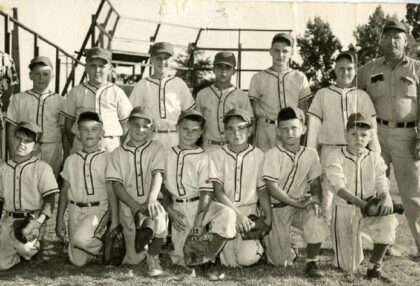
By 1990, you could go to a ballgame every night of the week in Sonoma, from late May through September, as there were seven fastpitch softball teams, more than 21 softball teams, six Women’s modified fast pitch games, and Little League teams playing on three different fields in the Valley.
Starting in 1999, adult teams began to fade away as players became Little League and High School coaches. Other sports began to be popular – golf, Pétanque, and Bocce ball. By 2010, there were very few adult teams playing any kind of ball. One can still see pick-up games around the Valley, but the golden era of baseball as a popular participatory sport was over.
This article first appeared in the April-June 2026 newsletter of the Sonoma Valley Historical Society. Reprinted with permission.




Be First to Comment