
By David Bolling
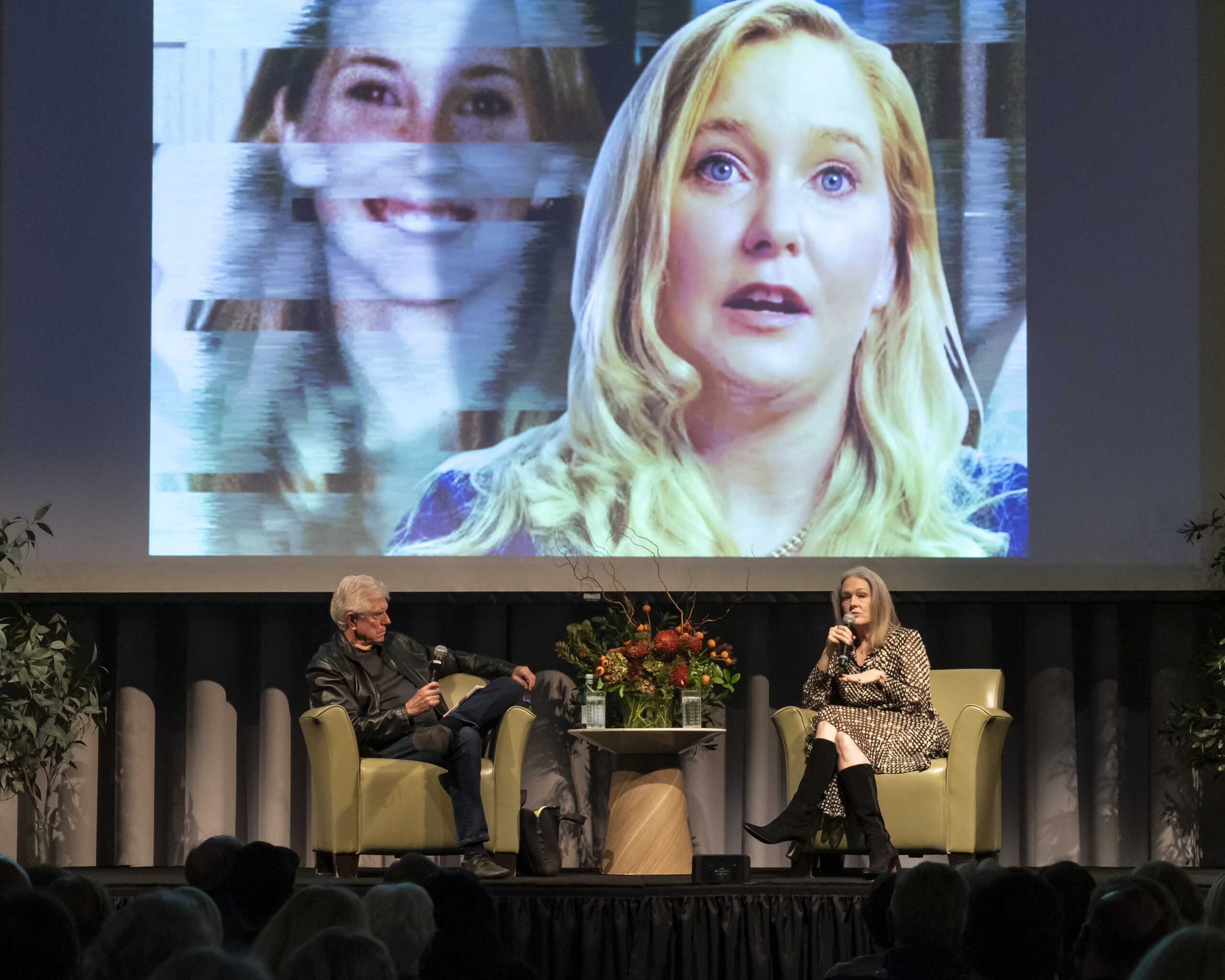
As the cascading drama of the Jeffrey Epstein files played out across headlines and breathless broadcasts, a sold-out audience of the Sonoma Speaker Series got a first-hand look inside the story of the first Epstein victim to go public.
Veteran journalist and Santa Rosa resident, Amy Wallace is the ghostwriter for “Nobody’s Girl, A Memoir of Surviving Abuse and Fighting For Justice.” It’s the story of Virginia Roberts Giuffre, the Florida native who was recruited, raped and trafficked as a sexual commodity for two years by Ghislaine Maxwell and Jeffrey Epstein. In a still-growing community of victims trafficked by Maxwell and Epstein, estimated to exceed 1,000, Giuffre was the first to take her agonizing story public.
Giuffre did not just fall into Jeffrey Epstein’s lap. She spent a lost childhood the victim of almost constant sexual abuse. Raped by her father for years, raped by her father’s friend, raped by the owner of a modeling agency that fronted for a high-priced escort service, who kept her captive for six months before “giving her away.” Raped by boyfriends and strangers, kicked out of her family house, it is astonishing that she survived to the age of 41, raised three children and established a strong, coherent, international voice against child trafficking and sexual abuse.
Discovered by Maxwell as a 16-year-old towel girl at Donald Trump’s Mar a Lago resort, she was lured to Epstein’s Palm Beach mansion with the promise of being paid to learn how to perform massage, and then to provide daily massages to a very wealthy man. Maxwell was eloquent, exotic and compelling.
So Giuffre accepted the offer, went with Maxwell, discovered a naked Epstein waiting on a massage table, was instructed on how to massage him and then was raped by both, with instructions to come back tomorrow. And so it began. Again, she was sixteen. And Epstein passed her around to a growing number of other men. In Palm Beach, in a Manhattan mansion, on a ranch in New Mexico, on a Caribbean island and in a Paris apartment.
During her time under Epstein’s control, she writes, “It is truly impossible to say how many men there were, in part because I didn’t keep count, and in part because my interactions with many of them were so similar.”
She describes some of her abusers this way. “There were old men and even older men; nerdy, shy men and boorish arrogant men. There were men who wanted me to wear outfits and men who wanted to see me naked and men who didn’t notice if I was clothed, as long as I touched them … I was expected to make all the men happy, even though doing so made me miserable.”
There was also, as the world now knows, at least one member of royalty, in the person of England’s then-prince Andrew. Randy Andy, as he was known since student days, was exposed as a sexual abuser in the wake of Giuffre’s revelations and a widely publicized party photo showing his arm around her waist when she was 17. Ultimately, and in the wake of a sizable cash settlement (reportedly contributed in part by Queen Elizabeth herself), Andrew was recently stripped of all royal titles (but not all his royal luxuries or financial assets).
Many among Epstein’s child sex entourage were prominent attorneys, business tycoons, fund managers, millionaires and billionaires. And, according to Giuffre’s book, at least one of them was a prime minister.
“We were on Epstein’s island,” Giuffre writes, “Immediately it was clear that this man, whom I’ve taken pains to describe in legal filings only as ‘a well-known prime minister,’ wasn’t interested in caresses. He wanted violence. He repeatedly choked me until I lost consciousness and took pleasure in seeing me fear for my life. Horrifically, the prime minister laughed when he hurt me and got more aroused when I begged him to stop. I emerged from the cabana bleeding…”
When she told Epstein about this horror, literally begging him not to make her see the “prime minister” again, he dismissed her concerns, casually remarking, “You’ll get that sometimes.”
That experience, Giuffre writes, changed the equation of her Epstein experience. She would later learn that, “Epstein liked to tell friends that women were merely ‘a life support system for a vagina.’” This was a degree of callousness she didn’t expect or hadn’t been willing to perceive.
And subsequently, Giuffre learned, Epstein and Maxwell had an added interest in her vagina – or more accurately – her uterus. During one of many trips to Epstein’s island, he approached Giuffre almost tenderly, put his hand on her back, and told her, she writes, “I want you to have our baby.”
Maxwell chimed in, “You’d have round-the-clock nannies to help you … Jeffrey would buy you a mansion … and you would have a hefty allowance.” Giuffre writes the figure she remembers was $200,000. Per month.
But there were conditions. She would have to sign over all legal rights to the child. And travel with Epstein everywhere he goes. It all was, Giuffre writes, “a bridge too far.”
Giuffre knew she couldn’t agree to do it, and she knew she couldn’t refuse. There were dangerous consequences either way. So she engineered a better alternative – an Epstein-funded escape. She told the two that she wanted them to make good on Maxwell’s original promise to teach her how to be a professional masseuse. She wanted them to send her to a massage school. And then she would have their baby.
Shortly before her nineteenth birthday, they sent her off to a prestigious school in Thailand that would certify her in just eight weeks. There was, of course, one catch. Epstein wanted Giuffre to recruit a particular young Thai girl, evaluate her and then Epstein would fly her to the U.S..
Giuffre agreed, knowing she would never do it and would never come back. And she didn’t. Her escape and subsequent life are an important part of the story, as is the story of telling it. But most important to Giuffre, says Amy Wallace, was leaving a legacy of resistance and resilience to combat the abuse she had suffered so much.
Reflecting on her four years absorbing, helping to shape and, most critically and laboriously, fact checking every part of Giuffre’s story, Amy Wallace reveals a deep love for her subject and bottomless admiration for her courage.
And in response to the common question, why didn’t she just leave when it all started, Wallace explains that early on during Giuffre’s time with Epstein, he casually showed her a photo of her younger brother Sky, told her he knew where Sky lived, and insinuated that bad things could happen if Giuffre ever compromised Epstein.
Asked during the Sonoma Speaker Series presentation if she knew some of the names of molesters Giuffre shared with the FBI during at least two depositions, Wallace confirmed she did, explaining that the names are in a bank security box and that at least one of the people included on the list has the means, the ability and the personality to kill. And Giuffre knew that other men she was trafficked to had the wealth and legal resources to tie her and her family up in litigation for years. Virginia Giuffre, says Amy Wallace, is a hero. She believed her story would help other people, she wanted it told, and told honestly, authentically.
There were tears on the stage and in the audience Monday night when Wallace, a Santa Rosa resident, addressed the sold-out audience in the Hanna Center Auditorium and described the four years she spent with Giuffre leading up to the October publication of the book. Giuffre died from suicide on April 25. On Tuesday, November 18, the House of Representatives finally passed a Discharge Petition that would force the Justice Department to release the Epstein Files. But before that can happen, the U.S. Senate has to also agree, and that’s not a sure thing.








Be First to Comment